
The short answer
Why did a factory law still need staff appointments and reporting machinery?
Evidence comparison
Read the records together
The records were created for different purposes and support different kinds of claims.
| Record | What it establishes | Question to keep open |
|---|---|---|
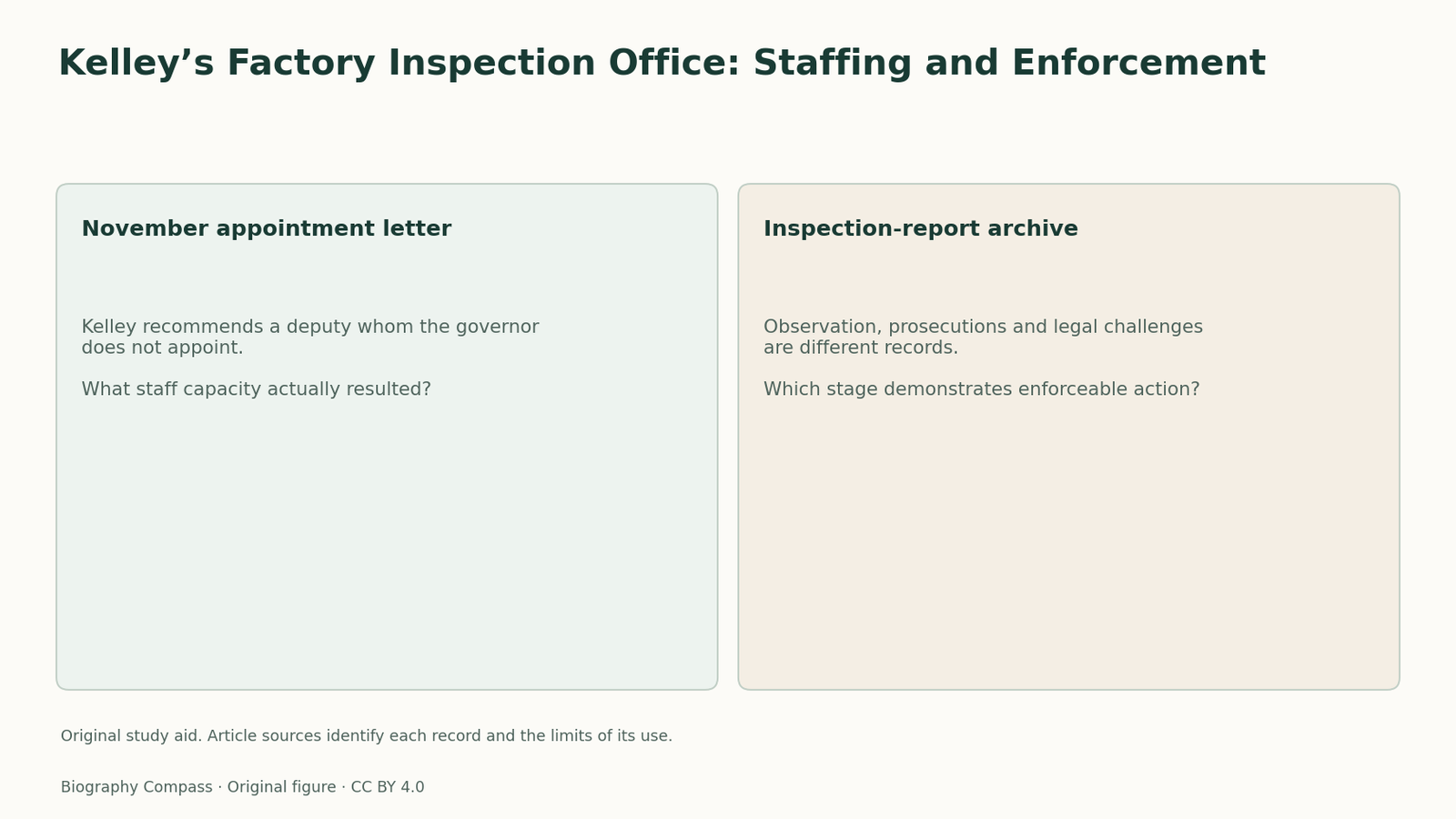
| November appointment letter | Kelley recommends a deputy whom the governor does not appoint. | What staff capacity actually resulted? |
| Inspection-report archive | Observation, prosecutions and legal challenges are different records. | Which stage demonstrates enforceable action? |
Chronology
A timeline of the turning points
Hull-House
Kelley joins the settlement.
Inspection office
Her factory administration begins and a staffing request is made.
Read the request as a request
Kelley’s letter of 7 November asked Altgeld to appoint Josephine Milligan as deputy factory inspector. The archive states that the appointment did not occur. This distinction is the central finding. A letter praising a candidate’s suitability is evidence of a recommendation, not proof that the person joined the staff. Any account of the office’s personnel should retain the outcome instead of copying the proposed title into a list of actual appointments.
Sources for this section: [2]
Connect staffing with the law’s operation
The inspection office needed people to visit workplaces, identify conditions and support enforcement. The annual reports described that work and the prosecutions arising under the law. A statutory prohibition therefore depended on administrative capacity after enactment. The archive’s account of Kelley choosing assistants shows one part of that capacity, while her unsuccessful request exposes a limit on her control over the organisation she was expected to lead.
Keep inspection and prosecution distinct
Northwestern’s account explains that the reports combine workplace observation, prosecutions and constitutional challenges. These are different stages. An inspector could record a condition without securing a conviction, and a legal challenge could alter what the office was able to enforce. A report’s rich descriptions should not be converted into a count of successful penalties. Identifying the stage makes both the evidence of conditions and the administrative difficulties more intelligible.
Sources for this section: [3]
Make an enforcement chain
Draw boxes for legislation, staffing, inspection and prosecution. Put Milligan’s proposed appointment beside staffing with its documented outcome, then identify what record would establish each later stage. A correct answer does not infer a conviction from a workplace visit or an appointment from a recommendation. The chain offers a useful way to evaluate reform beyond the date a law was passed, showing where practical resources and separate decisions were still required.
Continue the chronology
Related history guides
Biography context
Explore United States through connected lives
Connected biographies
People behind the records
1859–1932
Florence Kelley
Labour investigator and social reformerKelley turned settlement-house investigation into factory inspection and consumer campaigning, seeking better conditions for working women and children.Read biographyQuick answers
Common questions
- Did Milligan become deputy because Kelley recommended her?
- The archive explicitly states that the governor did not make the proposed appointment.
Primary and institutional sources
How this history was checked
Sources support the chronology and the record comparison. The reading exercise is original. This article was reviewed on 7 November 2026.