
The short answer
How did a Fairchild engineer’s role differ from a later venture investor’s?
Compare the evidence
Observation, method and result
Compare the inspected records and the different claims they support.
| Record | Evidence | Limit |
|---|---|---|
| Firm’s Caufield history | Separates 1972 formation from 1977 expansion. | A later four-name label is not a precise initial roster. |
| Firm’s Genentech history | Distinguishes founders, seed finance, board and planning roles. | Participation is not sole causation or scientific invention. |
Do not read a later firm name as a founding roster
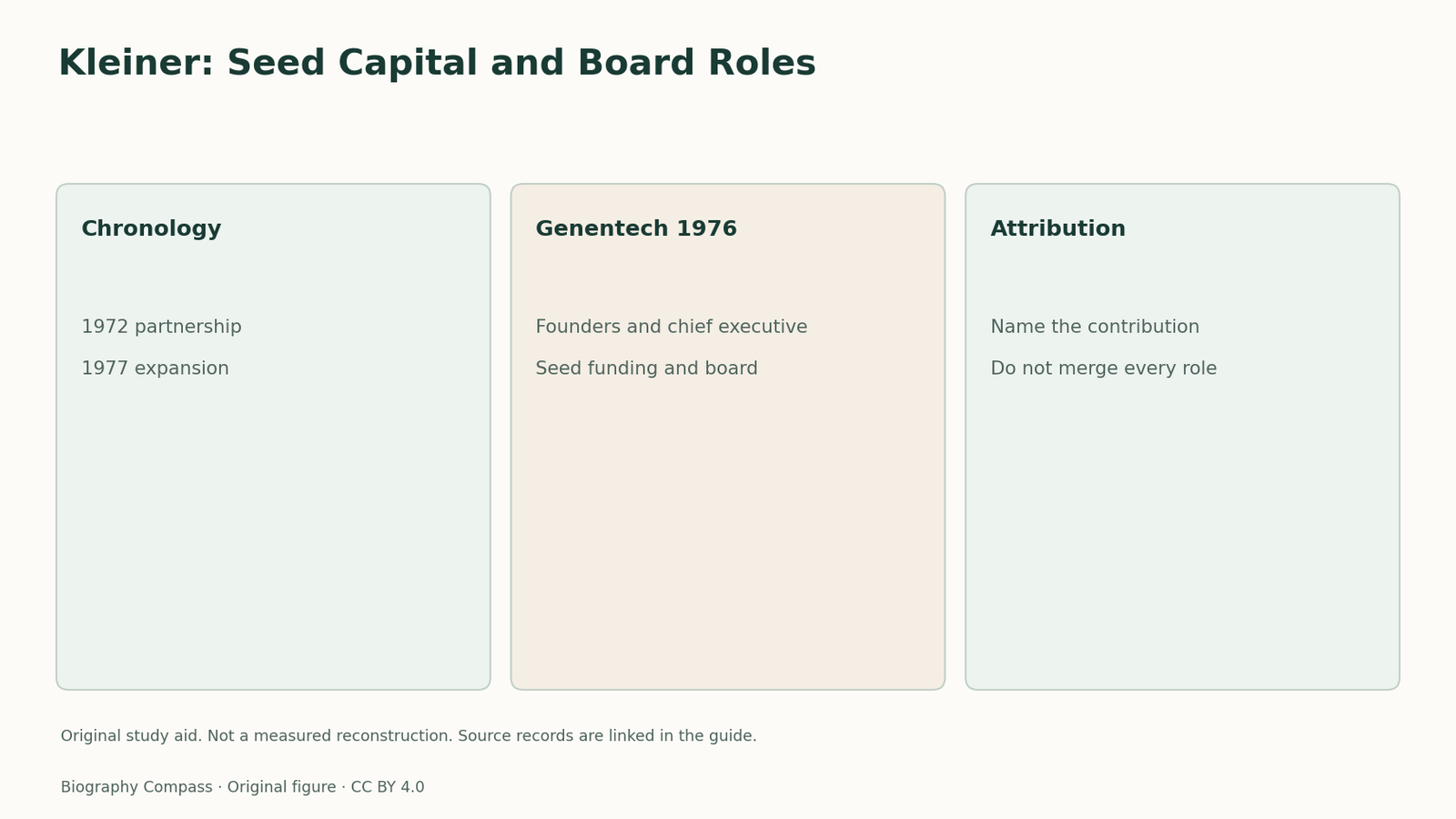
The Computer History Museum’s Fairchildren entry places KPCB under a 1972 heading and lists four familiar names. Kleiner Perkins’ own account is more specific about stages: Kleiner and Perkins formed the firm in 1972, while Caufield and Byers joined in 1977. Read the retrospective label beside the dated narrative rather than treating them as identical kinds of evidence. The useful correction is chronological. A later partnership name can be convenient shorthand without proving that every named partner held the same role at the beginning.
Genentech identifies several different jobs
The firm’s Genentech history identifies Boyer and Swanson as co-founders in 1976. It describes seed capital from Kleiner Perkins and board positions for Kleiner and Perkins, with Swanson becoming chief executive. The same record credits Byers with product-planning and market-analysis assistance. These are specific forms of participation. Funding, governance, management and scientific work can support one enterprise while remaining different contributions. An accurate role map does not need to turn every important participant into the inventor of the underlying laboratory technique.
Sources for this section: [4]
A role map is more useful than a success legend
Draw separate nodes for research, company formation, seed funding, board and operations. Place only the names and relationships documented by the account. A supported answer explains what the investor supplied and what remained the work of the company’s founders and scientists. It should also identify the record as the investment firm’s retrospective account. That source can document its stated participation, but evaluating returns or proving that its support alone caused the company’s later success would require additional financial and historical evidence.
Continue the chronology
Related history guides
Biography context
Explore United States through connected lives
Connected biographies
People behind the records
1923–2003
Eugene Kleiner
Engineer and venture capitalistEugene Kleiner moved from semiconductor company building into venture investing, combining technical experience with capital and board-level support for new enterprises.Read biography1925–2011
Julius Blank
Production engineer and company co-founderJulius Blank supplied manufacturing equipment and facilities expertise to early semiconductor firms and later helped found Xicor.Read biographyQuick answers
Common questions
- How did a Fairchild engineer’s role differ from a later venture investor’s?
- The later venture role supplied investment judgement, seed capital, governance and advice. These responsibilities differed from engineering a device or conducting a portfolio company’s scientific research.
Primary and institutional sources
How this history was checked
Source notes distinguish documented facts from the explanatory examples and diagrams created for this guide. This article was reviewed on 7 November 2026.