
The short answer
Why did a semiconductor laboratory need a production engineer?
Compare the evidence
Observation, method and result
Compare the inspected records and the different claims they support.
| Record | Evidence | Limit |
|---|---|---|
| CHM 2008 oral history | Long cycles required robust furnaces and controlled operation. | A recollection is not a quantified yield experiment. |
| Science History career record | Identifies facilities, engineering services and later company roles. | An organisational title alone does not assign every technical result. |
A successful experiment uses a limited setup
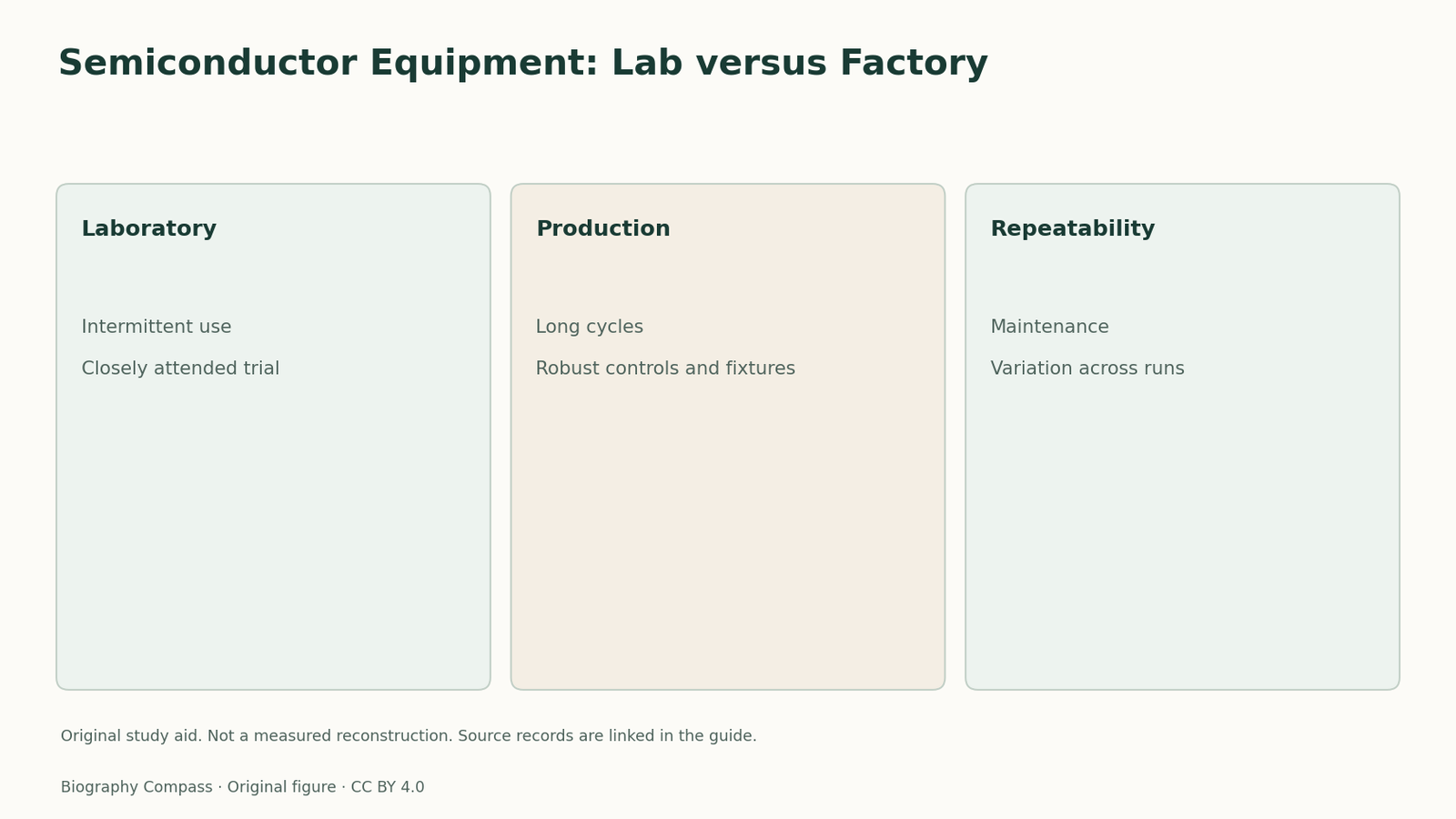
Blank recalls working with laboratory furnaces whose controls and construction were poorly suited to sustained semiconductor processing. A laboratory test may use equipment intermittently, with an operator closely attending it. A production cycle may instead need conditions held for many hours and repeated across many runs. The difference concerns duty, consistency and maintenance as well as the basic ability to reach a temperature. Equipment that performs once can therefore remain unsuitable for the work a growing manufacturing programme requires.
Sources for this section: [2]
Fixtures and facilities shape repeatability
His account also describes adapting evaporators and building crystal-growing equipment. A vacuum bell jar alone is not the complete production operation. Fixtures, controls, loading and service conditions help determine whether the apparatus can be used consistently. The Science History Institute’s career record places these recollections within Blank’s facilities and engineering responsibilities. Read the two records together rather than attributing all yield improvements to one device invention. They show an enabling role whose effects depend upon how several parts of a process work together.
A failure map gives the comparison practical meaning
Draw three boxes for process requirement, equipment capability and repeated operation. Connect a long temperature cycle to stable control, then to consistent treatment across runs. Add a branch for maintenance interruption. This is an invented explanatory map, not a reconstruction of a measured Fairchild yield study. A supported answer explains why a robust furnace might remove one source of variation while leaving others unresolved. Material quality, handling and later processing still matter. Production engineering improves the conditions under which good results can recur; it does not make every failure disappear.
Continue the chronology
Related history guides
Biography context
Explore United States through connected lives
Connected biographies
People behind the records
1925–2011
Julius Blank
Production engineer and company co-founderJulius Blank supplied manufacturing equipment and facilities expertise to early semiconductor firms and later helped found Xicor.Read biography1926–2014
Sheldon Roberts
Metallurgist and semiconductor co-founderSheldon Roberts brought metallurgy and crystal-production expertise to Fairchild before helping establish Amelco and supporting engineering institutions.Read biographyQuick answers
Common questions
- Why did a semiconductor laboratory need a production engineer?
- Production needed stable controls, durable equipment, fixtures and maintainable operations that could repeat a process; a single successful laboratory demonstration did not establish those conditions.
Primary and institutional sources
How this history was checked
Source notes distinguish documented facts from the explanatory examples and diagrams created for this guide. This article was reviewed on 7 November 2026.