
The short answer
Why did material purity matter before a transistor could be patterned?
Compare the evidence
Observation, method and result
Compare the inspected records and the different claims they support.
| Record | Evidence | Limit |
|---|---|---|
| Robson and Blank oral histories | Describe crystal operation and equipment responsibilities. | Retrospective accounts are not complete production logs. |
| Sparks patent description | Distinguishes selected impurities from contamination. | The patent explains a principle; it is not attributed to Roberts. |
A wafer has a production history
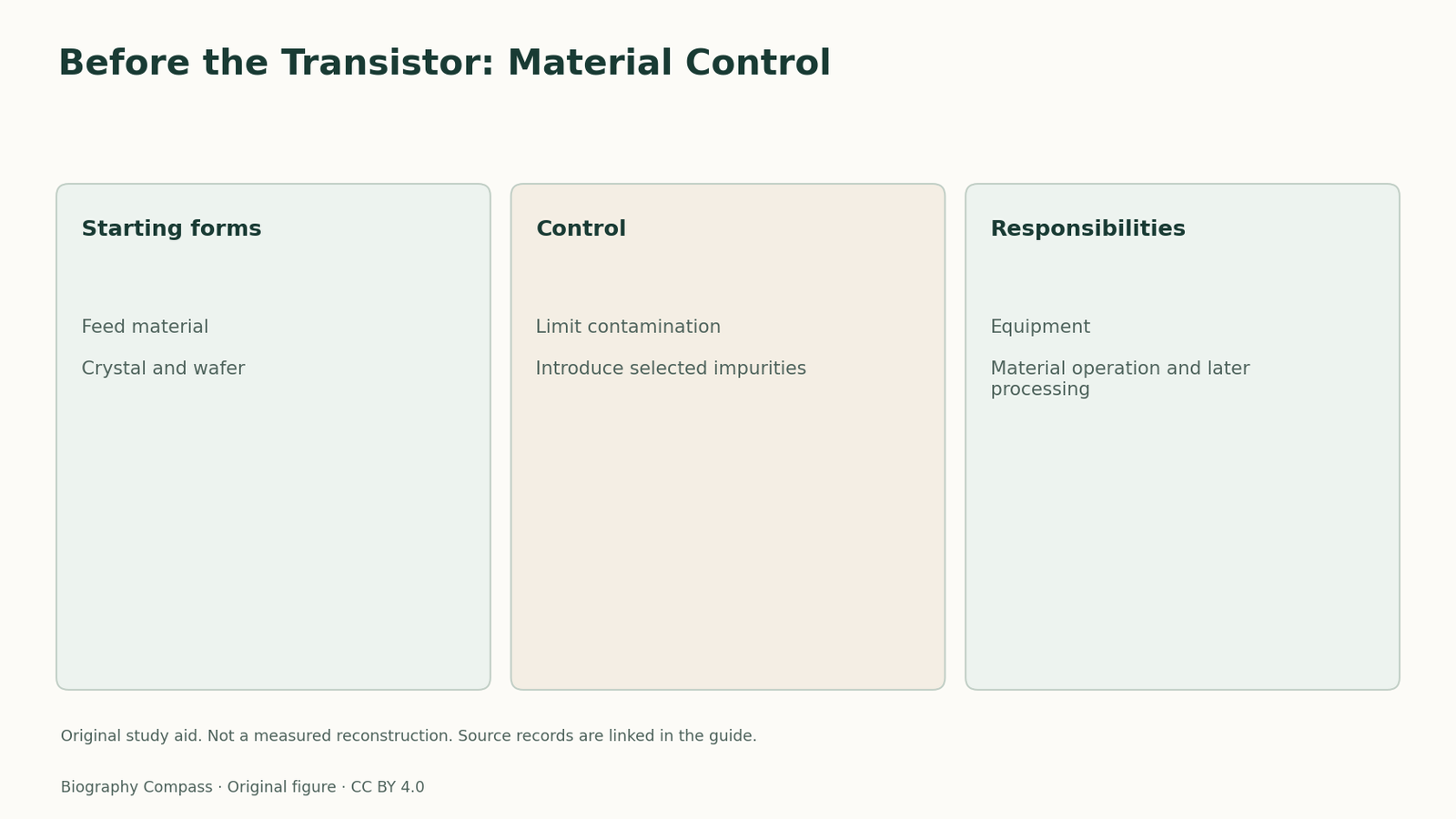
Robson’s account describes Roberts taking silicon feed material, growing a crystal and slicing it into wafers. These are stages before later device patterning. The sequence helps explain why a finished-chip story can omit substantial work if it begins only when a circuit is drawn on a wafer. A useful starting diagram keeps feed material, crystal and wafer as distinct forms. It should not imply that slicing alone establishes the electrical properties or removes every defect within the material.
Sources for this section: [2]
Control is more precise than absolute purity
Morgan Sparks’s contemporary patent describes deliberately introducing suitable impurities to form regions with different conductivity. It also discusses preventing contamination to obtain reproducible junctions. Those statements show why purposeful doping differs from unwanted variation. The aim cannot be summarised as removing every non-silicon atom and leaving the material unchanged thereafter. The technical record is used here to explain the distinction; it is not evidence that Roberts invented Sparks’s method or that Fairchild followed this exact patented procedure.
Sources for this section: [4]
Continue the chronology
Related history guides
Biography context
Explore United States through connected lives
Connected biographies
People behind the records
1926–2014
Sheldon Roberts
Metallurgist and semiconductor co-founderSheldon Roberts brought metallurgy and crystal-production expertise to Fairchild before helping establish Amelco and supporting engineering institutions.Read biography1925–2011
Julius Blank
Production engineer and company co-founderJulius Blank supplied manufacturing equipment and facilities expertise to early semiconductor firms and later helped found Xicor.Read biographyQuick answers
Common questions
- Why did material purity matter before a transistor could be patterned?
- Material control reduces unwanted variation while permitting deliberate doping. Crystal growth and wafer preparation establish starting conditions; later patterning still requires further process control.
Primary and institutional sources
How this history was checked
Source notes distinguish documented facts from the explanatory examples and diagrams created for this guide. This article was reviewed on 7 November 2026.