
The short answer
Listening and waiting solve different parts of a coordination problem. Start with the original network design, then deliberately simplify it to expose a probability calculation.
Invented contention outcomes
Invented equal-slot outcomes
Probabilities sum to 1 in each column.
| Outcome | p = 1/2 | p = 1/4 |
|---|---|---|
| One succeeds | 1/2 | 3/8 |
| Both collide | 1/4 | 1/16 |
| Both idle | 1/4 | 9/16 |
Chronology
A timeline of the turning points
Joint paper
Metcalfe and Boggs.
What the paper explains
Metcalfe and Boggs describe stations deferring while they hear a transmission. Propagation time still allows simultaneous starts; a detected collision leads to abandonment and a random retry interval. They also distinguish packet transport from the additional precautions applications require for reliable communication.
Carrier detection defers a new transmission when another is heard; interference detection identifies damage during an attempt. The paper treats these as different mechanisms. Listening locally cannot reveal a signal that has not yet propagated to that location.
Sources for this section: [1]
An original probability exercise
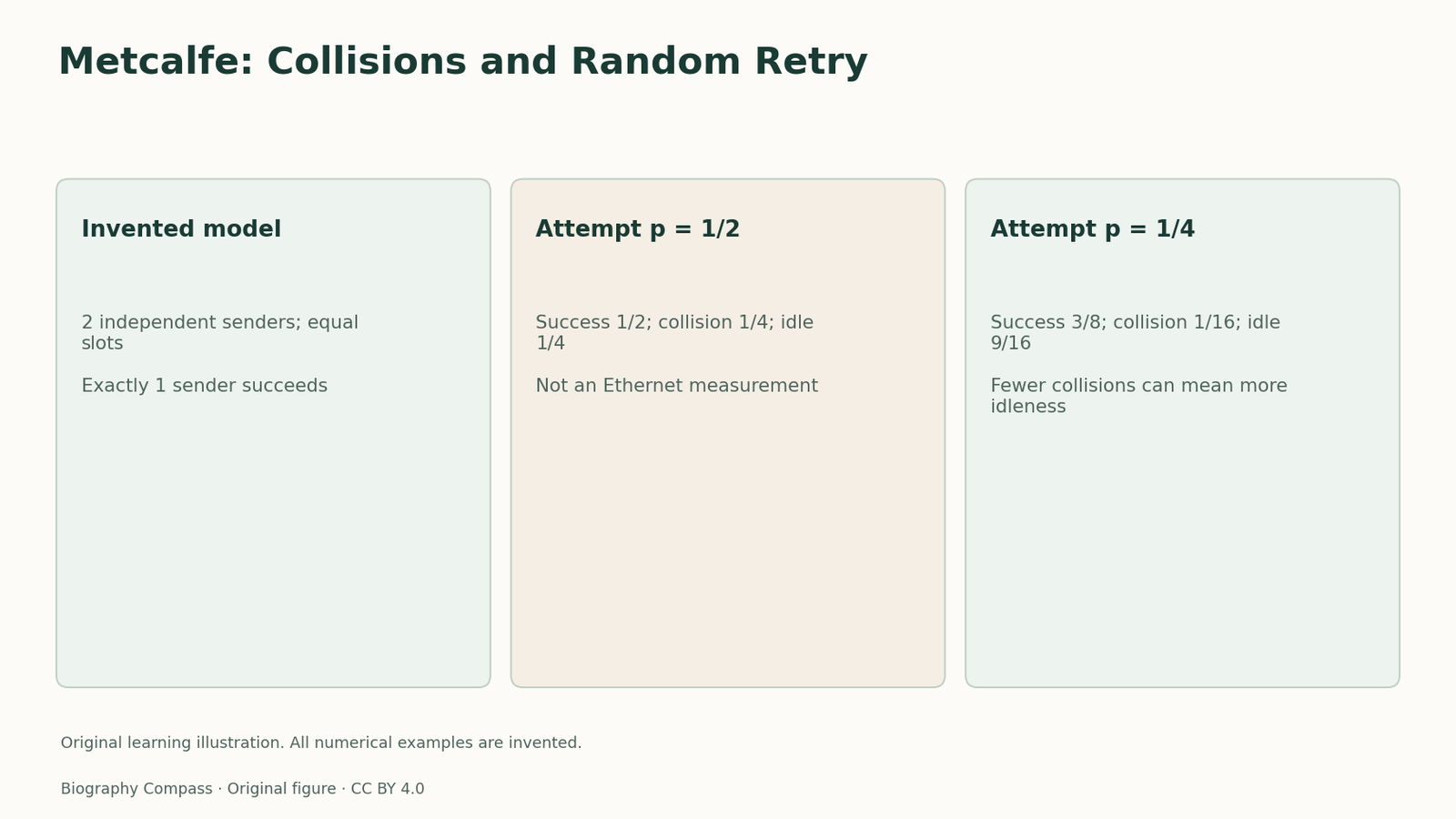
For this deliberately slotted toy, there are exactly two backlogged stations. Each independently transmits with probability p in a slot. Exactly one transmission succeeds; two collide; if neither transmits, the slot is idle. Assume equal slot durations, no carrier sensing, no propagation detail and fresh independent choices each slot. Compare p = 1/2 with p = 1/4.
Sources for this section: [1]
Reference answer
Exactly one transmits with probability p(1-p)+(1-p)p = 2 p(1-p). At p = 1/2 this is 1/2; collision and idle probabilities are each 1/4. At p = 1/4, success is 3/8, collision is 1/16 and idle is 9/16. Lowering the attempt probability reduces collisions but can waste more slots through idleness. A lower collision count alone is not the same as higher useful throughput.
Sources for this section: [1]
Do not mistake the toy for Ethernet
The real design listens, detects interference and adapts retransmission timing. Our equal-slot model does none of those things; it isolates independent contention. It cannot predict measured Ethernet utilisation, latency or a modern switched network's behaviour. The exercise explains a trade-off without claiming to reproduce the paper's later performance analysis.
Likewise, a successful slot in this toy means exactly one sender attempted. It does not test a packet checksum or confirm that a destination application accepted data. Keeping these layers distinct prevents a probability of contention success from becoming an unsupported end-to-end reliability guarantee.
Sources for this section: [1]
Continue the chronology
Related history guides
Biography context
Explore United States through connected lives
Connected biographies
A career behind the record
Quick answers
Common questions
- Why can sensing fail to prevent a collision?
- Signals need time to propagate.
Primary and institutional sources
How this history was checked
Original records and selected institutional histories support the historical discussion. Invented examples are labelled and are not reconstructed experiments. This article was reviewed on 31 October 2026.