
The short answer
The same final amount can be represented as a gain or a loss. Make that representation explicit before calculating a model score.
Fixed outcomes, changing references
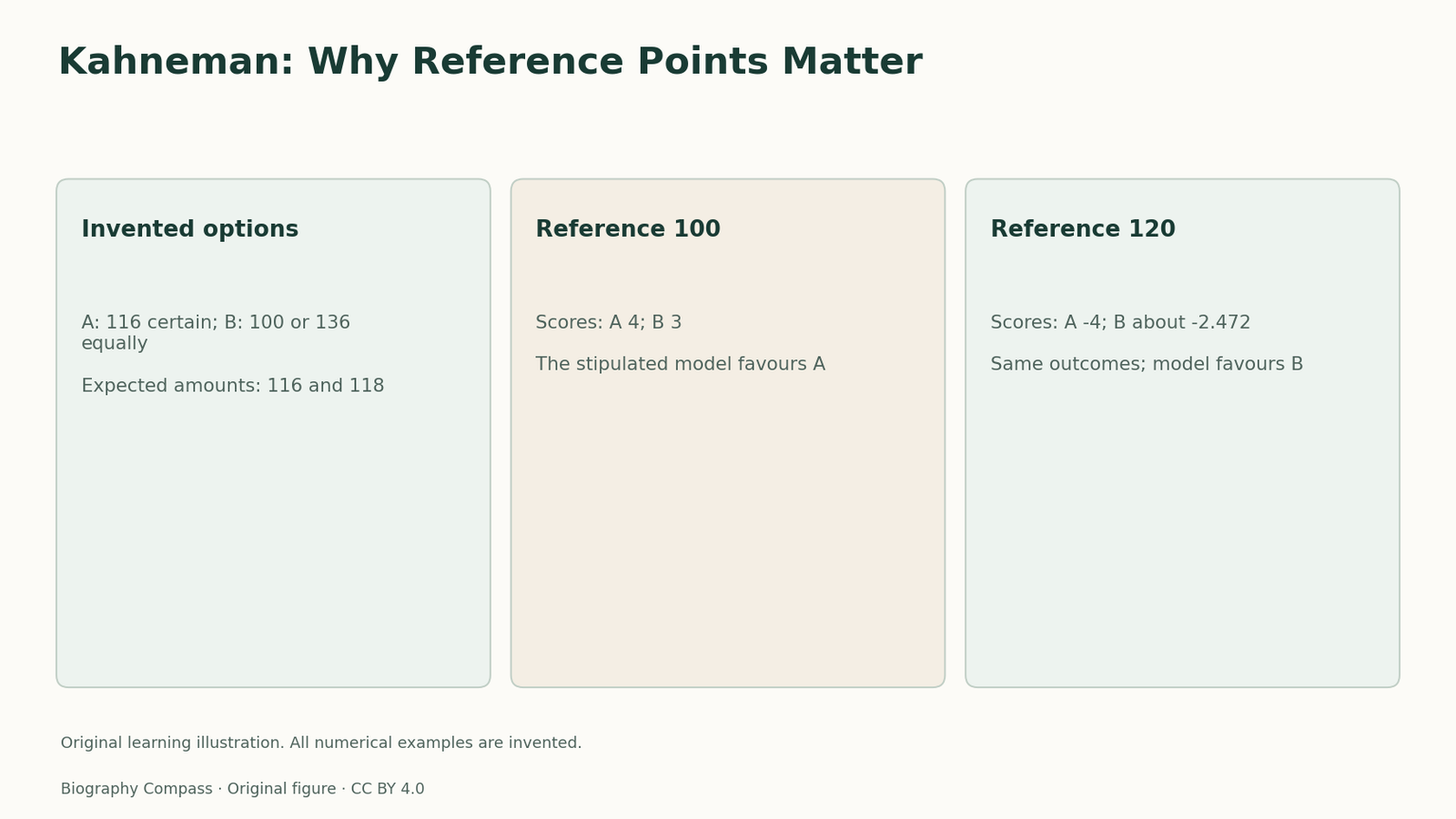
Same final amounts, different reference
All amounts and scores are invented.
| Reference | A score | B score |
|---|---|---|
| 100 | 4 | 3 |
| 120 | -4 | about -2.472 |
Chronology
A timeline of the turning points
Prize lecture
Reference-dependent value.
The actual conceptual change
Kahneman's lecture explains a value function defined over gains and losses relative to a reference point, with different shapes on either side. It cautions against extending the function to losses near ruin. This is not a universal formula that converts every person's wealth into a known preference.
The lecture contrasts changes around a reference with final asset positions. Choosing a reference therefore changes the quantities supplied to the value function, even when the monetary outcomes themselves stay fixed.
Sources for this section: [1]
An original, incomplete preference model
Invent v(x) =sqrt(x) for x at least 0, and v(x) = -2 sqrt(-x) for x below 0. The coefficient 2 is stipulated, not an empirical estimate. A pays a certain final 116 units; B pays 100 or 136 with equal probability. Score each option using probabilities as weights, ignoring probability distortion. First use reference 100, then reference 120.
Sources for this section: [1]
Reference answer
With reference 100, A gains 16 and scores 4. B gains 0 or 36 and scores(0+6)/2 = 3, so the toy ranks A higher. With reference 120, A loses 4 and scores -4. B loses 20 or gains 16 and scores(-2 sqrt(20)+4)/2, about -2.472, so B ranks higher. Expected final amounts remain 116 for A and 118 for B in both cases.
Sources for this section: [1]
A model result is not a measured preference
The ranking reversal follows our stipulated function and reference points. It is not evidence that actual participants would choose either option. Using probabilities as weights is an extra stipulation of this exercise. This is a reference-point demonstration, not a complete theory of decision-making or a financial recommendation.
Compare scores only between options under the same reference and the same stipulated function. A score is not an amount of money, and our square-root scaling gives no interpersonal measure of wellbeing. The unchanged expected amounts help isolate what the invented reference-dependent calculation is doing.
Sources for this section: [1]
Continue the chronology
Related history guides
Biography context
Explore United States through connected lives
Connected biographies
A career behind the record
Quick answers
Common questions
- What does the reference point change?
- The lecture evaluates gains and losses relative to a reference point.
Primary and institutional sources
How this history was checked
Original records and selected institutional histories support the historical discussion. Invented examples are labelled and are not reconstructed experiments. This article was reviewed on 31 October 2026.