
The short answer
How does a tale’s framing affect what readers can know about an apparent crime?
Read the evidence
Sources, interpretation and production roles
The records answer different questions about this work. The final exercise is an original teaching model.
| Record or question | Supported reading | Boundary or contrast |
|---|---|---|
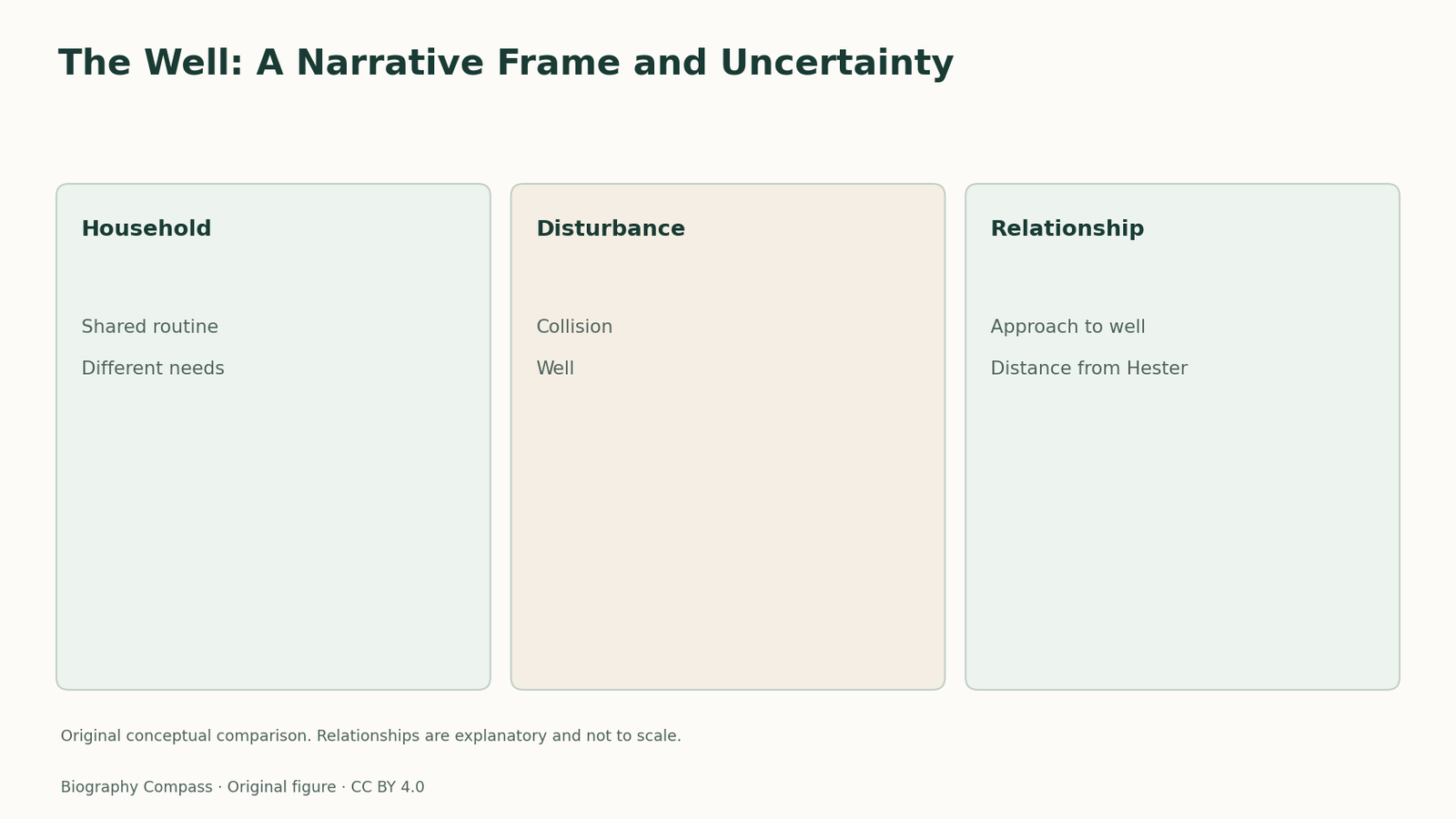
| Routine | Shared meals, work and music | Closeness can create dependence |
| Well | Disposal becomes disturbing attention | A voice is not a settled explanation |
| Movement | Katherine approaches the well | Her bond with Hester weakens |
A household built around two people
Elizabeth Jolley’s The Well appeared in 1986 and won that year’s Miles Franklin Award. The publisher describes Hester Harper bringing the younger Katherine into a secluded household. Sewing, meals, farm work and music establish a shared routine before a night-time collision and the disposal of a body in the well disturb it. The sequence makes domestic closeness central to the suspense. The well’s importance depends on its place within a shared household: the disturbance changes what the women attend to, not simply what they know about a concealed event.
An object changes its narrative job
The publisher first associates the well with discarded dishes and then with the concealed body. Our reading is that the same place moves from an apparently convenient disposal point to an unwanted source of attention. Katherine’s reported hearing of a voice draws her towards it while increasing the emotional distance between the women. Thus physical movement and relational movement run in opposite directions: approaching the well can mean withdrawing from Hester. This is an interpretation of the supplied synopsis, which keeps the voice and its effects distinct from a settled explanation of exactly what has happened.
Sources for this section: [4]
Care can coexist with a demand for control
The 1986 Publishers Weekly review emphasizes Hester’s gifts, attachment and fear of losing Katherine, while also noting changes in property and a deliberately ambiguous conclusion. These details suggest a useful question: who controls the conditions of closeness? Generosity may create pleasure and dependence simultaneously. Likewise, leaving the central uncertainty unresolved can preserve the pressure within a relationship rather than offer the reader a clean solution to a crime. We do not assign one definitive psychological explanation to either woman. The critical emphasis here is on how a domestic arrangement becomes vulnerable when its members respond differently to the same disturbance. A shared household can make the loss of attention as consequential as the loss of property. That connection allows an apparently external disturbance to change ordinary routines without becoming a separate story pasted onto them.
Sources for this section: [5]
Exercise: map opposite movements
Draw a line between a house and a well, and a separate line between two invented characters. Move one character closer to the well and ask whether the relationship line becomes stronger or weaker. A possible answer makes physical approach coincide with emotional separation, following the publisher’s account of Katherine and Hester. Next write two brief explanations for a character’s gift: affection and an attempt to secure company. Explain why both might remain plausible without one cancelling the other. The exercise links an ordinary action to unequal needs; its purpose is to test the relation between suspense and dependence, rather than to supply an invented ending for Jolley’s novel.
Continue the chronology
Related history guides
Biography context
Explore Australia through connected lives
Connected biographies
People and related creative practices
1923–2007
Elizabeth Jolley
Novelist, short-story writer, radio dramatist and teacherElizabeth Jolley developed a distinctive Australian writing career after migrating from England, bringing dark humour to dependence, loneliness and unsettled domestic relationships.Read biography1902–1983
Christina Stead
Novelist, short-story writer and translatorChristina Stead carried Australian memories into fiction written across Europe and the United States, combining family conflict with wider questions of money and power.Read biography1902–1983
Christina Stead
Novelist, short-story writer and translatorChristina Stead carried Australian memories into fiction written across Europe and the United States, combining family conflict with wider questions of money and power.Read biographyQuick answers
Common questions
- What award did The Well win?
- It won the 1986 Miles Franklin Award.
- Does the well have only one function?
- The publisher’s synopsis connects it first with disposal, then with a disturbing presence that changes the relationship between the women.
Primary and institutional sources
How this history was checked
The discussion compares Penguin’s synopsis with the identified 1986 review; it is not a complete novel or film-adaptation review. The reading exercises and comparisons are original analytical models. This article was reviewed on 8 November 2026.