
The short answer
How can a family’s affectionate language also become a structure of power?
Read the evidence
Sources, interpretation and production roles
The records answer different questions about this work. The final exercise is an original teaching model.
| Record or question | Supported reading | Boundary or contrast |
|---|---|---|
| Background | Australian family memories | Not an exact character key |
| Setting | Baltimore in the 1930s | Not Stead’s birthplace |
| Title | A profession of affection | The family’s experience may differ |
One family, more than one place
The Man Who Loved Children was first published in 1940. Penguin’s description identifies its setting as Baltimore in the 1930s and presents relations between parents, children, husbands and wives as its central field. Woollahra’s historical account supplies an important complication: the publisher wanted an American setting for a story grounded in Stead’s Australian family experience. The result is neither a straightforward Sydney memoir nor an interchangeable account of an American household. A reader can ask what changes when remembered relationships are placed inside another social geography, while remaining attentive to the novel as a constructed work.
A loving title can name an unequal relationship
The National Portrait Gallery describes a family dominated by a monstrous father. Placed beside the affectionate claim in the title, that institutional reading produces a useful interpretive tension: a person’s declaration of love and the experience of those receiving it need not agree. This is our reading question, rather than a diagnosis of Stead’s relatives. Family authority can operate through language and ideals as well as through material dependence. The title invites a reader to test who defines the family’s happiness, and whose account of that happiness is allowed to stand.
Sources for this section: [5]
Relocation is a writing decision, not a changed birthplace
Woollahra’s account explains that Baltimore detail was laid over material associated with Camp Cove. Our interpretation is that setting works on two levels: it locates the action and also creates distance from the experiences that helped produce it. That distance can give a novelist room to exaggerate, combine or reorganize relationships. The available records do not license matching every character to a real relative. The National Library’s warning that early manuscripts have not survived also limits any confident reconstruction of each revision. The documented relocation is useful evidence without becoming a complete history of composition. The point is not that affection must be false. It is that a story can let a reader compare a claim of care with the practical freedom available to those who depend on it.
Exercise: separate background, action and authority
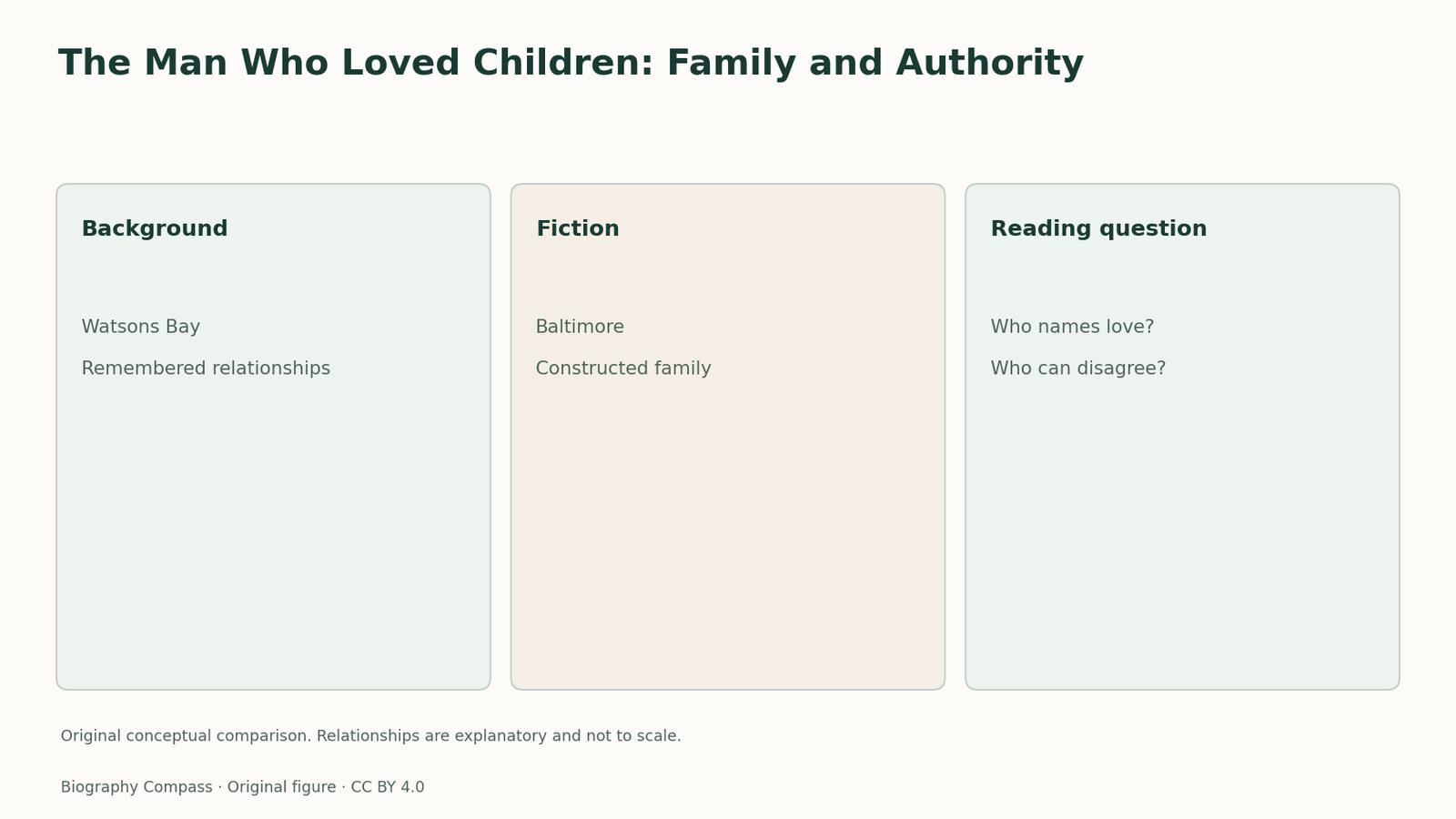
Make three columns headed remembered background, fictional setting and family claim. Enter Watsons Bay in the first, Baltimore in the second and the title’s profession of love in the third. Then invent a scene in which a parent announces a family outing while one child wants to stay home. Write one sentence from the parent’s perspective and one from the child’s. A possible answer lets the first call the outing generous and the second experience it as an obligation. The changed viewpoint reveals an unequal power to name the event. The comparison makes affection a relationship that can be assessed from more than one position, rather than a label accepted solely because the more powerful person supplies it.
Continue the chronology
Related history guides
Biography context
Explore Australia through connected lives
Connected biographies
People and related creative practices
1902–1983
Christina Stead
Novelist, short-story writer and translatorChristina Stead carried Australian memories into fiction written across Europe and the United States, combining family conflict with wider questions of money and power.Read biography1912–1990
Patrick White
Australian novelist and playwrightPatrick White developed an Australian literary career through European education, wartime service and a return to Sydney, writing ambitious novels, stories and plays.Read biography1923–2007
Elizabeth Jolley
Novelist, short-story writer, radio dramatist and teacherElizabeth Jolley developed a distinctive Australian writing career after migrating from England, bringing dark humour to dependence, loneliness and unsettled domestic relationships.Read biographyQuick answers
Common questions
- Is the novel set in Australia?
- Its fictional setting is Baltimore in the United States, although Stead drew on Australian family memories.
- Why compare the setting with the background?
- The comparison shows how a novelist can transform lived material rather than reproduce a family history unchanged.
Primary and institutional sources
How this history was checked
The work discussion uses institutional history and a publisher description, not a complete novel reading or a reconstruction of Stead’s original drafts. The reading exercises and comparisons are original analytical models. This article was reviewed on 8 November 2026.