
The short answer
How can the same flexible bottle-top sculpture change between installations?
Compare the records
What the sources allow us to say
Read the object record alongside the contextual account.
| Record | Evidence | Reading limit |
|---|---|---|
| Met artist transcript | Joined metal allows folding and crumpling. | Material flexibility does not erase object identity. |
| Akron installer account | Gli changed configuration between Akron and Brooklyn. | One comparison does not document every later display. |
The structure permits a new arrangement
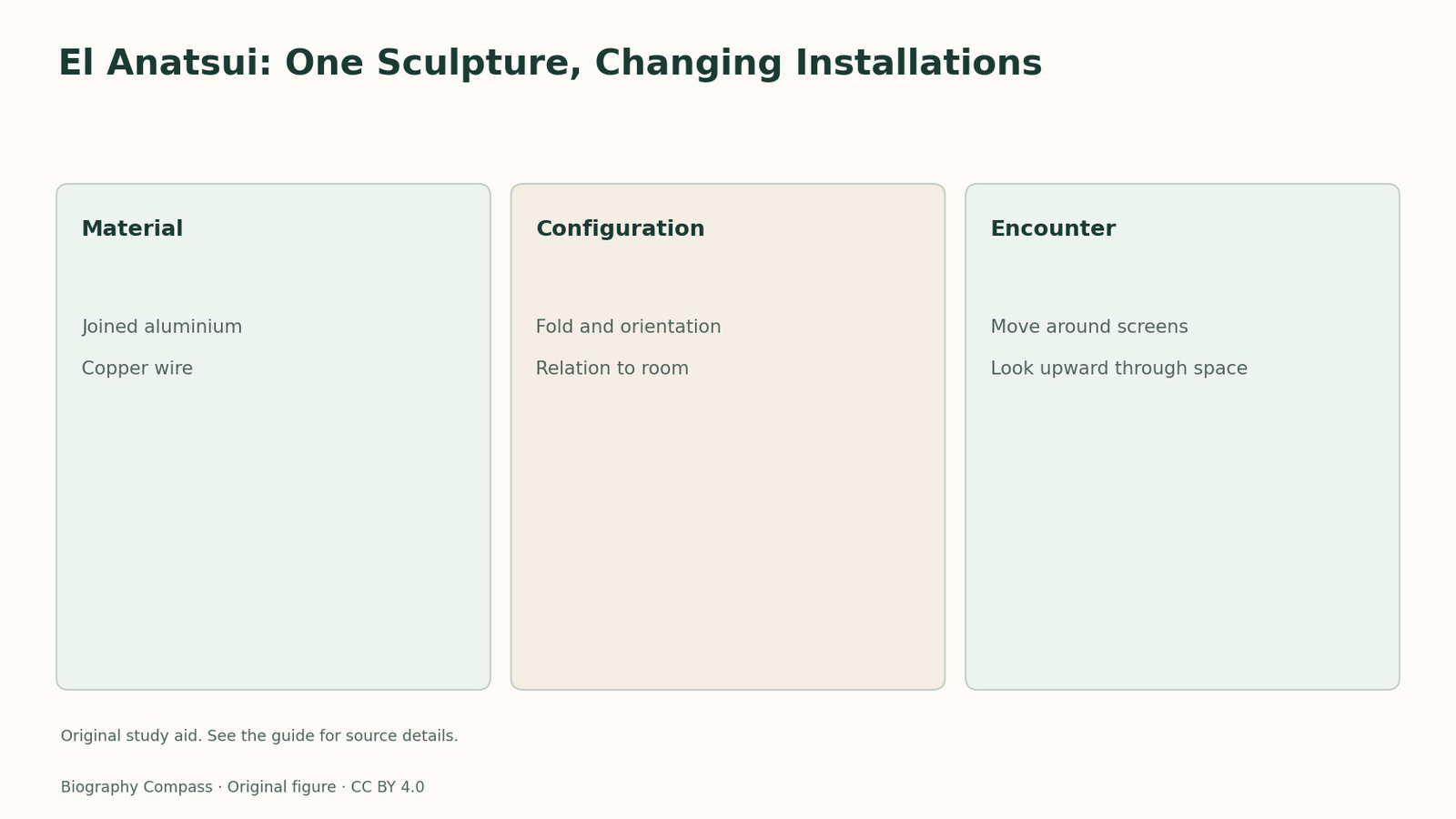
In the Met’s artist transcript, Anatsui describes a work capable of being shaped from a densely crumpled surface toward a flatter arrangement. Its joined metal elements allow folds that give the surface a sculptural character. Flexibility is therefore an attribute of how the object is made, not merely a curator’s imaginative reading. The work can retain its material identity while changing the depth, orientation and rhythms through which an audience encounters it in a particular room.
Sources for this section: [2]
An installer records an actual change
Akron’s collections manager describes helping install Gravity and Grace in Brooklyn in 2013. His account gives Gli a precise comparison, moving from a maze of screens in Akron to suspended elements climbing through Brooklyn’s rotunda. The difference concerns movement around the work as well as its vertical extent. This is stronger evidence than a general claim that every display is unique, because it identifies an object, two settings and the aspect of the arrangement that changed between them.
Sources for this section: [3]
Separate identity from configuration
Draw one flexible strip in two neutral arrangements, first forming a passage and then rising vertically. Keep a single object label beneath both. A supported answer explains what remains constant and what changes. The material work retains an identity, while position, folding and the relation to the building create a different configuration. The example should not be treated as an instruction to install an original work without its authorised guidance. Its purpose is to clarify why a sculpture’s exhibition history can contain substantive formal changes rather than only a list of venues.
Continue the chronology
Related history guides
Biography context
Explore Nigeria through connected lives
Connected biographies
Read the artist’s biography
b. 1944
El Anatsui
Sculptor and teacherA Ghanaian sculptor long associated with Nigeria whose joined metal works can change shape between installations.Read biographyQuick answers
Common questions
- Does a different installation necessarily mean a different artwork?
- No. These records describe the same flexible work taking a different configuration in another architectural setting.
Primary and institutional sources
How this history was checked
The listed records support the facts. Observation exercises and arguments are Biography Compass editorial interpretations. This article was reviewed on 7 November 2026.