
The short answer
How does a bark-cloth support affect the surface of a painting?
Compare the records
What the sources allow us to say
Read the object record alongside the contextual account.
| Record | Evidence | Reading limit |
|---|---|---|
| Artist and museum account | Lubugo bark cloth provides an irregular painting support. | Its joins and openings are material properties, not painted marks. |
| Institutional interpretation | Relates support and imagery within particular paintings. | A material’s history does not determine one meaning for every work. |
A support can arrive with a history
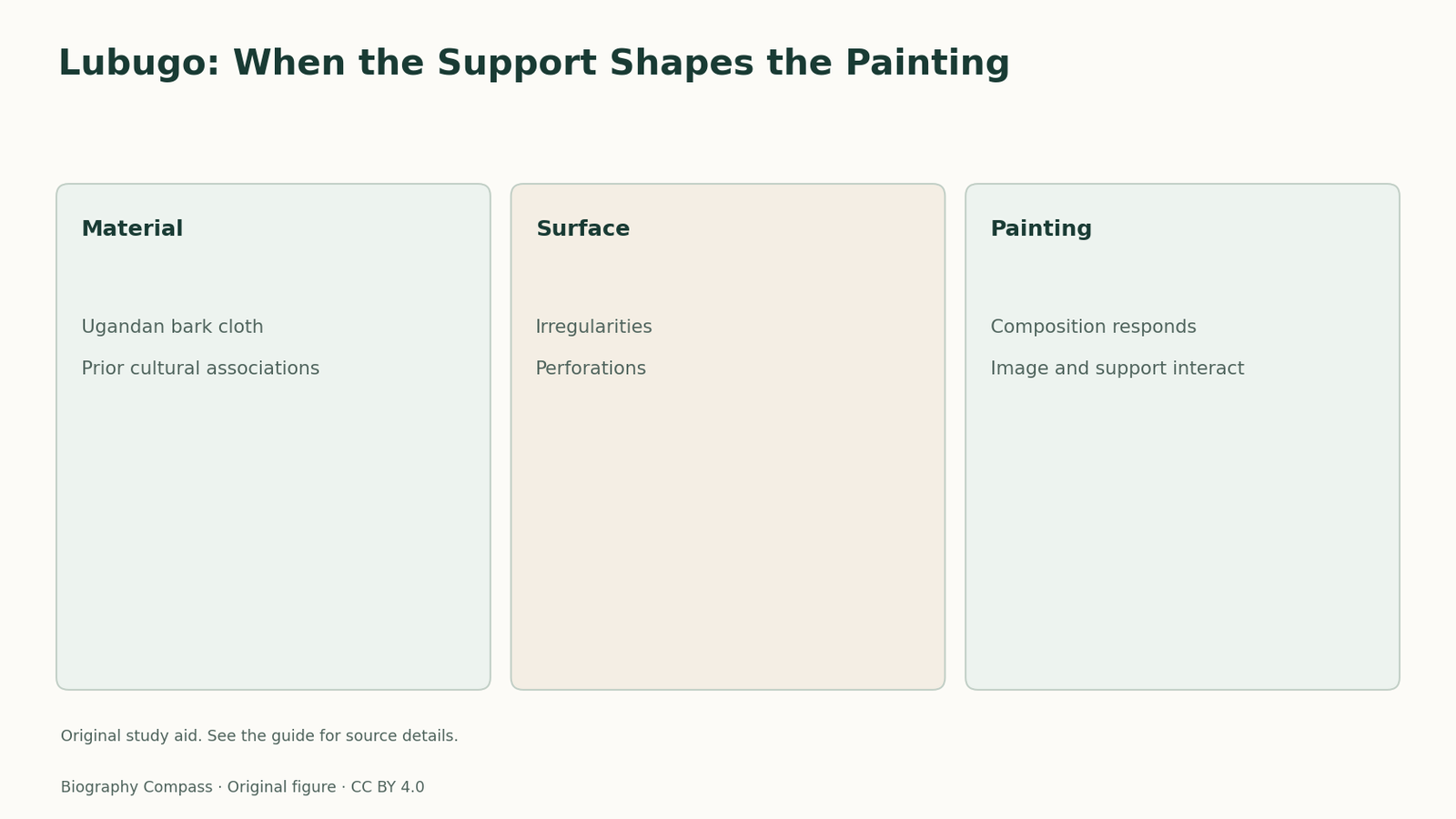
Armitage describes seeking a material that would locate his paintings in East Africa from the beginning of the process. Lubugo is made from fig-tree bark in Uganda and has ceremonial associations. Its selection therefore changes the cultural starting point of a painting. The choice does not supply a complete interpretation of the finished image, but it prevents the support from being treated as an interchangeable blank surface whose identity matters only after the pigments have been applied.
Sources for this section: [2]
Irregularity becomes a compositional condition
Glenstone notes perforations and punctures integrated into Armitage’s paintings. These are physical features that an artist must negotiate when placing a figure or organising a field of colour. The relationship can be reciprocal. A planned image meets the available surface, and the surface can suggest a different arrangement. The biographical account’s discussion of his figurative work gives this material process a context, showing why the image’s East African concerns are carried through both subject matter and support.
A practical comparison without reproducing the work
Draw two neutral rectangles, one empty and one interrupted by a small gap. Place a simple line through each and explain how the gap changes its course or emphasis. A useful answer demonstrates the compositional effect of an interruption while acknowledging that it does not reconstruct Armitage’s technique. Connect the result with the documented perforations. The exercise clarifies a material relationship, while precise claims about preparing, repairing or priming an original work would require its conservation and making records beyond the observations used here.
Continue the chronology
Related history guides
Biography context
Explore Kenya through connected lives
Connected biographies
Read the artist’s biography
b. 1984
Michael Armitage
PainterA Kenyan British painter whose East African subjects and bark-cloth supports reshape the terms of figurative painting.Read biographyQuick answers
Common questions
- Is lubugo simply another name for ordinary canvas?
- No. The sources identify a Ugandan bark cloth made from a fig tree, with its own material and cultural history.
Primary and institutional sources
How this history was checked
The listed records support the facts. Observation exercises and arguments are Biography Compass editorial interpretations. This article was reviewed on 7 November 2026.