
The short answer
Eicher’s milestone list is a useful starting point, but it compresses a learning process. A more detailed case asks how engineers obtained tools, adapted production and worked with suppliers. The study uses those mechanisms to test what “made locally” can establish—and which further evidence a claim about independent design needs.
Evidence and interpretation
Keep the claim attached to the record
Each row answers a different part of the question.
| Record | Supported reading | Limit |
|---|---|---|
| Product location | Where manufacture occurs | Does not uniquely identify design knowledge. |
| Production adaptation | Jigs, fixtures and supplier development | Different from a wholly original product design. |
| Corporate chronology | Compressed indigenisation milestone | Not a complete yearly progress series. |
Chronology
A timeline of the turning points
Corporate milestone
Local product milestone in the company list.
Intermediate result
Case study reports a missed target.
Publication
UNIDO publishes the retrospective case.
A milestone and a mechanism
The corporate timeline identifies a locally built tractor in 1959.
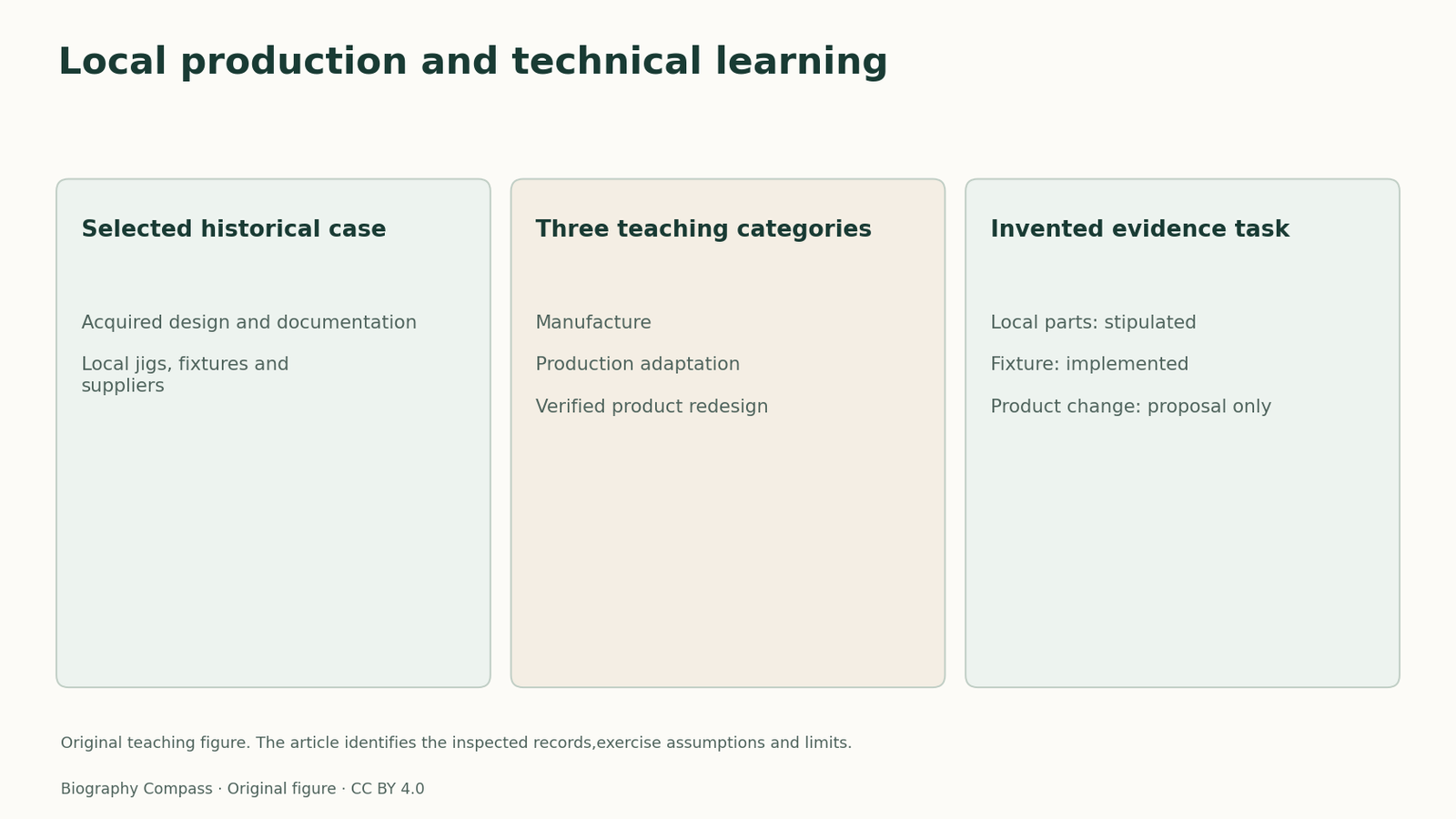
The UNIDO case describes a German design and documentation, local jigs and fixtures, supplier development and a mix of general- and special-purpose machinery.
These are compatible kinds of evidence. A finished product’s location does not identify where each design decision originated. Conversely, using an acquired design does not mean that the receiving factory learned nothing: solving manufacturing and adaptation problems is itself technical work.
Targets are not a time series of achievement
The case reports planned local-content stages of 48.6%, 79.5% and 100%, but only 37% achieved by 1966. It describes later engine manufacture and development of suppliers for gears.
The company chronology groups full indigenisation within 1965–1975.
The detailed case supplies intermediate difficulty that a milestone list does not. Read the planned stages as targets, not three observed results. Neither selection justifies attributing all engineering to one executive.
Original evidence-classification task
Invented workshop: it produces every component locally using purchased specifications. Team A has implemented a fixture that improves one operation. Team B has proposed a product change, but supplied no test results. Which observations establish local manufacture, adaptation of production and verified product redesign? Identify one missing item of evidence for the strongest claim.
Reference answer
Local production is stipulated. Team A supplies evidence of production adaptation. Team B supplies a proposal; without the stipulated missing test evidence, verified redesign is not established. An evaluated specification change and relevant test results would strengthen that claim. These categories are an original teaching framework, not quoted contractual definitions.
The exercise avoids turning one local-content percentage into a complete capability score. It also leaves room for team contributions: production staff, tooling engineers and suppliers can solve different problems even when the finished product retains an acquired design.
Continue the chronology
Related history guides
Biography context
Explore India through connected lives
Connected biographies
The working life
Quick answers
Common questions
- Does using an acquired design rule out local technical learning?
- No. Manufacturing adaptation and product design are different claims; evidence should specify which work was done.
Primary and institutional sources
How this history was checked
Compare the selected accounts and objects below; each has a stated date and scope, and the learning task supplies its own instructions. This article was reviewed on 31 October 2026.