
The short answer
A percentage looks precise until its denominator changes. Compare two policy records, then use a deliberately invented budget to see why the same expenditure can produce different ratios.
Original worked comparison
Read the conditions alongside the result
All numerical examples in this table are invented teaching cases. They are not historical measurements.
| Case | Calculation or observation | Conclusion and limit |
|---|---|---|
| National-income base | 60÷1,000=6%. | Valid only for the supplied national-income base. |
| GDP base | 60÷1,200=5%. | The numerator is unchanged. |
| Target amount | 0.06×1,200=72. | A target or authorisation is not proof of expenditure. |
Chronology
A timeline of the turning points
Fix the inputs
Use expenditure 60, income 1,000 and GDP 1,200 in one period and one unit.
Name each denominator
Compute 6% and 5% without changing expenditure.
Inspect the document stage
Distinguish a target amount from recorded expenditure.
Read the denominator in the actual record
Paragraph 11.4 of the education policy modified in 1992 recalls an earlier target measured against national income and acknowledges shortfalls. Its later wording says outlay would uniformly exceed 6% of national income. The denominator and the distinction between reaching and exceeding a threshold both matter.
The 2020 policy’s section 26.2 states a public-investment target of 6% of GDP. These are differently worded records. Neither statement, by itself, supplies an audited figure for spending in the present year.
Keep one numerator and change the base
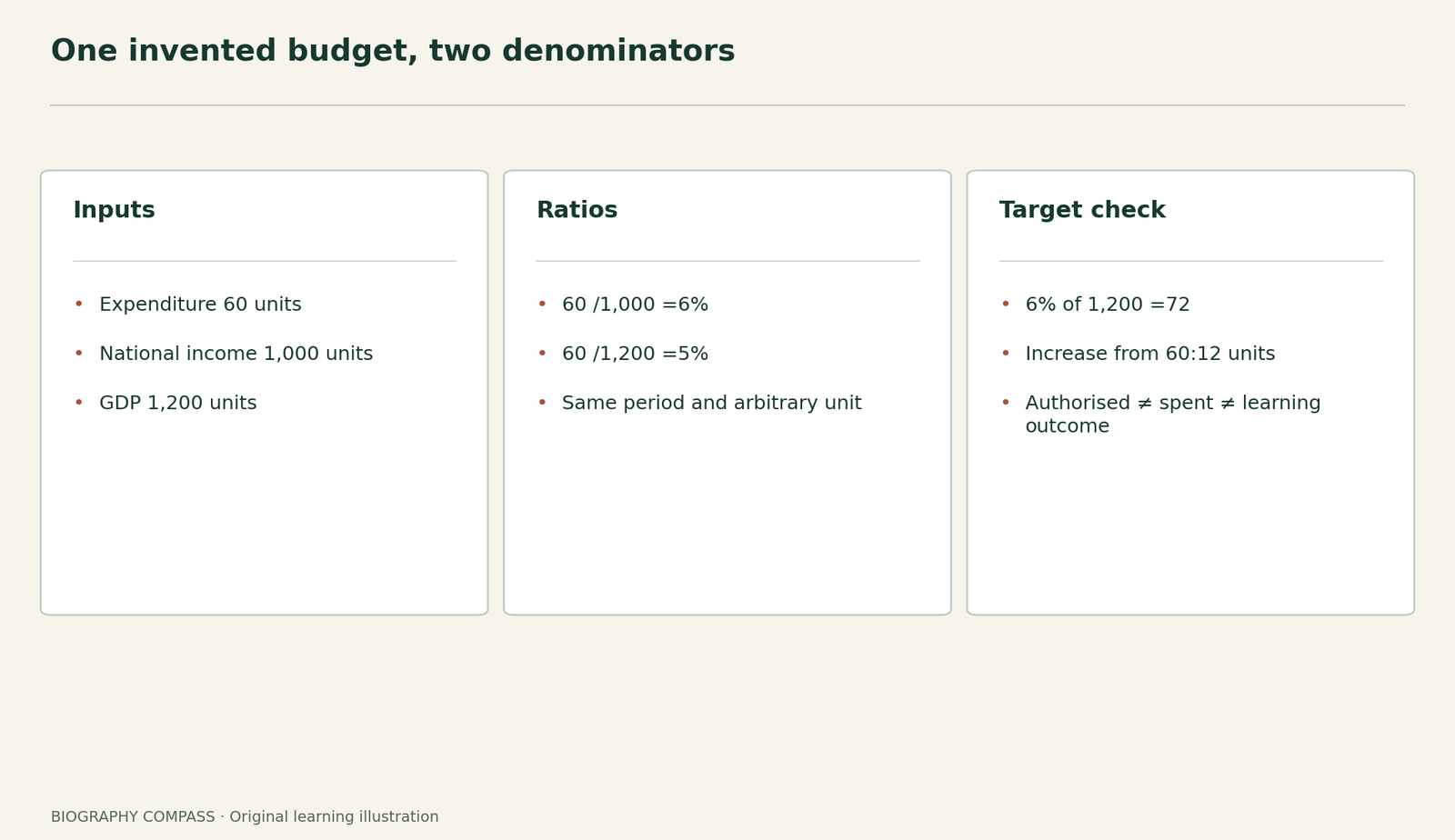
For this exercise only, invent a country with education expenditure 60, national income 1,000 and GDP 1,200. All amounts use the same arbitrary accounting unit and the same period. These are supplied numbers, not Indian expenditure estimates. Do not import a real currency, current price series or unprovided conversion.
Calculate 60÷1,000=0.06, or 6%. Against the second supplied denominator, 60÷1,200=0.05, or 5%. The numerator has not fallen. The reported percentage changes because the base has changed. Comparing the ratios without their labels would confuse a measurement convention with a change in expenditure.
Turn a ratio into an amount, then check the stage
With the invented GDP still fixed at 1,200, a 6% target corresponds to 72 accounting units. Relative to the supplied 60, that is an increase of 12 units, or 20% of the original expenditure. It is not a one-percent increase: the move from 5% to 6% is one percentage point of the stated denominator.
Now suppose a hypothetical budget authorises 72 but a later account records expenditure 60. The authorisation equals the invented target amount, while the recorded expenditure remains 5% of the invented GDP. An approval, a release and an expenditure account answer different questions. A ratio cannot tell us which stage a document measures unless its coverage is specified.
Sources for this section: [2]
Exercise and reference answer
An invented headline says: “Spending reached 6%, so it met every education target and improved learning.” Rewrite it using only the supplied information. List the extra records that would be needed before comparing different years or claiming a learning outcome.
Reference answer: expenditure 60 equals 6% of the supplied national income and 5% of the supplied GDP. It does not meet a 6%-of-GDP expenditure test in this example. To compare years, obtain consistent periods, definitions and price conventions; to assess learning, obtain relevant outcome evidence. Meeting an accounting ratio alone supplies neither that evidence nor a causal explanation. In an invented “greater than 6%” test, exactly 6% also fails: a boundary value needs the stated comparison operator.
Section 26.5 of the 2020 policy itself discusses delays and unspent funds. This guide uses selected policy passages and an invented calculation; it does not claim a complete policy review or estimate current expenditure.
Biography context
Explore India through connected lives
Connected biographies
People connected with this question
1906–1993
D. S. Kothari
Physicist and education administratorKothari connected physics, university teaching and the organisation of defence science and education.Read biographyQuick answers
Common questions
- Is one percentage point the same as a one-percent increase?
- No. In this example, moving from 60 to 72 is 20% more expenditure, while the ratio rises from 5% to 6%: one percentage point.
- Are the exercise numbers actual Indian spending?
- No. They are invented inputs for checking ratios; they are not a current or historical national dataset.
Primary and institutional sources
How this history was checked
The 1992 paragraph was read in indexed primary text; its origin PDF was unavailable. The 2020 PIB copy was sampled at sections 26.1–26.5. The worked budget and answers are original teaching material. This article was reviewed on 29 October 2026.