
The short answer
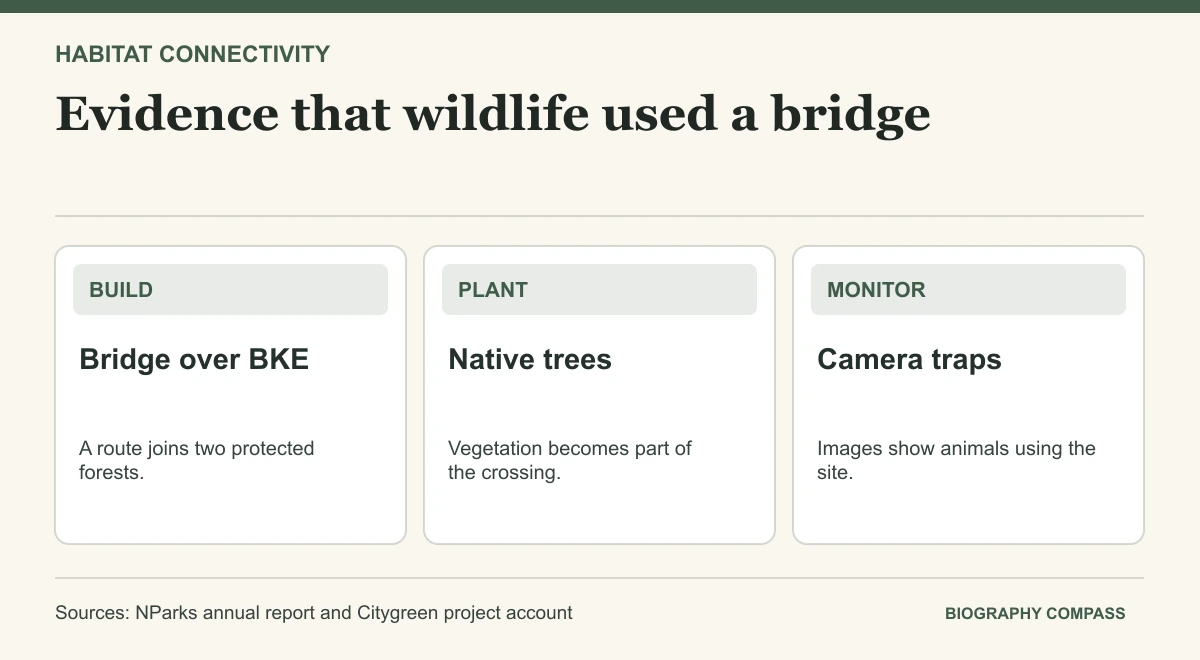
An expressway severed a patch of rainforest used by animals on both sides. Singapore’s Eco-Link@BKE established a planted route over the road. Building that route was one milestone. Establishing that an animal had actually used it required another type of evidence.
Reading the records
What the bridge records can establish
Physical completion, habitat establishment and wildlife use require different evidence.
| Question | Evidence | Limit |
|---|---|---|
| Was the structure finished? | 2013 NParks annual report | Construction date only. |
| Was a species present? | Identifiable camera-trap image | A recorded observation at the monitoring site. |
| How regularly was it used? | Longer series of comparable records | Requires accounting for monitoring effort. |
Chronology
A timeline of the turning points
An expressway divided the forest
The Bukit Timah Expressway separated two protected forest areas.
Construction completion
Participants planted 50 native trees on the bridge.
Early use recorded
Camera traps detected Sunda pangolin and palm civet.
Why a bridge needed its own habitat
The expressway separated the Bukit Timah and Central Catchment nature reserves. The engineering task was to cross the road, while the conservation task was to give forest animals a usable route. A planted surface and vegetation at its approaches were part of that plan. NParks marked construction completion with the planting of 50 native trees in October 2013.
What the early cameras recorded
The project team reports detecting a Sunda pangolin and a palm civet on the bridge in April 2014. This is direct evidence that the site was being used by those animals while the plantings were still developing. The observation matters because completion of a structure alone cannot confirm animal movement. The dates put physical completion and initial monitoring on the same timeline.
Use the evidence at the right scale
A camera can establish the presence of an identifiable animal at a particular place and time. It cannot by itself establish how many individuals cross, how frequently they do so, or how a whole population changes. Those questions require consistent monitoring and an account of sampling effort. NParks’ restoration handbook places camera traps within that wider observation work.
Continue the chronology
Related history guides
Connected biographies
People in this history
Quick answers
Common questions
- Which reserves does Eco-Link@BKE connect?
- It connects Bukit Timah Nature Reserve and the Central Catchment Nature Reserve.
- Did monitoring find wildlife on the bridge?
- The project team reported detecting a Sunda pangolin and a palm civet on the bridge in 2014.
Primary and institutional sources
How this history was checked
Dates, legal milestones and historical claims are checked against the official and institutional records below. This article was reviewed on 19 November 2026.