
The short answer
Bukit Timah has two histories that are often folded into one. One concerns preserving forest from extraction and development. The other concerns managing paths, slopes and public access where many visitors enter that forest. The reserve’s 1883 designation and its 2016 reopening belong to different parts of that story.
Reading the records
How the purpose of protection changed
Land designation, ongoing management and the condition of walking routes each require their own records.
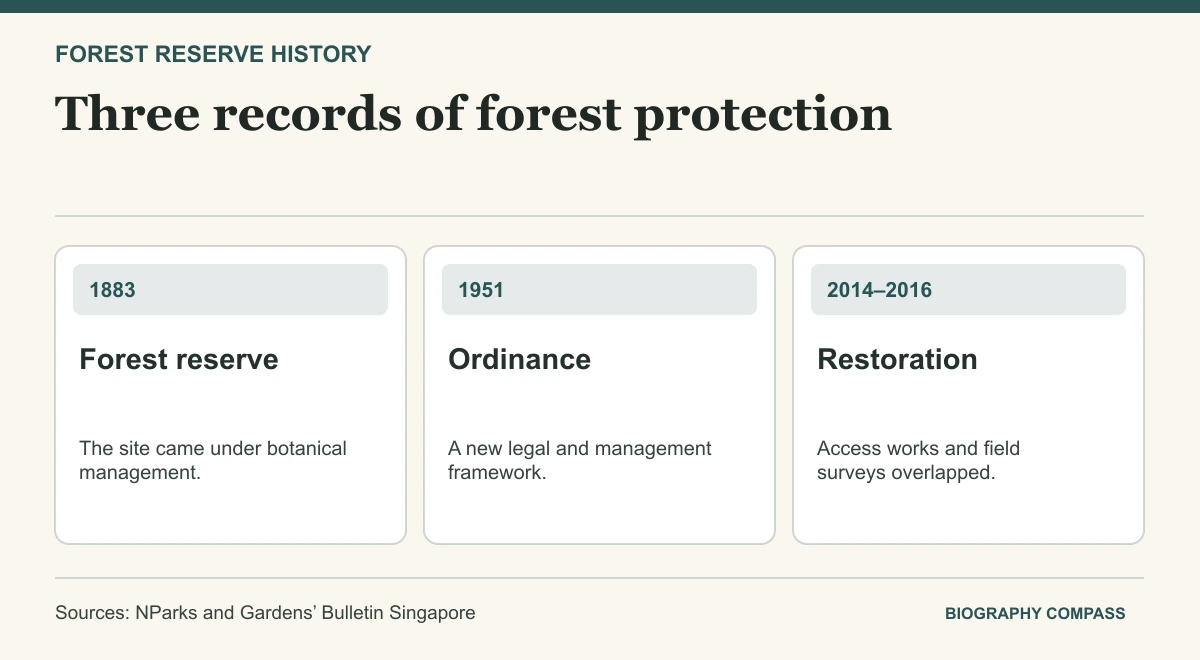
| Period | Record | What it covers |
|---|---|---|
| 1883 | Forest reserve | Early set-aside of forest land. |
| 1951 | Ordinance | A statutory framework and management board. |
| 2014–2016 | Restoration and monitoring | Repairs and study during an interruption to ordinary access. |
Chronology
A timeline of the turning points
Forest reserve established
NParks attributes the proposal for early reserves to Nathaniel Cantley.
Stronger legal protection
The Nature Reserves Ordinance and board changed reserve management.
Restoration closure
Works addressed slopes, trails and visitor infrastructure.
Reserve reopened
A two-year period of restrictions and works ended.
A forest reserve preserved under botanical management
NParks credits Nathaniel Cantley, superintendent of the Singapore Botanic Gardens, with recommending early forest reserves. It says Bukit Timah was the only one of those reserves that was not worked for timber. Botanical management helped preserve the plants and animals there while other reserves had been depleted by the late 1930s. The name forest reserve alone does not establish what happened on the ground.
Sources for this section: [1]
Public access required work of its own
The historical record for 1951 concerns stronger legal protection. The 2014 closure addressed a different responsibility. Field reporting in Gardens’ Bulletin describes works on physical infrastructure, including the visitor centre and access. Improving a trail or managing erosion could require temporary restrictions even though those measures served the longer-term protection and use of the reserve.
A closure also made room for fieldwork
The Botanic Gardens’ research series describes planning a comprehensive biodiversity survey from 2014, with much fieldwork in 2015 and 2016. The work assessed what was present while the reserve was undergoing repairs. A catalogue of surveys gives more evidence than treating the reopening as proof of biological recovery. Researchers needed to describe when, where and how they looked.
Continue the chronology
Related history guides
Eco-Link@BKE: How Singapore Tested a Wildlife Bridge
See how a planted bridge connects the reserve with the Central Catchment.
Read the timeline1859–2015How Singapore Botanic Gardens Helped Spread Rubber Growing
Read about the botanical institution that once managed the forest reserve.
Read the timelineConnected biographies
People in this history
Quick answers
Common questions
- When was the original forest reserve established?
- NParks dates it to 1883.
- What happened between 2014 and 2016?
- A restoration programme restricted ordinary access and addressed physical conditions. Biodiversity researchers also carried out fieldwork during the period.
Primary and institutional sources
How this history was checked
Dates, legal milestones and historical claims are checked against the official and institutional records below. This article was reviewed on 19 November 2026.