
The short answer
How does a monumental drawing’s title guide comparison without making two works interchangeable?
Read the evidence
Sources, interpretation and production roles
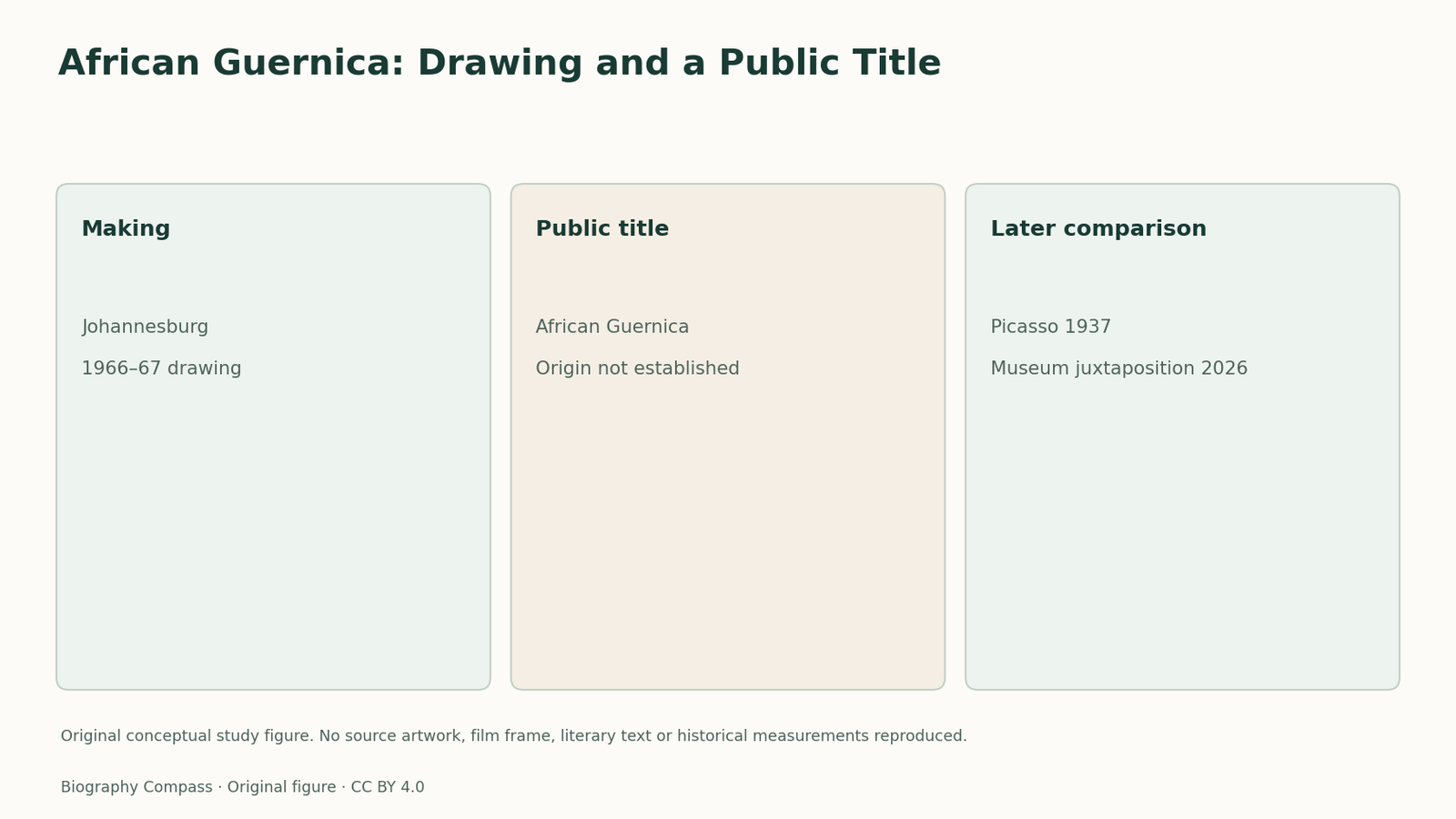
The records answer different questions about this work. The final exercise is an original teaching model.
| Record or question | Supported reading | Boundary or contrast |
|---|---|---|
| Material record | Charcoal/pencil on joined newsprint; 1966–67 making. | A later exhibition date is not the production date. |
| Title/influence account | Title approved for exhibition; origin unknown, direct influence not proven. | Resonance is not documentary proof of copying. |
| 2026 loan | A curator and institutions constructed a later comparison. | Juxtaposition does not imply an original collaboration. |
A large drawing made under apartheid
African Guernica is a 1967 work in the University of Fort Hare collection. The Reina Sofía press material describes charcoal and pencil on joined sheets of newsprint, made in 1966–67 and shown at Gallery 101. Its scale and material bring drawing into a public ambition beyond the small decorative object. The Johannesburg setting and apartheid’s restrictions are central to this history, not an interchangeable background of unspecified suffering.
A title with an unresolved origin
The museum’s detailed record says the title’s origin is unknown, while the work was exhibited under it with Feni’s approval. It also says that a direct influence from Picasso is not established. These are concrete distinctions, not reasons to avoid comparison. A publicly used title can invite a relationship even when its first author is unidentified, and formal or political resonance need not prove a direct borrowing from one particular reproduction.
Sources for this section: [3]
The 2026 juxtaposition
The Reina Sofía displayed the drawing in relation to Picasso’s 1937 Guernica, using Tamar Garb’s curatorial framework. The two works arose in different historical circumstances. Comparing monochrome, expressive distortion or the conjunction of humans and animals can sharpen attention to both, provided the comparison does not collapse apartheid Johannesburg into the Spanish Civil War. The Fort Hare announcement establishes the loan; it does not turn a later exhibition pairing into an original collaboration. Newsprint also changes the usual expectation of a monument: the drawing’s public ambition is carried by joined paper rather than a permanently installed stone or bronze group. Material and scale therefore pull in an unusually productive relation.
Original exercise: compare without merging
Make a two-row table naming the 1937 painting and the 1967 drawing. Use separate columns for medium, historical setting and the later museum relationship. A reference answer distinguishes painting from drawing on newsprint and the Spanish Civil War from South African apartheid, then places the 2026 juxtaposition in a shared final column. Add a fourth question: what does the title demonstrate? The supported answer is that it was publicly attached to Feni’s work with his approval; it does not identify its unknown originator or prove direct copying. This exercise gives a positive structure for comparative art history. Similarities can become questions about how artists give violence a form, while differences preserve the specificity of each work. The diagram uses text only and reproduces no figures or compositions. A final response should explain one formal parallel and one historical difference, rather than concluding that two works about oppression must tell the same story. Such a comparison lets the later exhibition become a new encounter between works instead of an invented account of their original making.
Continue the chronology
Related history guides
Biography context
Explore South Africa through connected lives
Connected biographies
People and related creative practices
1942–1991
Dumile Feni
South African draughtsman and sculptorDumile Feni developed a forceful drawing and sculptural practice in Johannesburg, then continued working in London and the United States after leaving in 1968.Read biography
1944–
Mongane Wally Serote
Poet, novelist and cultural organiserMongane Wally Serote developed a literary career through township life, detention, exile and cultural organising. Poetry and fiction offered different ways to explore violence, community and freedom. After returning to South Africa, he also worked in Parliament and heritage institutions, while continuing to write.Read biography1904–2002
Ernest Mancoba
South African artist working in sculpture, painting, drawing and printErnest Mancoba moved from carved figures in South Africa into a long European career, developing an independent practice across sculpture, painting and drawing.Read biographyQuick answers
Common questions
- Is the origin of the title African Guernica known?
- The inspected Reina Sofía press record says it is unknown, while noting Feni’s approval of its exhibition use.
Primary and institutional sources
How this history was checked
Sources include production records, institutional collections and the specifically identified passages discussed here. Interpretations and teaching models are distinguished from credits and publication facts. This article was reviewed on 8 November 2026.
- South African History OnlineDumile Feni
- South African History OnlineDumile Feni biography by Sophia Reuss
- Museo Reina SofíaAfrican Guernica 2026 exhibition and press kit
- Nationalmuseum, Tamar Garb lecture noticeAfrican Guernica: Viewing Picasso from the South
- University of Fort HareFort Hare 2026 loan announcement