
The short answer
In 1980, Digital Equipment Corporation, Intel and Xerox published a joint Ethernet specification. The document described a 10-megabit-per-second local network and the conventions equipment needed to share it. IEEE adopted 802.3 in 1983. Common ancestry explains the similarities between the two specifications, while the way they describe data in a frame explains a practical difference.
Compatibility
What had to match for two implementations to communicate
A device needs to work at the level of the shared medium and at the level of the frame.
| Layer of agreement | What the specification addressed | What to look for in an implementation |
|---|---|---|
| Physical connection | How a station attaches to the network | Compatible equipment and a suitable shared medium. |
| Media access | When a station can transmit and what follows a collision | A shared procedure for operating on the cable. |
| Interpreting a frame | How the receiving software identifies the data | DIX-style type codes or the early IEEE 802 conventions for length and protocol identification. |
Chronology
A timeline of the turning points
Experimental Ethernet at Xerox PARC
The local-network design addresses sharing a common medium.
Digital, Intel and Xerox issue their specification
It describes 10 Mbit/s operation and how equipment sends and receives frames.
IEEE adopts Ethernet as a standard
IEEE 802.3 provides a formal framework for standardised implementations.
Why the publication mattered to manufacturers
A demonstration network can rely on equipment built by one group. Suppliers need a written agreement if their components should work together. The Digital, Intel and Xerox publication specified interfaces and a frame format along with requirements for the 10 Mbit/s medium.
The document is dated September 1980. Read it alongside IEEE’s account, which places formal adoption in June 1983. One is the three-company specification. The other is the later standards process.
How a receiver knows what is in a frame
In the DIX-style frame convention, the field after the two addresses identifies the payload’s protocol. For example, RFC 894 specifies a type value for carrying IP datagrams. With the early IEEE 802.3 convention, that position describes length. Logical link control and additional fields can identify the carried protocol, as RFC 1042 illustrates.
Thus both implementations may use Ethernet signalling and share a physical link, yet the receiving software still has to recognise the way a frame labels its contents.
How the pictured hardware fits the story
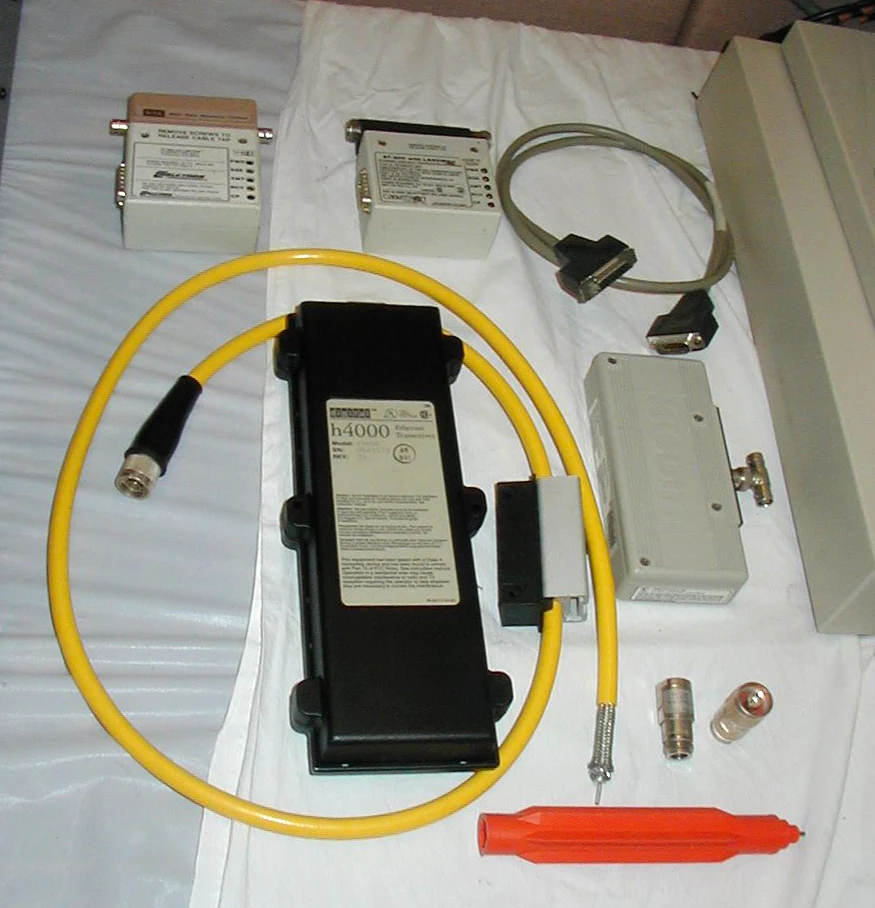
The photograph shows hardware associated with coaxial Ethernet, including transceivers and a tool for tapping a cable. It makes the physical attachment visible. A photograph of an adapter gives little evidence about the software’s interpretation of a frame. The specifications and RFCs are the right records for that question.
Continue the chronology
Related history guides
Connected biographies
People connected to this history
Quick answers
Common questions
- What does DIX stand for?
- Digital Equipment Corporation, Intel and Xerox, the companies behind the joint specification.
- Is IEEE 802.3 the same document as the 1980 Ethernet specification?
- The publications come from different organisations. The IEEE standard followed the joint specification and made formal use of related Ethernet technology.
Primary and institutional sources
How this history was checked
Dates, legal milestones and historical claims are checked against the official and institutional records below. This article was reviewed on 19 November 2026.
- Digital, Intel and Xerox, archived by the Computer History MuseumThe Ethernet, a local area network, Version 1.0
- IEEE Standards AssociationEthernet through the years
- Charles Hornig, RFC EditorRFC 894, Transmission of IP Datagrams over Ethernet Networks
- Jon Postel and Joyce Reynolds, RFC EditorRFC 1042, Transmission of IP Datagrams over IEEE 802 Networks
- Robert Harker and Wikimedia Commons contributors10BASE5 Ethernet transceivers and installation equipment