
The short answer
A fan can dance before understanding a song’s words, then learn their meaning through friends. Didi Kempot’s audience records offer a concrete case of that sequence. Comparing one organiser’s account with the national cultural festival report explains both how participation can work and what the surviving numbers actually count.
Original source comparison
Different records answer different parts of the question
Compare the concrete information each record supplies before combining its claims.
| Record | What it establishes | What remains open |
|---|---|---|
| Fan recollection | A narrated route from online discovery to shared explanation and concerts. | Its prevalence beyond this person and community. |
| Festival report | Artist participation and a whole-event visitor total. | Didi’s set attendance, crowd ages or language outcomes. |
| Original interview plan | Separate questions about discovery, understanding and social activity. | Answers and sampling are still required; the plan is not a completed survey. |
Chronology
A timeline of the turning points
A fan’s recalled entry
Deni describes following Twitter discussion before seeking meanings from other listeners.
Pekan Kebudayaan Nasional
Didi appears in the ministry’s list of participating artists.
Participant testimony published
Alinea records fan and musician recollections after his death.
Begin with the listener’s route into a song
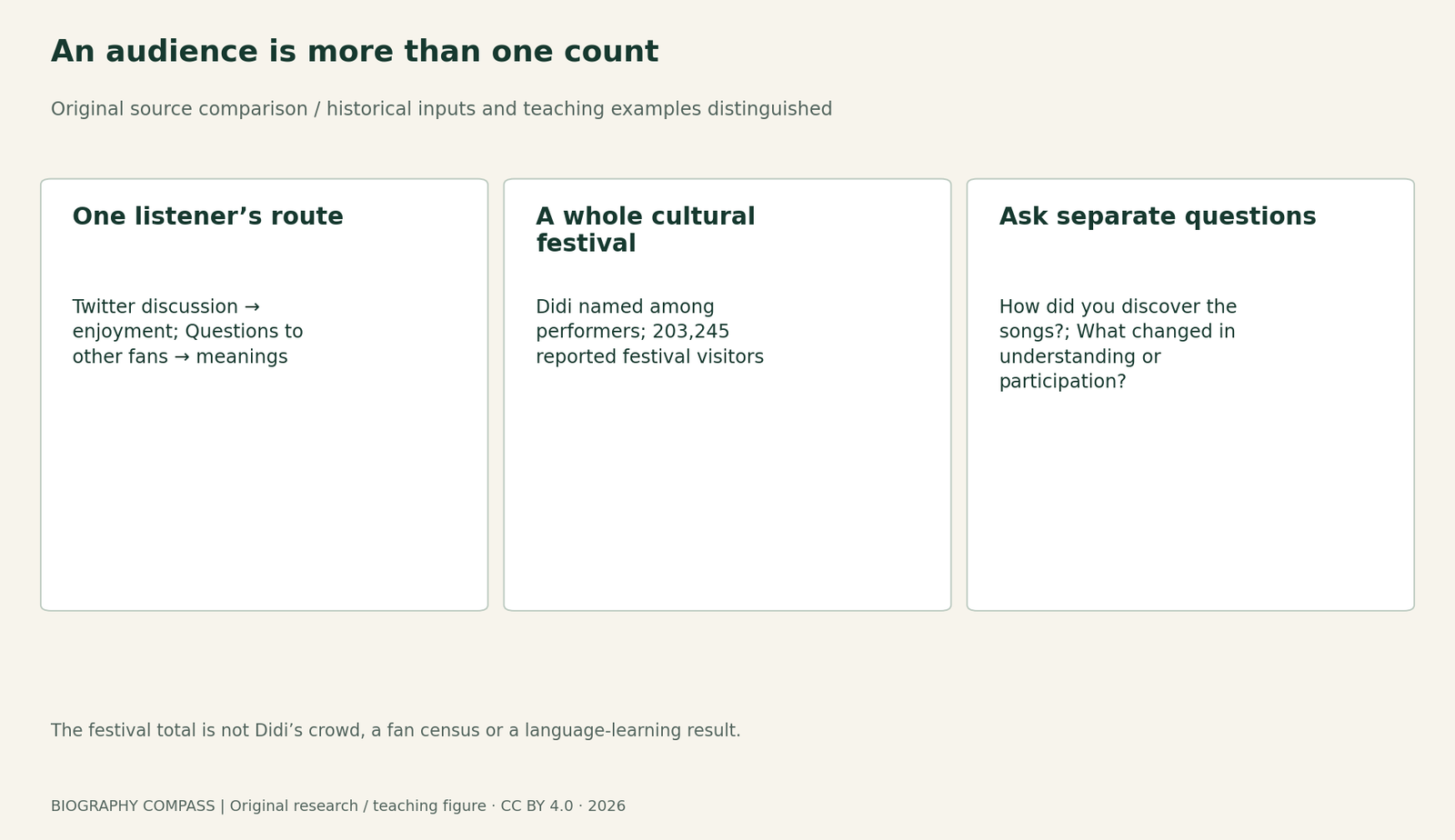
In Alinea’s May 2020 interview, Jakarta fan organiser Deni Purwanto recalled first following discussion of Didi Kempot on Twitter in June 2019. He then asked other fans about the Javanese words and remembered discovering that a song he had treated as cheerful carried sadness. The sequence is revealing: social discovery, enjoyment, questions and explanation. Language knowledge developed within participation rather than functioning as an entrance examination. This one account gives a concrete mechanism through which a regional-language repertoire could acquire listeners who did not initially follow all its words.
Sources for this section: [1]
Put an established artist inside the wider festival
The ministry’s Jendela report names Didi among performers at Pekan Kebudayaan Nasional 2019. The event combined performances with exhibitions, discussions and other cultural activities. Its list places him alongside artists working in other forms. That setting made Javanese popular song part of a wider national programme of encounter. It also changes the meaning of the audience evidence: attendance at a multi-activity festival cannot automatically be assigned to one performer. The record establishes a programmed appearance and the event’s breadth, while leaving the composition of his particular crowd unanswered.
Sources for this section: [2]
The actual numbers describe different populations
Jendela reports 203,245 visitors to the festival as a whole. Deni, by contrast, described roughly a hundred registered members in his Jakarta fan community, mainly aged 25–33, while mentioning younger and older members too. The first number concerns a broad event; the second is an organiser’s approximate description of a particular group. Neither is a national census of fans. Dividing one by the other would create an impressive-looking percentage with no defensible relationship between numerator and denominator. Even the festival total does not by itself tell us how many unique people attended, understood Javanese or watched Didi.
A better explanation separates three kinds of participation
The comparison suggests three questions worth asking separately. How did someone encounter the music? What could that person understand at the time? What did they do with other listeners? Deni’s account supplies possible answers—online discussion, asking for meanings and joining a concert community—without proving that everyone followed the same route. For a student researching another regional-language music scene, these distinctions are more useful than a simple fluent/non-fluent division. They allow enjoyment, learning and social attachment to change over time. This is an analytical framework drawn from the case, rather than a universal theory of every Didi listener.
Exercise: repair a display and plan two questions
Imagine a small exhibition proposes this caption: “Didi Kempot brought 203,245 young fans to his 2019 concert and taught them Javanese.” Write a replacement of two or three sentences using only the records examined here. Then design two interview questions capable of investigating language learning without assuming it happened. Keep the whole-festival number attached to the festival, identify the fan account as one participant’s recollection, and avoid turning attendance into evidence of a specific educational outcome. Your questions should allow someone to answer that their understanding did not change. This is an original exercise, not a quotation from either record.
Worked answer: participation is the finding, instruction a question
One possible replacement is: “Didi Kempot was among the performers at Pekan Kebudayaan Nasional 2019, whose report records 203,245 visitors across the festival. A Jakarta fan organiser later recalled asking other fans to explain Javanese words after discovering the singer through online discussion. His account shows one route from enjoyment towards understanding, rather than a measured result for the entire crowd.”
Two useful interview questions are: “When you first encountered these songs, which parts could you understand, and has that changed?” and “Can you describe anything another listener helped you understand, or explain why you did not seek that help?” Ask for an occasion and a comparison over time. Recruitment at one fan meeting should be identified as recruitment from that meeting; it cannot stand in for all fans or all young Indonesians. The historical result is a documented social route into the repertoire, with its wider frequency still open to research.
Continue the chronology
Related history guides
What changed when Tulus’s Sepatu became Kutsu?
Use TulusCompany’s release account and Hiroaki Kato’s interview to distinguish song translation, collaborator credit and launch strategy, with an original brief.
Read the timeline1970s–2018What did Soneta need to take a show on the road?
Compare Rhoma Irama’s touring-equipment recollection with his festival aims, then solve an original planning exercise without turning a cargo anecdote into a ranking.
Read the timelineBiography context
Explore Indonesia through connected lives
Didi Kempot biography
Read the musician’s broader career alongside the focused research question.
Explore the biographiesRelated learning guideWhat changed when Tulus’s Sepatu became Kutsu?
Use TulusCompany’s release account and Hiroaki Kato’s interview to distinguish song translation, collaborator credit and launch strategy, with an original brief.
Explore the biographiesRelated learning guideWhat did Soneta need to take a show on the road?
Compare Rhoma Irama’s touring-equipment recollection with his festival aims, then solve an original planning exercise without turning a cargo anecdote into a ranking.
Explore the biographiesConnected biographies
People connected with this question
1966–2020
Didi Kempot
Singer and songwriterDidi Kempot was an Indonesian singer and songwriter associated with Javanese-language songs of longing and heartbreak. His route from street musician to an international and cross-generation audience became a major chapter in contemporary campursari.Read biographyQuick answers
Common questions
- Does 203,245 mean Didi Kempot’s concert audience?
- No. It is the report’s whole-festival visitor total.
- Must a listener understand every word before participating?
- Deni’s testimony gives one example in which enjoyment and social participation preceded fuller understanding. It does not quantify how common that route was.
Primary and institutional sources
How this history was checked
Compare these historical records while keeping participant testimony, event totals and release metadata distinct. This article was reviewed on 27 October 2026.