
The short answer
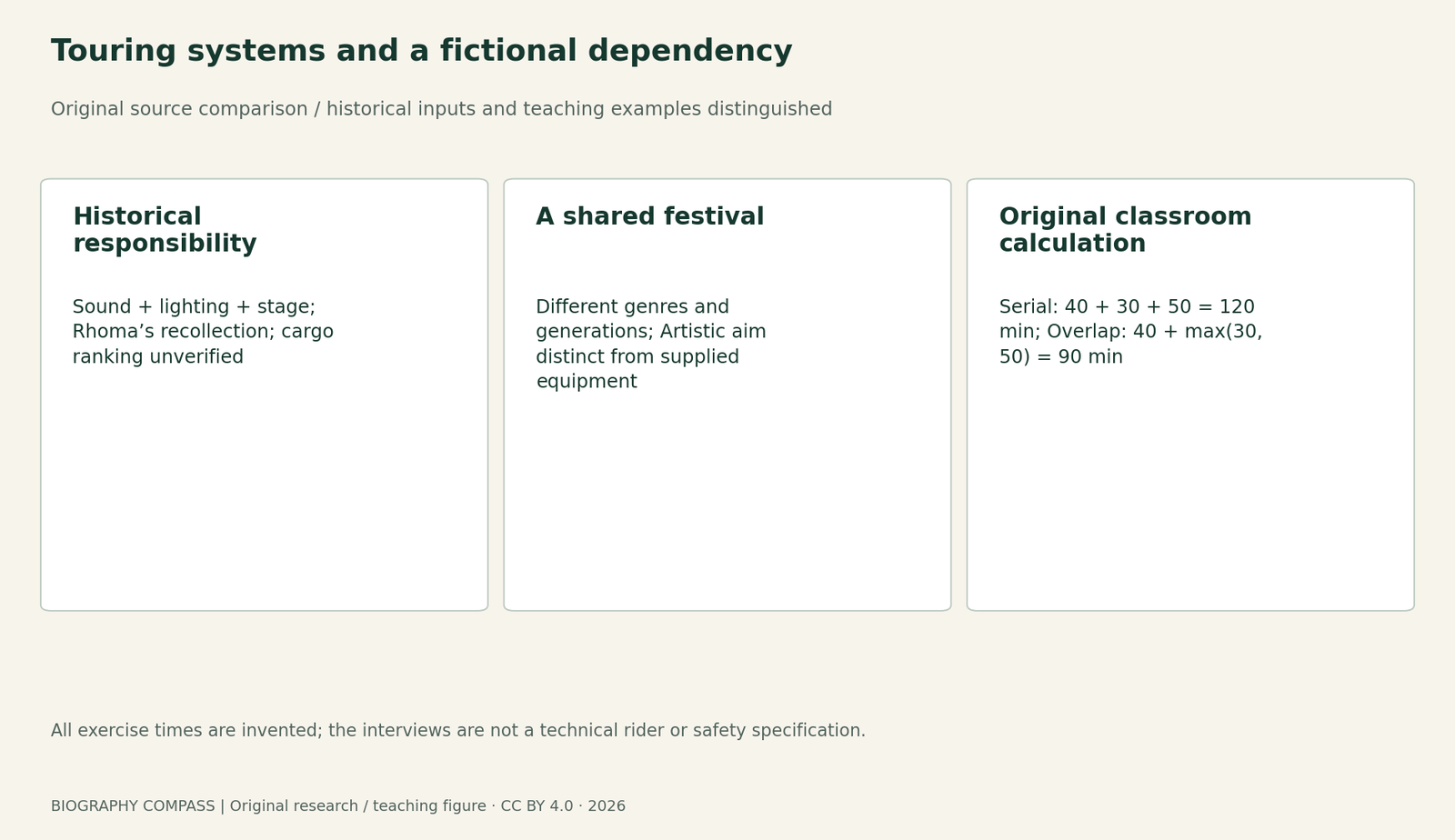
A touring act needs more than its songs and the people singing them. Rhoma Irama’s 2018 interviews connect Soneta’s sound, lights and stage with a later wish to share a festival across genres and generations. The comparison shows why a performance plan must account for both production responsibilities and the audience setting.
Original source comparison
Different records answer different parts of the question
Compare the concrete information each record supplies before combining its claims.
| Record | What it establishes | What remains open |
|---|---|---|
| Touring recollection | The act historically supplied several systems, not just musicians. | No weighed inventory, verified cargo ranking or usable technical rider. |
| Festival interview | Rhoma’s reason for joining a mixed programme. | Intention is not measured audience impact or a supply contract. |
| Original dependency model | 40 + max(30, 50) = 90 minutes under stated assumptions. | Invented times do not describe a real Soneta show. |
Chronology
A timeline of the turning points
An act-supplied environment
Rhoma recalls carrying sound, lights and stage equipment.
Festival rationale published
He explains interest in a cross-genre, cross-generation setting.
Cargo interview published
He declines to verify the alleged world ranking.
Equipment explains the cargo story
In an October 2018 interview, Rhoma explained that Soneta had historically carried sound equipment, lighting and even its stage when organisers did not supply them. He recalled twelve trucks and bulky older equipment. The useful finding is the allocation of responsibility: the touring act sometimes supplied an entire performance environment. Rhoma explicitly declined to verify the suggestion that its cargo ranked second in the world behind the Rolling Stones. A memorable touring anecdote therefore supports a practical account of what had to travel, while the global ranking remains unsupported.
Sources for this section: [1]
A musician count cannot describe the whole operation
The same account contrasts the number of players with the amount of equipment needed. Transport requirements depend on what the act supplies, the design of the show and the equipment available, rather than following automatically from how many musicians perform. Rhoma also mentions “100,000 watts”, but that recollection supplies no measured system specification. It cannot establish loudness at a listener’s position, electricity consumption or a safe power plan. For historical interpretation, keep the statement attached to his remembered scale of production. For an actual event, qualified technical documentation and the venue’s requirements would be needed.
Sources for this section: [1]
Festival participation answers another practical question
A September 2018 interview records Rhoma’s intention to return to Synchronize Fest, after an earlier appearance reported in 2016. He valued its combination of different genres and generations and described musical variety as a way to bring people together. That addresses why Soneta would choose this setting. It does not specify which party supplied the equipment there, nor prove that every listener responded as hoped. The two interviews thus illuminate different sides of performance: the technical environment makes a show possible, and the programme creates an occasion on which different listeners might encounter it.
Original planning model: assign responsibilities before a timetable
A useful student plan starts with three rows: stage, lighting and sound. For each, name the supplying party, the checking party and the information still needed. The historical interviews suggest these rows; they do not provide an actual Soneta rider. A festival might offer shared infrastructure, while a self-contained tour might transport its own. Either arrangement can fail if each party assumes the other supplies a necessary element. The comparison also keeps an artistic aim visible: a shared festival programme may introduce a repertoire to listeners who came for another act, even when that outcome has not yet been measured.
Exercise: solve a fictional setup dependency
This original classroom model uses invented times, not Soneta’s actual schedule. A stage team needs 40 minutes. Lighting then needs 30 minutes and sound needs 50; both can start only when the stage is ready. Each has its own crew, so those two tasks may run together. Calculate the total if everything is serial and if the two later tasks overlap. Decide whether either fits a 100-minute setup window. Finally name two pieces of information you would request before applying a similar timetable to a real festival. Do not use Rhoma’s truck or watt figures to fill missing engineering data.
Worked answer: distinguish a calculation from a production plan
Serial setup takes 40 + 30 + 50 = 120 minutes, exceeding the window by 20. With the allowed overlap it takes 40 + max(30, 50) = 90 minutes, leaving 10 minutes in the fictional window. Merely adding a crew would not remove the dependency on a completed stage. The calculation changes only because the exercise explicitly permits lighting and sound to proceed in parallel after that point.
Before real planning, ask for the venue’s confirmed infrastructure and the act’s technical requirements, plus an agreed allocation of installation and testing responsibilities. Other essential checks would extend beyond this toy model. A review of the artistic programme could separately ask how audiences move between genres and stages. The historical interviews support investigating both production and encounter; they do not supply an operational schedule or an audience-impact result. The reference answer is therefore a worked dependency calculation and a focused information request, not technical instructions for staging an actual concert.
Continue the chronology
Related history guides
How did listeners join Didi Kempot’s Javanese song world?
Compare a Sobat Ambyar organiser’s testimony with the 2019 cultural-festival record, then design a useful way to study language, age and musical participation.
Read the timeline2014–2016What changed when Tulus’s Sepatu became Kutsu?
Use TulusCompany’s release account and Hiroaki Kato’s interview to distinguish song translation, collaborator credit and launch strategy, with an original brief.
Read the timelineBiography context
Explore Indonesia through connected lives
Rhoma Irama biography
Read the musician’s broader career alongside the focused research question.
Explore the biographiesRelated learning guideHow did listeners join Didi Kempot’s Javanese song world?
Compare a Sobat Ambyar organiser’s testimony with the 2019 cultural-festival record, then design a useful way to study language, age and musical participation.
Explore the biographiesRelated learning guideWhat changed when Tulus’s Sepatu became Kutsu?
Use TulusCompany’s release account and Hiroaki Kato’s interview to distinguish song translation, collaborator credit and launch strategy, with an original brief.
Explore the biographiesConnected biographies
People connected with this question
1946—
Rhoma Irama
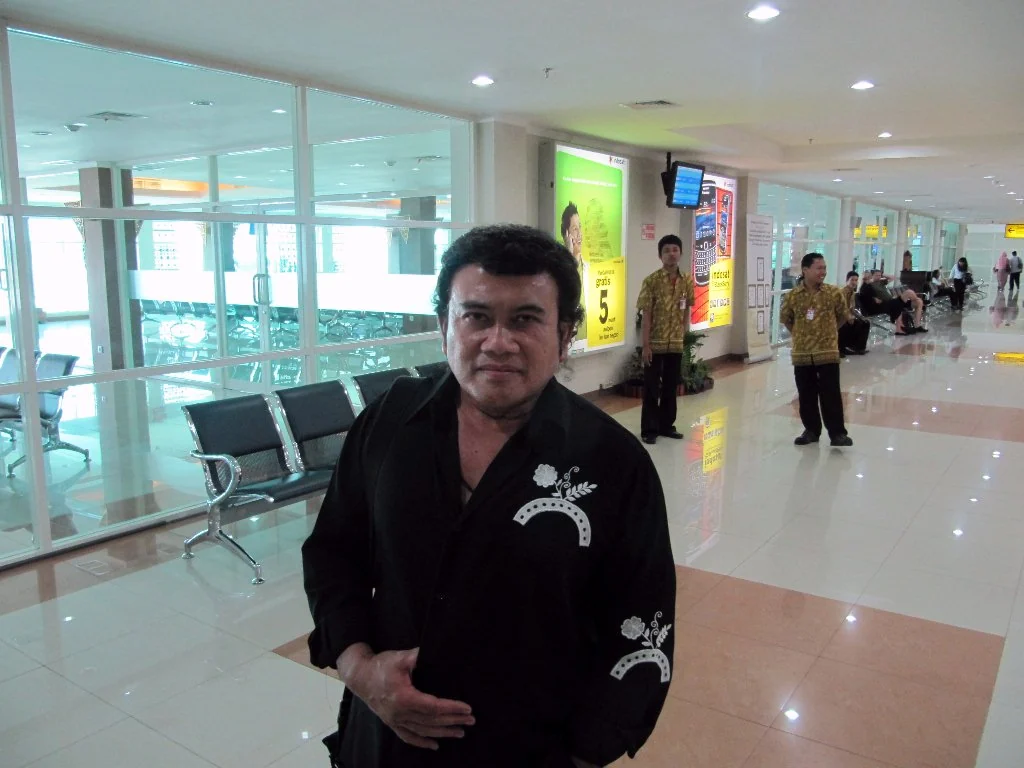
Singer, songwriter, guitarist and actorRhoma Irama is an Indonesian singer, songwriter and actor strongly associated with Soneta and dangdut. His career joins recording, touring, film and an explicitly social and religious understanding of musical responsibility.Read biographyQuick answers
Common questions
- Was the second-heaviest-cargo claim verified?
- No. Rhoma expressly declined to verify it in the selected interview.
- Are the exercise times historical Soneta data?
- No. All setup durations and the 100-minute window are invented for the calculation.
Primary and institutional sources
How this history was checked
Compare these historical records while keeping participant testimony, event totals and release metadata distinct. This article was reviewed on 27 October 2026.