
The short answer
An edit plan can look correct on paper while specifying the wrong operation. Labels identify segments, but they do not preserve what happens inside those segments. This study turns that difference into a small, solvable model without reproducing a historical recording.
Selected records and practical choices
Compare the working decisions
Keep a segment’s internal direction separate from its position and duration.
| Question | Consulted record | Original task |
|---|---|---|
| Direction | Reversed recording | Mark internal direction as well as order. |
| Selection | Chosen fragments | Remove B* before calculating duration. |
Chronology
A timeline of the turning points
Interview recorded
Peter Kember’s conversation.
Interview published
Surface publication.
A transformation sequence in a written account
Derbyshire told Peter Kember that, for a robot project, she recorded actors, reversed the recording, selected rhythmically useful fragments and changed their speed. Her description concerns transformations of sound, rather than a fresh order of unchanged words.
Manchester’s collection description distinguishes finished work from make-up elements, cues and written records. Those categories suggest different questions for a researcher: what was captured, what was selected and how the final sequence was assembled.
What the labels must preserve
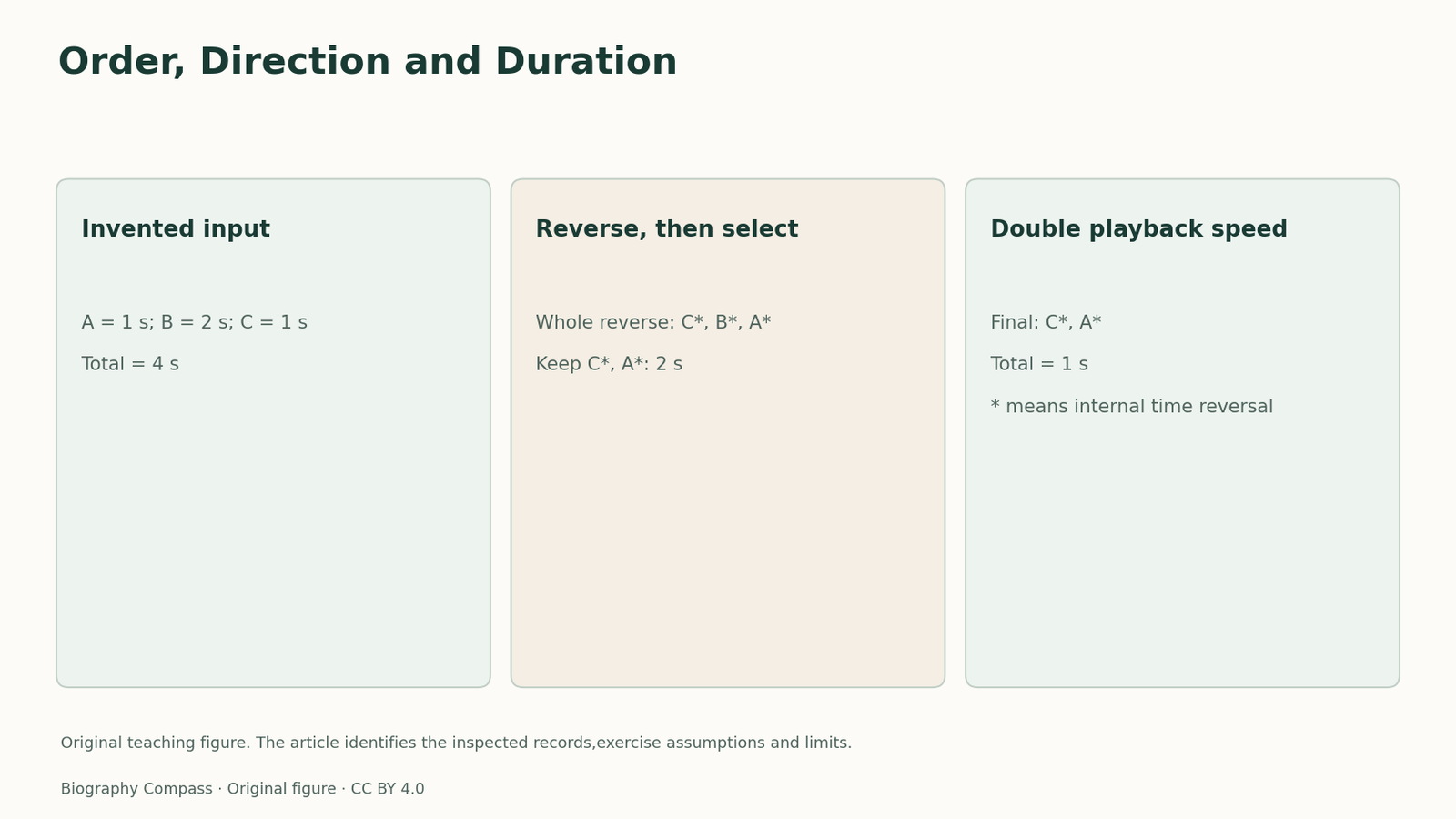
For this original model, an asterisk means that the internal time direction of a segment has been reversed. It does not mean louder, shorter or in a new position. A rearrangement moves intact segments. Whole-recording reversal changes their order and their internal direction. A selection then discards material; a speed change affects the retained duration under an explicit assumption.
A written plan can establish which operation is proposed. It cannot establish the resulting timbre, intelligibility or dramatic effect without a resulting sound and an appropriate listening test. Here we solve the edit logic only.
Sources for this section: [1]
Original four-second clip task
Assume a fictional recording with consecutive segments A = 1 second, B = 2 seconds and C = 1 second. First reverse the whole recording. Then retain only the reversed versions of C and A, in that order. Finally play the retained material at twice the original speed, with no pauses or added material. Write the final segment labels and total duration. Explain why merely arranging C, B, A would fail to specify the first operation.
Sources for this section: [1]
Reference answer and a useful limit
Whole reversal produces C*, B*, A*, still totalling 4 seconds before the speed change. Selecting C* and A* leaves 2 seconds. Playback at twice the original speed reduces that retained sequence to 1 second under the stipulated model. The final labels are C*, A*. The order C, B, A lacks the internal reversal marks and could describe three unchanged clips.
A better production note therefore names both the chosen material and the operation applied to it. The calculation predicts duration, not artistic success. It neither reconstructs Derbyshire’s project nor supplies a claim that we listened to her recording.
Sources for this section: [1]
Continue the chronology
Related history guides
Biography context
Explore United Kingdom through connected lives
Connected biographies
Follow the working life
Quick answers
Common questions
- Did the study listen to the historical piece?
- No. It uses a written interview and an invented duration model.
Primary and institutional sources
How this history was checked
Begin with the interview, then ask which surviving production record could test a proposed edit. This article was reviewed on 31 October 2026.