
The short answer
Repetition does not tell us how a mark was made. A plan, a tool and the resulting surface are related evidence, but they are not interchangeable. Comparing a technical account with a collection description makes that distinction concrete.
Selected records and practical choices
Compare the working decisions
Compare a proposed interval with a measurement before naming a method.
| Question | Consulted record | Original task |
|---|---|---|
| Plan | A prepared composition | State the intended intervals. |
| Surface | Visible traces | Describe a result without inventing its cause. |
Chronology
A timeline of the turning points
Material example
The Wall #2.
A later direction
Return to painting and bands.
Planning and a physical surface
Christopher Régimbal’s technical account describes Martin planning compositions on paper and drawing with a short T-square and a string. Small joins could remain where she lifted the pencil. NMWA’s record of The Wall #2 identifies painted canvas mounted on board with nails: a grid can include physical relief as well as drawn lines.
The Whitney adds another complication: subtle differences in works such as The Islands are difficult to convey in reproduction. A small digital image is therefore a limited record of surface and colour, even when its caption identifies the materials correctly.
Do not confuse a measurement with a cause
Equal intervals can result from several methods. Unequal intervals can also have several causes, including a deliberate plan or a measurement error. A critic should separate the measured pattern from a claim about tools, intention or emotion. The latter claims need further evidence.
A comparison becomes more informative when it names its scale and conditions. Looking closely at a surface may answer a different question from measuring a photograph. Neither observation should silently become the other.
Original spacing-log task
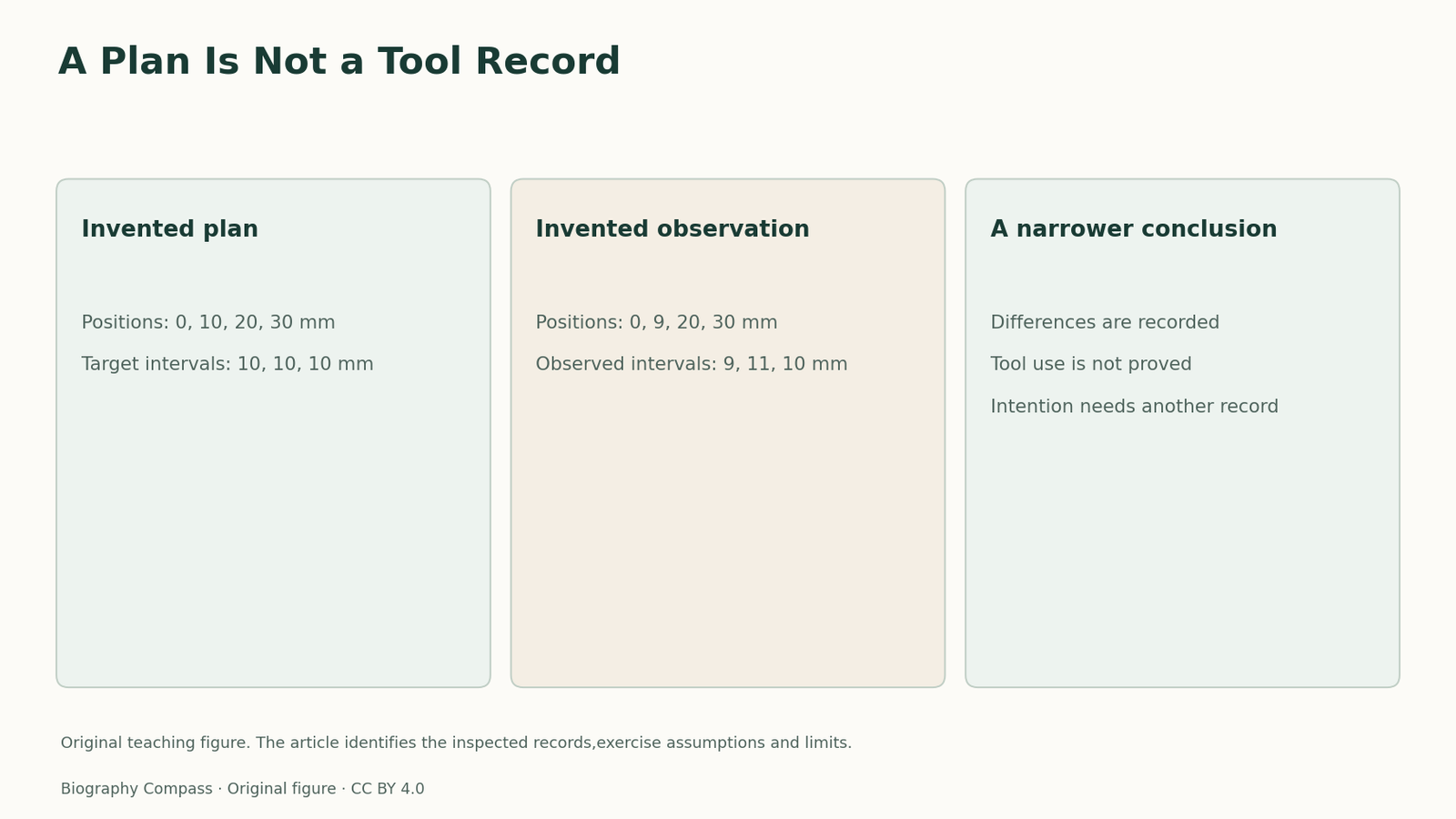
Our invented paper strip has planned marks at 0, 10, 20 and 30 millimetres. A measurement log records marks at 0, 9, 20 and 30 millimetres. Calculate the three observed intervals. A second note says only “a ruler was available.” Decide whether the log proves that a ruler was used, that the differences were intended, or that the maker’s hand moved at particular points. Name one additional record that would help.
Sources for this section: [1]
Reference answer
The intervals are 9, 11 and 10 millimetres. The log establishes departures from the specified plan under its own measurement conditions. It does not prove use of the available ruler, deliberate irregularity or the locations of hand movements. A process note, a documented tool sequence or direct examination of the strip could help, depending on the question.
Even perfect agreement with the plan would not by itself identify the method. The lesson is to make a narrower, testable statement before offering an explanation. Our strip is a new schematic problem, not a copy of a painting or an assessment of Martin’s precision.
Sources for this section: [1]
Continue the chronology
Related history guides
Biography context
Explore United States through connected lives
Connected biographies
Follow the working life
Quick answers
Common questions
- Does equal spacing prove a machine made it?
- No. A measurement alone does not identify a method.
Primary and institutional sources
How this history was checked
Use the technical account and material labels together; the measurement log is entirely invented. This article was reviewed on 31 October 2026.