
The short answer
The debate about ending protection also concerned the date on which the new trading arrangements would operate.
Evidence comparison
Read the records together
The records were created for different purposes and support different kinds of claims.
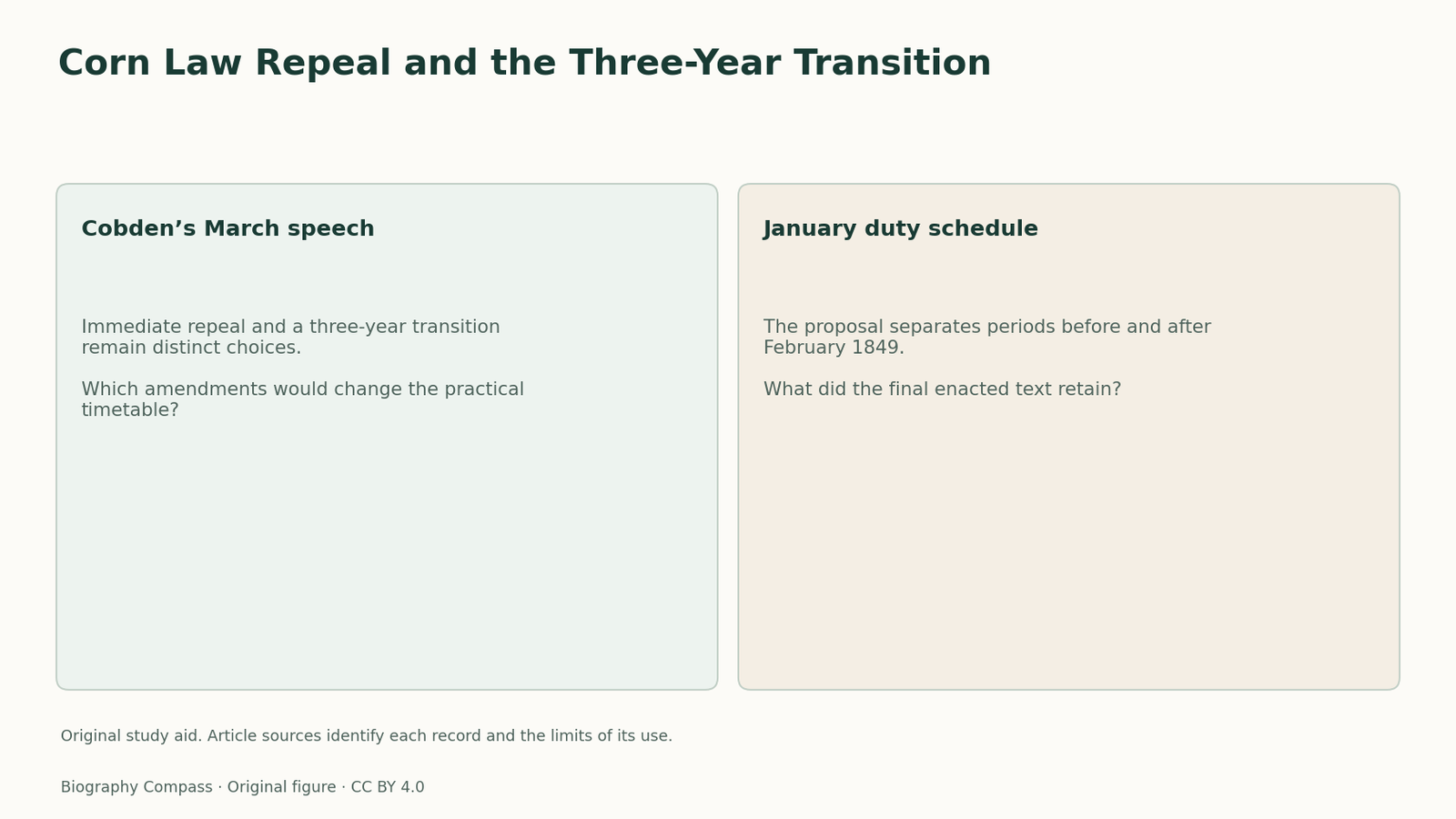
| Record | What it establishes | Question to keep open |
|---|---|---|
| Cobden’s March speech | Immediate repeal and a three-year transition remain distinct choices. | Which amendments would change the practical timetable? |
| January duty schedule | The proposal separates periods before and after February 1849. | What did the final enacted text retain? |
Chronology
A timeline of the turning points
Repeal debated
Cobden discusses immediate change and transition.
Later schedule
The proposals identify a February threshold.
Separate principle from commencement
Cobden’s March 1846 intervention identifies a narrow disagreement about timing. A measure could accept the principle of repeal while retaining a transition. Someone describing the debate only as protection against free trade would miss that remaining choice. Read for the operative date and the proposed interval before assuming that agreement on an eventual destination meant agreement on the terms under which businesses and consumers would reach it.
Sources for this section: [2]
Read the schedule as a time series
The January resolutions print duties applying before 1 February 1849 and then distinguish what would apply afterwards. This arrangement should be represented as two periods. A headline date of 1846 belongs to the political and legislative decision, while 1849 belongs to the transition described in the proposals. Keeping both dates avoids the mistaken impression that all duties necessarily disappeared on the day Parliament began considering repeal.
Sources for this section: [3]
Remember the status of the text
The printed parliamentary resolution is a proposal within legislative proceedings. It offers direct evidence of rates and dates placed before the House. It is not a substitute for identifying the final enacted measure if the research question concerns enforceable law. Cobden’s campaigning biography adds context for why the issue mattered, but his political success cannot itself determine every detail in a later customs assessment or the price paid in a market.
Make two clocks
Draw one clock for political decisions and another for the operation of the schedule. Place the March argument on the first and the February 1849 threshold on the second. A correct answer can say that supporters agreed on ending protection while disagreeing about delay. To test effects on bread prices, add a third line for observed market evidence. The proposals alone cannot supply those observations, even when their intended economic direction is clear.
Continue the chronology
Related history guides
Biography context
Explore United Kingdom through connected lives
Connected biographies
People behind the records
1804–1865
Richard Cobden
Businessman and free-trade parliamentarianCobden turned commercial experience and organised campaigning into a sustained challenge to protective grain duties.Read biographyQuick answers
Common questions
- Why do both 1846 and 1849 appear in repeal accounts?
- They can refer to the decision to change the system and the transition to the later duty arrangements.
Primary and institutional sources
How this history was checked
Sources support the chronology and the record comparison. The reading exercise is original. This article was reviewed on 7 November 2026.