
The short answer
The dispute involved three questions: who had been elected, what parliamentary admission required and what options the law supplied.
Evidence comparison
Read the records together
The records were created for different purposes and support different kinds of claims.
| Record | What it establishes | Question to keep open |
|---|---|---|
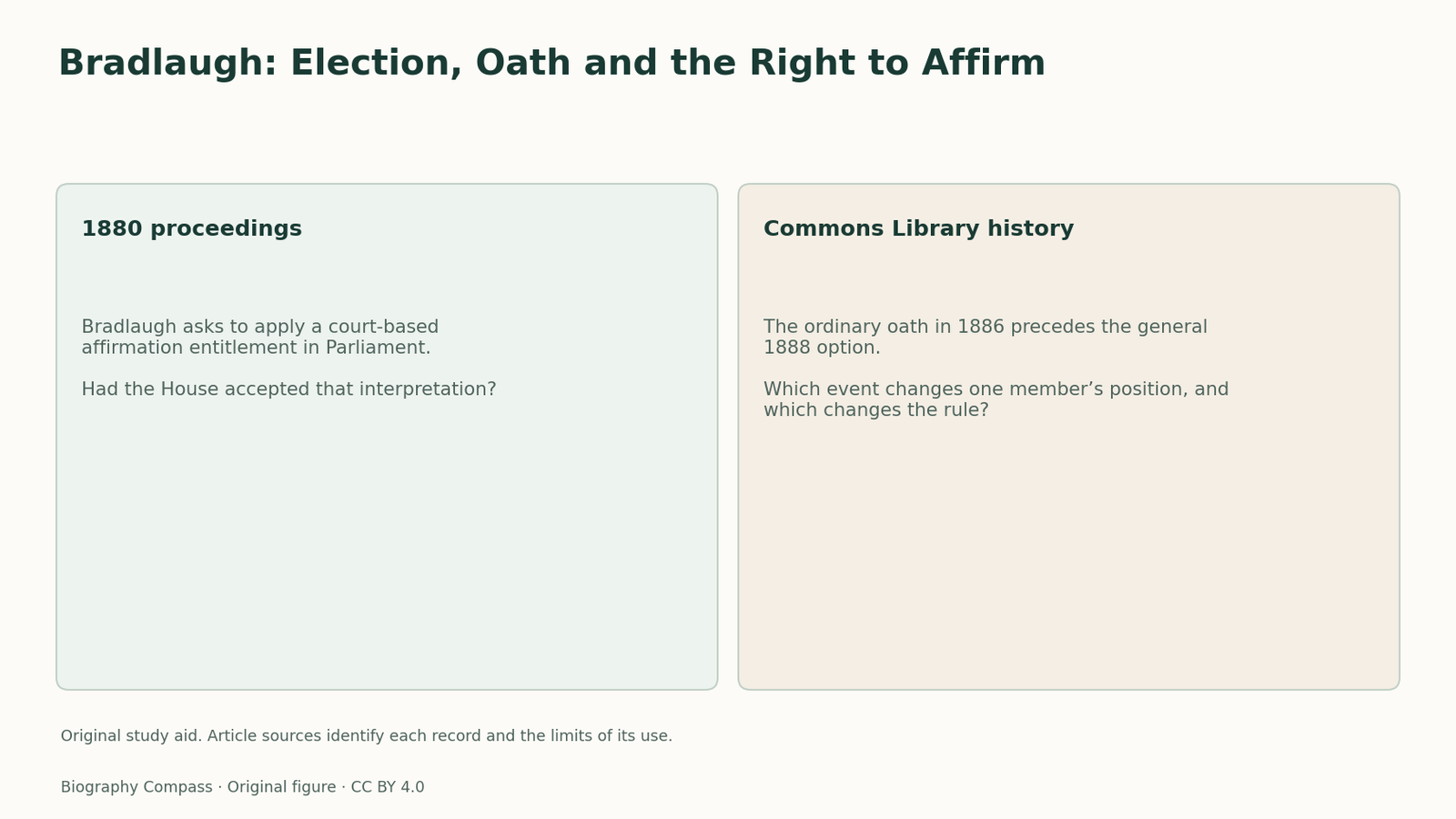
| 1880 proceedings | Bradlaugh asks to apply a court-based affirmation entitlement in Parliament. | Had the House accepted that interpretation? |
| Commons Library history | The ordinary oath in 1886 precedes the general 1888 option. | Which event changes one member’s position, and which changes the rule? |
Chronology
A timeline of the turning points
Affirmation claimed
Bradlaugh submits his claim at the table.
Ordinary oath taken
His individual admission is secured.
Law changes
A general statutory affirmation option follows.
Read the legal bridge he proposed
Bradlaugh’s written claim relied on evidence legislation allowing affirmation in courts. He asked Parliament to recognise an equivalent entitlement when a member appeared at its table. That proposed bridge is the essential legal question. A rule operating in one institutional setting does not automatically govern another. The recorded request establishes the argument he advanced and the basis he named, rather than proving that the Commons had already accepted his interpretation.
Sources for this section: [2]
Keep the individual solution distinct
The Commons Library describes repeated exclusion and re-election before Speaker Peel allowed Bradlaugh to take the ordinary oath in 1886. This mattered enormously to his ability to serve, but it was not the same event as creating a general right to affirm. A short history that labels 1886 an affirmation victory would misidentify the form he actually used. Admission resolved his immediate position through an existing ceremony.
Sources for this section: [3]
Follow the wider statutory option
The 1888 legislation supplied a broader option for people without religious belief and for those whose beliefs made an oath objectionable. Its reach was therefore different from the Speaker’s handling of one member. The parliamentary database’s repeated constituency entries help locate the elections, while the Library’s legal history explains the admissions dispute. These records answer complementary questions and should be used together rather than treated as interchangeable proof.
Use a three-column chronology
Build columns for election, admission and general law. Put the 1880 claim beside election, the 1886 ordinary oath beside admission and the 1888 measure beside general law. A correct answer can explain a gap between electoral success and practical participation. It can also recognise that one person’s admission preceded the lasting legislative option. The columns make a complex procedural dispute readable without collapsing all its outcomes into a single date.
Continue the chronology
Related history guides
Biography context
Explore United Kingdom through connected lives
Connected biographies
People behind the records
1833–1891
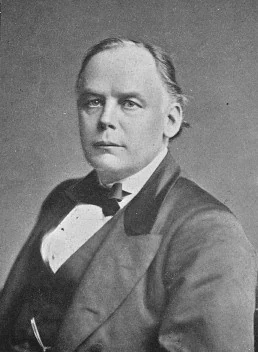
Charles Bradlaugh
Secularist and parliamentarianBradlaugh’s repeated elections exposed a conflict between constituency choice and the religious form required for admission to Parliament.Read biographyQuick answers
Common questions
- Did Bradlaugh affirm when he finally entered in 1886?
- The Commons Library records that he took the ordinary oath. The general right to affirm followed in 1888.
Primary and institutional sources
How this history was checked
Sources support the chronology and the record comparison. The reading exercise is original. This article was reviewed on 7 November 2026.