
The short answer
How did Federation become a continuing administration?
A worked comparison
What each part contributes
Use the specific distinctions developed in the study.
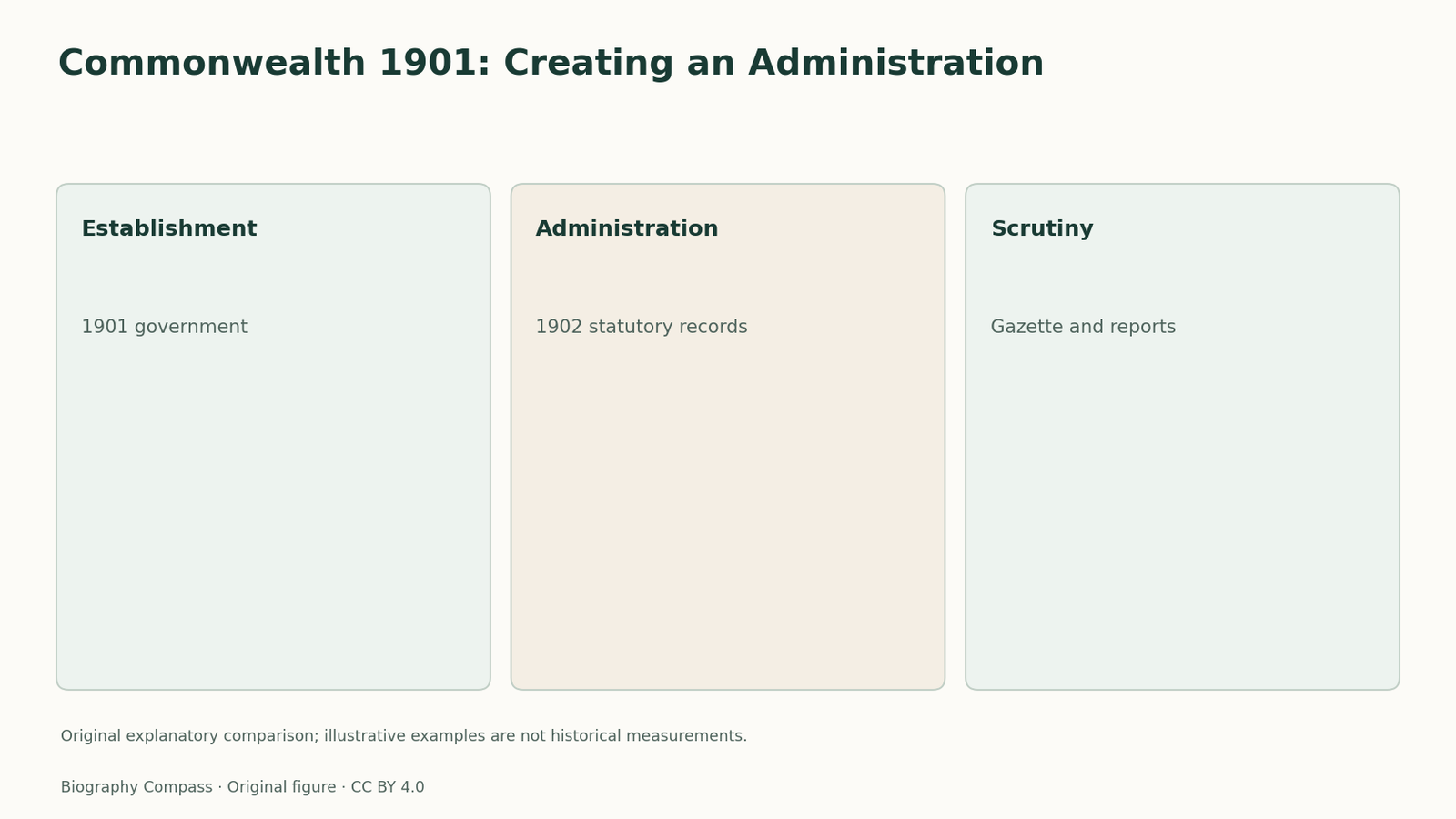
| Part or record | What it establishes | Why the distinction matters |
|---|---|---|
| Initial appointment | A department’s first officer | Not the complete later service |
| Personnel record | Position, class, salary and service | More than a name list |
| Inspection report | How work was performed | Different from establishment |
How did Federation become a continuing administration?
The Commonwealth began on 1 January 1901, but the existence of a new constitutional government did not supply every procedure needed to employ and manage its staff. Garran’s initial appointment as departmental secretary and parliamentary draftsman belonged to this period of institution building. The Public Service Act assented to in May 1902 addressed a more specific task: regulating an ongoing service. Reading its actual provisions reveals how broad public authority was translated into records, classification, inspection and reports. This is a study of those administrative mechanisms rather than a general history of Federation.
Section 9 made a personnel record part of the system
The original Act required the Commissioner to keep records identifying officers’ positions, service and salary, together with their division or grade. It also addressed officers transferred from state service. These details mattered because a national service inherited people and arrangements from earlier administrations. A list of names alone would not establish the relevant classification or employment history. The record was therefore an administrative tool linking a particular officer with a defined place in the new system, not merely a ceremonial roll of the Commonwealth’s employees.
Sources for this section: [3]
Publication connected internal administration with public scrutiny
Section 9 also provided for a yearly list in the Gazette and for a copy to be laid before Parliament. The distinction between keeping an internal record and publishing a specified list is important. The first supports continuing management; the second makes prescribed information available in an official form. The Act gave the published list an evidentiary role, but that does not make every later interpretation of a list automatically correct. A researcher still has to identify the date, fields and statutory purpose of the document being used.
Sources for this section: [3]
Inspection and reporting addressed performance
The Act’s inspection provisions required examination of departments and written reports to the Commissioner. Its reporting structure also connected the condition and efficiency of the service with ministerial and parliamentary consideration. These mechanisms performed a different function from appointing one department’s head. They created a continuing means to examine work, propose changes and explain administration. The legal text consequently reveals a government concerned with how a service would be observed and adjusted after establishment. Garran’s drafting career belongs within that wider institutional task, without making him the office-holder responsible for every function the statute assigned.
Sources for this section: [3]
Record-design exercise and checked answer
A fictional national department inherits ten employees from a state office. Is a list containing only their names enough to answer questions about salary, classification and previous service? No. The checked answer requires the relevant fields and a dated record, then a distinction between internal management and what the law requires to be published. If a researcher asks whether the department worked efficiently, the staff list is still insufficient; inspection and performance reports address that different question. This exercise uses the Act’s actual separation of functions to show why institution building depended on several connected documentary systems.
Sources for this section: [3]
Continue the chronology
Related history guides
Biography context
Explore Australia through connected lives
Connected biographies
People and wider context
1867–1957
Robert Garran
lawyer, parliamentary draftsman and public servantRobert Garran was a lawyer, parliamentary draftsman and public servant, known for the legal and administrative foundations of the Australian Commonwealth.Read biographyQuick answers
Common questions
- Was the Public Service Act part of the events of 1 January 1901?
- The Act was assented to in May 1902. It regulated the continuing service after the Commonwealth’s establishment.
Primary and institutional sources
How this history was checked
The source notes distinguish original records, institutional descriptions and later historical interpretation. Exercises and comparisons are original editorial analysis. This article was reviewed on 8 November 2026.