
The short answer
What work did Elisha Root’s machinery do inside a firearms factory?
Evidence comparison
Read the records together
The records were created for different purposes and support different kinds of claims.
| Record | What it establishes | Question to keep open |
|---|---|---|
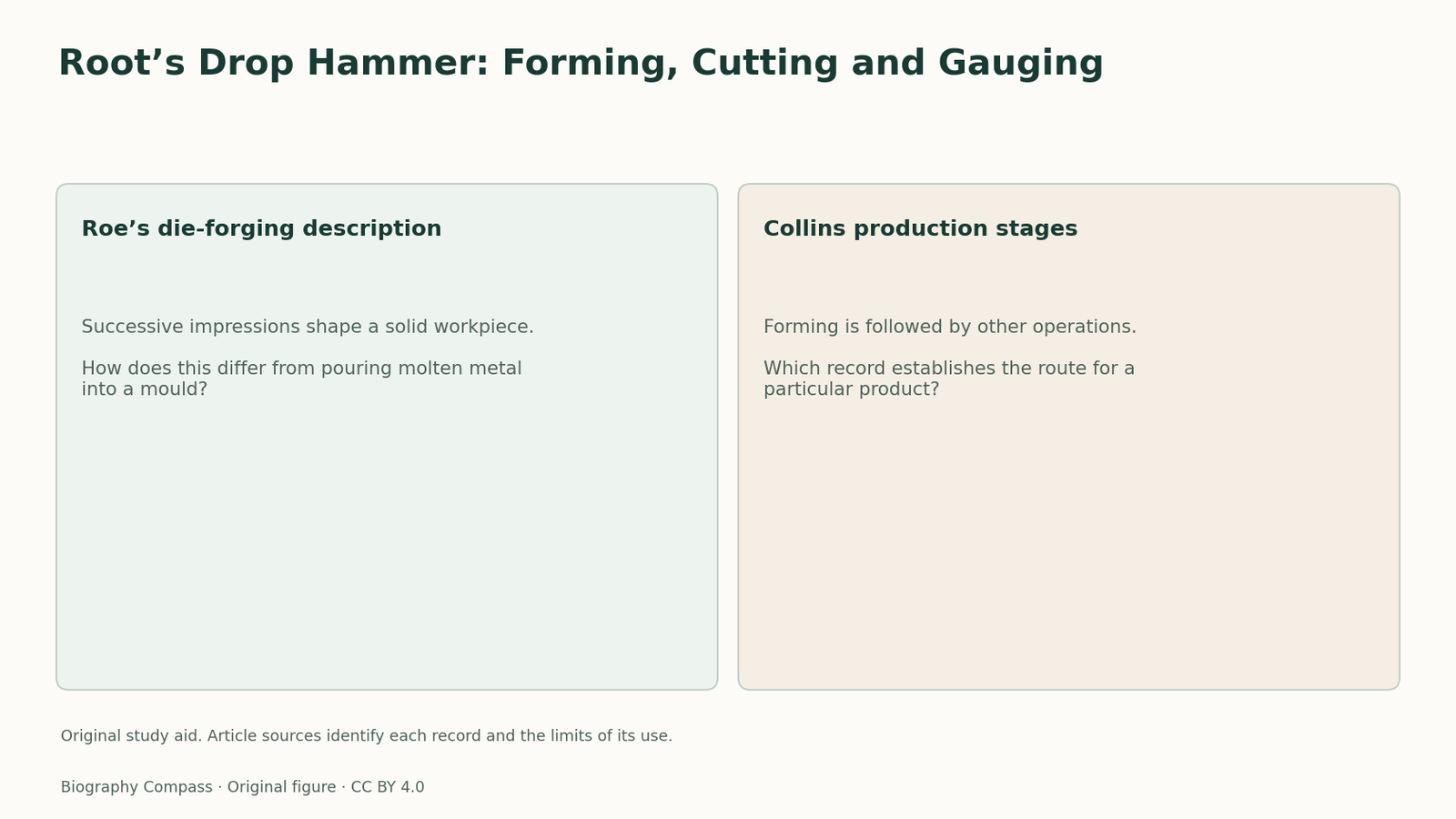
| Roe’s die-forging description | Successive impressions shape a solid workpiece. | How does this differ from pouring molten metal into a mould? |
| Collins production stages | Forming is followed by other operations. | Which record establishes the route for a particular product? |
Chronology
A timeline of the turning points
Collins employment
Root enters axe manufacturing.
Superintendent
He assumes factory responsibility.
Colt
He moves to Hartford manufacturing.
President
He succeeds Colt as company president.
Identify what a hammer changes
Roe describes a hammer arrangement with successive die impressions used in shaping metal. The process concerns force applied to a solid workpiece through shaped tools. It belongs to forming and should not be confused with casting, in which liquid metal is placed in a mould. The difference is essential even when both processes eventually produce an object with a recognisable outline.
Sources for this section: [3]
Place forming within a longer sequence
The Collins history distinguishes forging, grinding, tempering and polishing in axe production. These stages show why producing a rough shape is not equivalent to completing a finished article. Roe’s account of Root’s later machinery likewise includes operations beyond the hammer. A manufacturing history becomes more informative when it identifies which operation changes shape, which removes material and which prepares the object for its intended performance.
Separate machine operation from inspection
Cutting and boring machinery can produce features, while gauges help assess conformity to dimensions. These functions were connected within Root’s factory responsibilities, but a gauge does not itself drill a hole or hammer a blank into shape. Nor does a list of machines prove that every finished part passed an identical test. The account establishes the scope of his production work; detailed acceptance rates and tolerances require the relevant factory and inspection records.
Build an operation map
Draw four boxes marked forming, material removal, treatment and inspection. Place a drop hammer, boring machine, tempering stage and gauge in their appropriate boxes, explaining that the combined example is a teaching model rather than a recovered Colt routing sheet. A strong answer names the operation performed by each item and identifies where further finishing may be necessary. It also corrects a caption that labels a drop-hammer scene as liquid-metal casting, preserving a useful technical distinction without making an unsupported invention-priority claim.
Continue the chronology
Related history guides
Biography context
Explore United States through connected lives
Connected biographies
People behind the records
1808–1865
Elisha Root
Machinist, factory superintendent and company presidentElisha Root developed production machinery for axes and firearms, moving from machinist to superintendent and later president of the Colt company.Read biographyQuick answers
Common questions
- Was Root’s drop-hammer work the same process as die casting?
- No. A drop hammer forms a solid workpiece through force; casting involves liquid metal in a mould. Claims about one should not be used as evidence for the other.
Primary and institutional sources
How this history was checked
Sources support the chronology and the record comparison. The reading exercise is original. This article was reviewed on 7 November 2026.