
The short answer
How did Blanchard’s copying lathe turn a model into a gunstock?
Evidence comparison
Read the records together
The records were created for different purposes and support different kinds of claims.
| Record | What it establishes | Question to keep open |
|---|---|---|
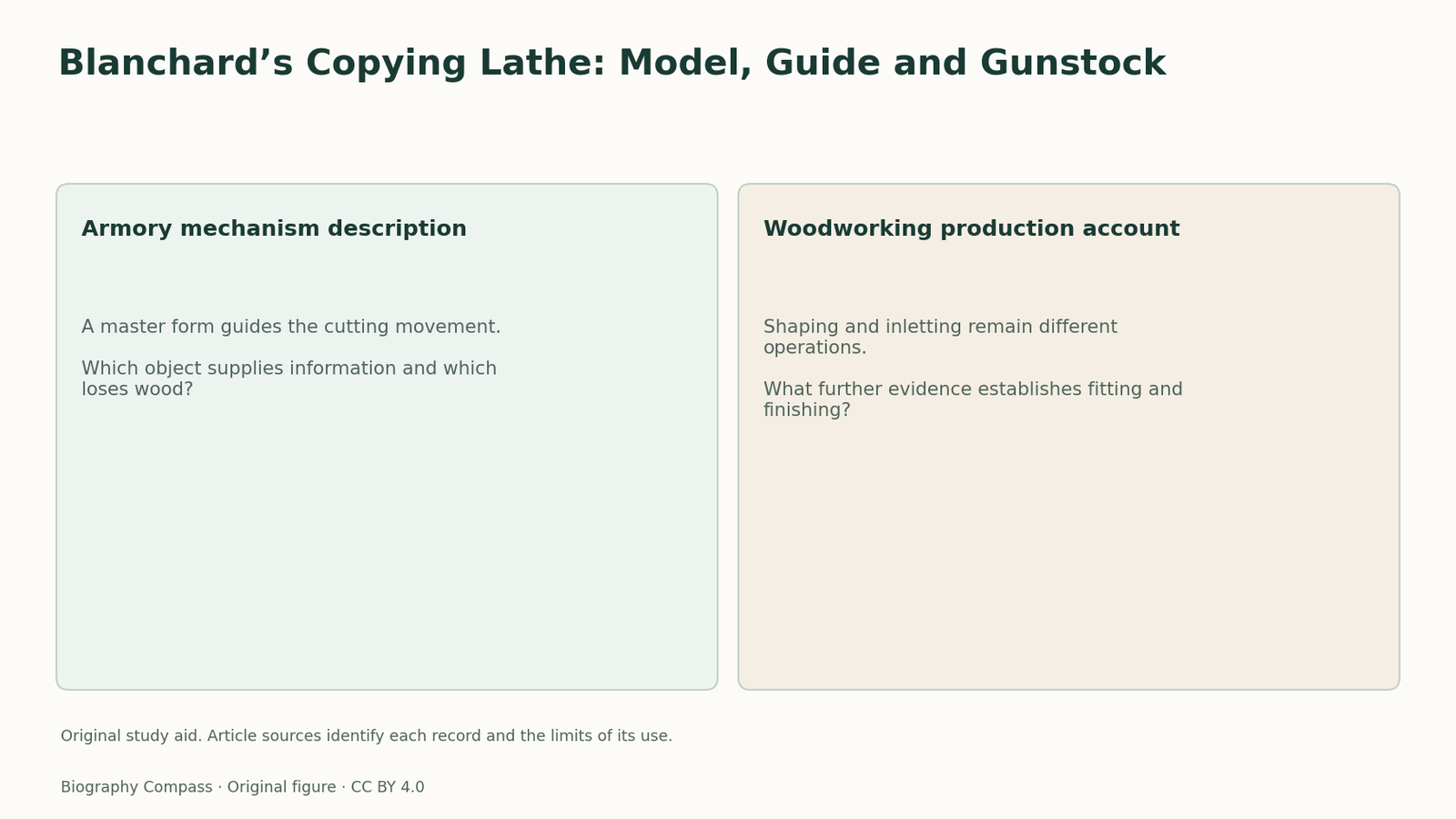
| Armory mechanism description | A master form guides the cutting movement. | Which object supplies information and which loses wood? |
| Woodworking production account | Shaping and inletting remain different operations. | What further evidence establishes fitting and finishing? |
Chronology
A timeline of the turning points
Barrel machine
Springfield uses Blanchard’s metal-shaping machinery.
Copying patent
He patents irregular-form turning.
Preserved machine
The armory dates its surviving example.
Begin with the master form
The armory account describes an iron master shaped like a gunstock. As it rotates, a guide wheel follows its surface. The master supplies the shape to be copied; it is not the wooden workpiece being cut. Distinguishing these two objects is the first step in understanding the machine. Otherwise a reader may imagine a tool merely spinning a stock around a fixed cutting edge as in ordinary circular turning.
Sources for this section: [1]
Follow the linked movement
The guide directs a rotating cutting wheel as a wooden blank turns in the corresponding position. The source therefore calls the machine a shaper as well as explaining its familiar lathe name. The important relation is between the motion following the model and the motion removing wood. A simplified diagram can show that connection without claiming to reproduce every gearing detail or the dimensions of the surviving machine.
Sources for this section: [1]
Separate shaping from fitting
The woodworking history places stock-shaping machinery beside other equipment for cutting recesses and completing production tasks. Creating an exterior outline is different from making spaces in which metal components will sit. The adoption of a dozen specialised machines reveals a sequence of operations. It does not support the claim that copying an external shape automatically established the interchangeability of every finished stock, lock and barrel.
Label a production exercise
Give readers a diagram with a master, follower, cutter and wooden blank. Ask them to draw the information route from the first object to the last, then add a separate box for inletting. A good answer explains which surface the guide touches and which object loses material. Finally, place the 1819 patent and preserved 1822 machine on separate points in a chronology. This avoids making a museum object’s date the invention date of every principle visible within it.
Continue the chronology
Related history guides
Biography context
Explore United States through connected lives
Connected biographies
People behind the records
1788–1864
Thomas Blanchard
Inventor of copying and production machineryThomas Blanchard moved from tack-making and barrel machinery to copying irregular wooden forms, helping mechanise the shaping of musket stocks.Read biographyQuick answers
Common questions
- Did one copying operation finish every part of a gunstock?
- The armory history describes separate shaping and inletting machinery. Copying the exterior was an important step within a production sequence.
Primary and institutional sources
How this history was checked
Sources support the chronology and the record comparison. The reading exercise is original. This article was reviewed on 7 November 2026.