
The short answer
A visible trace is evidence that must be interpreted. This study separates a historical comparison from an invented classifier whose assumptions can be inspected completely.
Evidence and a classification rule
Observation, model and conclusion
Only the exercise values below are numerical.
| Stage | Available | Not established |
|---|---|---|
| Observed vector | (2.2,4.8) | A physical detector calibration |
| Nearest reference | A under equal weighting | Universal correctness of the metric |
| Particle claim | No mass is calculated | An experimental identification |
Chronology
A timeline of the turning points
Photographic method
Bose and Chowdhuri publication.
Historical reconstruction
Roy and Singh study.
The inspected original record
Bose and Chowdhuri's abstract describes comparing mean grain spacing and track curvature with proton tracks of known energies on similar plates. That comparison supplies a reference rather than a particle name printed inside the image. The subscription article's full derivation was not inspected here.
Grain spacing concerns the separation of developed grains; curvature concerns track bending. These are different recorded features.
Sources for this section: [1]
An original two-feature exercise
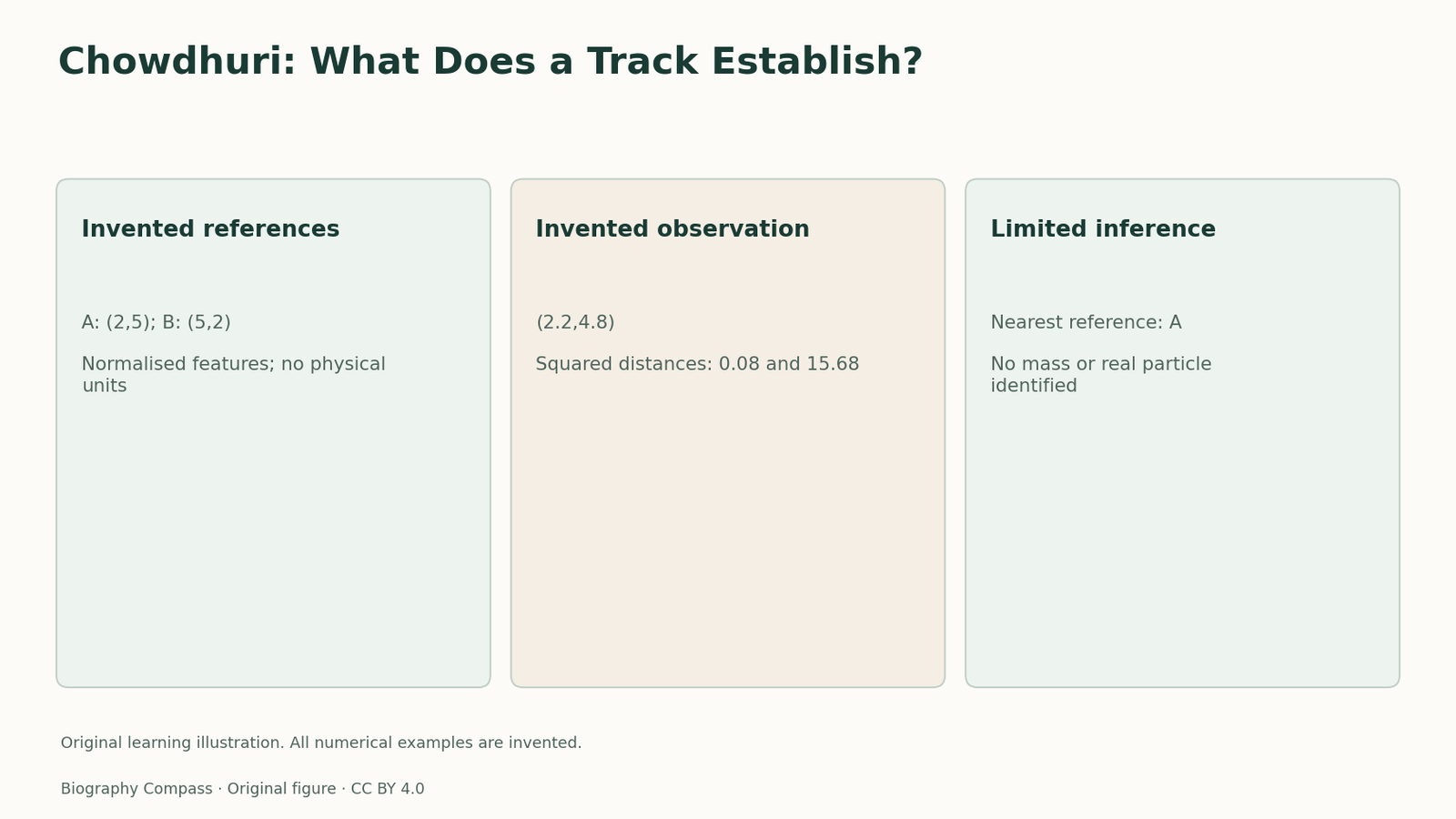
Invent two already-normalised features g and c; neither has a physical unit in this exercise. Reference A is (2,5), reference B is (5,2), and a new observation is (2.2,4.8). Define squared distance as (g minus reference g) squared plus (c minus reference c) squared. Use nearest distance to choose a reference, then ask what the choice does not establish.
Sources for this section: [1]
Reference answer
Distance to A is 0.2 squared plus (-0.2) squared = 0.08. Distance to B is (-2.8) squared plus 2.8 squared = 15.68. The invented rule selects A. It does not produce a mass, prove that A describes a real particle species or establish that the features deserve equal weighting. A different normalisation can change a distance-based classification.
Sources for this section: [1]
What makes this historical reading useful
The exercise exposes where evidence and an inference rule meet. In a physical experiment, reference measurements, detector response and a defensible relation between observables and the proposed identity would all matter. Our numerical features are deliberately not claimed to be historical grain spacings, energies, masses or plate measurements.
A nearest-reference calculation answers a question defined by its metric. It supplies neither a probability that the label is correct nor an error rate. Those would require additional observations or a justified statistical model, not merely the two distances computed here.
Sources for this section: [1]
Continue the chronology
Related history guides
Biography context
Explore India through connected lives
Connected biographies
A career behind the record
Quick answers
Common questions
- Which features does the 1941 abstract compare?
- Grain spacing and track curvature.
Primary and institutional sources
How this history was checked
Original records and selected institutional histories support the historical discussion. Invented examples are labelled and are not reconstructed experiments. This article was reviewed on 31 October 2026.
- D. M. Bose and Biva Choudhuri, Nature 148,259-260,30 August 1941A Photographic Method of Estimating the Mass of the Mesotron
- S. C. Roy and Rajinder Singh, Indian Journal of History of Science 53.3, 2018Historical Note: Bibha Chowdhuri - Her Cosmic Ray Studies in Manchester
- Atreyee Sinha and Ritam Sinha / Cherenkov Telescope Array ObservatoryBibha Chowdhuri: A Ray of Light