
The short answer
A poem can contain more than one speaking position without becoming a transcript of several historical people. Read the movement of address before deciding whose experience a voice represents.
Compare voice and interpretation
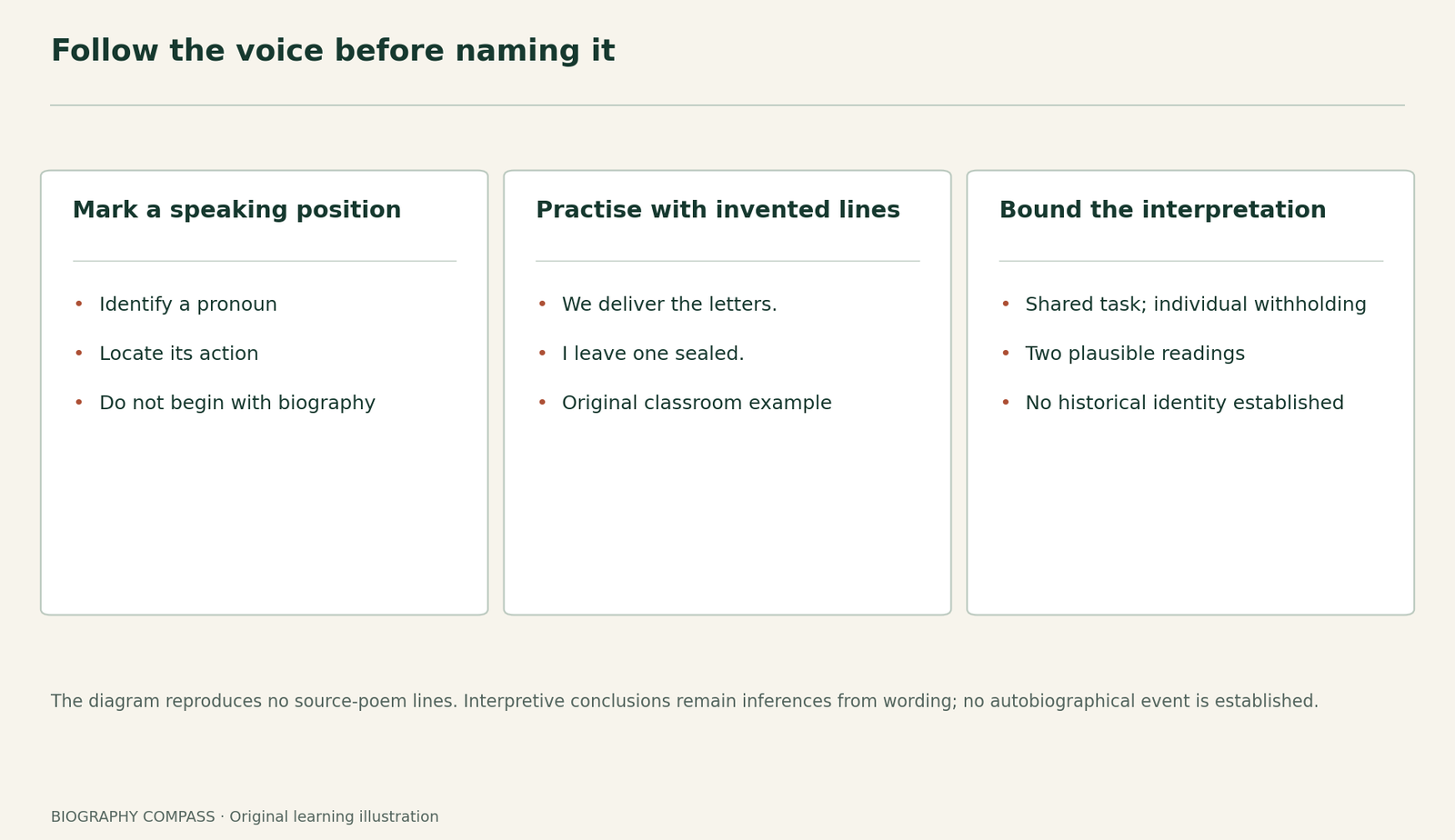
Voice is evidence; identity is a further claim
Keep the claim no broader than the field or passage that supports it.
| Evidence | Supported reading | Remaining question |
|---|---|---|
| Pronoun | Locates a speaking position | Does not name a historical person |
| Image and action | Support a possible interpretation | Do not prove an autobiographical event |
| Translation credit | Identifies the language version | Does not make it the Thai original |
Chronology
A timeline of the turning points
Credit the version being read
The Center for the Art of Translation credits Noh Anothai’s English translation from Thai of Chiranan Pitpreecha’s Night Ponderings. Its page dates the poem 1971 and the web publication 27 April 2020.
These labels answer different questions: the poet’s name identifies authorship, the translation credit identifies this language version, and the dates identify different stages of circulation. Our reading concerns the English wording, not an independently inspected Thai original.
Sources for this section: [1]
Track address before assigning biography
The stars offer collective reassurance: “Let us soothe”. By the close, an “I” expresses fear of becoming a star whose glory fades.
This is an interpretive movement from an offered consolation toward a vulnerable reply. The change matters because the promise is not simply accepted and closed. The ending reopens the relation between comfort, visibility and endurance. It does not, without further evidence, identify a particular incident in the poet’s life.
Sources for this section: [1]
Test the method with an invented text
Use this newly written classroom example: “We deliver the letters. I leave one sealed.” It is not a translation or a line from Chiranan. First mark the pronouns; next identify the action attached to each; finally write two plausible interpretations and one claim that the two sentences cannot establish.
Reference answer: we accompanies a shared task, while I singles out a withholding action. The speaker may be part of the group, or the second voice may interrupt it; the text does not settle that relationship. The sealed letter could suggest privacy or hesitation. Nothing in these words establishes who wrote a real letter, a historical date, or an author’s political allegiance.
Sources for this section: [1]
Compare a speaker without turning it into testimony
In Speck of Dust, also translated by Anothai, a rock speaks through weathering and imagines becoming dust.
Try the same sequence: identify the grammatical speaker, follow the material changes, then state an interpretation as an inference. A nonhuman voice makes the separation between speaker and author especially clear. Comparison can strengthen a method without requiring the two poems to have one fixed meaning or a shared autobiographical incident.
Sources for this section: [2]
Continue the chronology
Related history guides
Was This Thai Fiction Written in English?
Practise a different documentary question: edition responsibility and missing information.
Read the timelineDecision, imprint and anniversaryDid UNESCO Award a Novel a Prize?
Practise a different documentary question: institutional acts and different date fields.
Read the timelineBiography context
Explore Thailand through connected lives
Connected biographies
Writers behind the records
Born 1955
Chiranan Pitpreecha
Poet, writer and visual artistChiranan Pitpreecha’s career extends from student activism and poetry to translation, photography and other forms of public writing.Read biographyQuick answers
Common questions
- Is the speaker automatically the poet?
- No. Treat that identification as a separate claim requiring evidence.
- Why use an invented practice text?
- It isolates a reading operation without adding another quotation from the copyrighted poems.
Primary and institutional sources
How this history was checked
The selected English translations were read. The Thai originals and the complete collection were not inspected; interpretations concern the credited English wording. This article was reviewed on 30 October 2026.