
The short answer
Modern Times asks how people find food, work and companionship in a world organised for productivity. Its selective use of voices makes the question audible as well as visible. Plot and ending details follow.
Chronology
A timeline of the turning points
A world beyond Hollywood
Chaplin’s travels brought him into contact with the effects of depression, nationalism and unemployment.
Dialogue is considered
The estate account records prepared dialogue and trials before the final reliance on pantomime, intertitles and selective voices.
Modern Times is released
Chaplin and Goddard’s characters move through factories, streets and service work before leaving together.
The factory turns a person into a required movement
The factory worker’s task is repetitive: keep tightening bolts as the conveyor moves. The feeding-machine demonstration proposes to eliminate even the interruption of lunch. The estate’s production account places these inventions against depression, unemployment and automation. The joke is specific enough to be physical, but it also raises a question about whose time a workplace is organised to serve.
The worker’s body cannot adjust indefinitely to the system’s pace. His breakdown makes the demand visible through exaggerated movement rather than an explanatory speech. That is why the factory sequence is more than a general statement that machines are bad. The relevant relation is between machinery, management and a person required to keep up. A useful question for a viewer is who can change the pace and who has to absorb its consequences.
Leaving the factory does not end the problem of work
Hospital, prison and unemployment interrupt the worker’s attempts to find a place in the world. The film’s official description follows this movement between institutions rather than confining the story to the assembly line. Being outside the factory can bring freedom from its rhythm while also removing wages and shelter. The predicament is therefore larger than one disastrous job or one unreasonable supervisor.
Paulette Goddard’s Gamine becomes his companion. Her resourcefulness supplies a second active presence, and their search for a home becomes part of the story’s measure of success. They are trying to assemble ordinary security from uncertain opportunities. Read the partnership alongside the earlier worker’s isolation: cooperation changes what endurance looks like, even when it cannot change the labour market or prevent another intervention by the police.
It is not an entirely silent film
Modern Times combines pantomime and intertitles with a recorded musical score, effects and selected voices. The BFI explicitly distinguishes it from a wholly silent production. In the estate’s account, the boss addresses workers through a screen and the feeding-machine salesman is heard through a phonograph. Speech arrives as part of a system that transmits instructions, sells equipment and observes the worker.
The character played by Chaplin does not become an ordinary dialogue-speaking hero. At the café he sings a nonsense song after losing the words he had written on his cuffs. The audience hears a voice without receiving a stable national language. The contrast is useful: technological speech can command, while the improvised performance communicates through sound, gesture and rhythm. Calling the whole film silent removes this deliberate difference; calling it a conventional talkie obscures it too.
The road ending offers companionship, not a guaranteed job
The final road scene sends the pair away together. The estate’s account records an earlier filmed ending in which the Gamine became a nun and the two were separated; the released conclusion takes another direction. This production history matters because the last image is a choice among possible emotional outcomes, not an inevitable result of everything that came before it.
Their departure supplies hope without showing that economic insecurity has been solved. The uncertainty of the road remains, but it is shared. This is an interpretation grounded in the documented ending, rather than a claim that the characters have found permanent employment beyond the frame. The ending can feel affirmative precisely because it preserves their ability to act together. It closes the film’s sequence of jobs and interruptions with a relationship, leaving the future open.
Sources for this section: [14]
Continue the chronology
Related history guides
Biography context
Explore United States through connected lives
Connected biographies
The filmmaker behind Modern Times
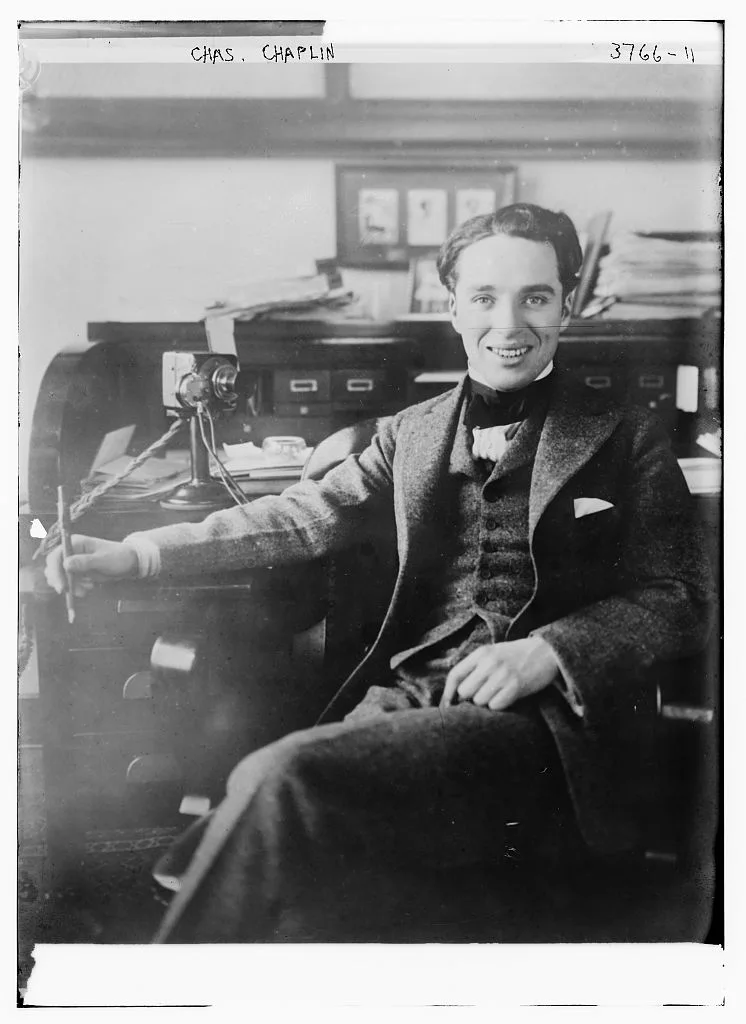
1889–1977
Charlie Chaplin
Actor, comedian, filmmaker and composerCharlie Chaplin was a British actor and filmmaker whose Tramp character made physical comedy, vulnerability and social observation central to international screen culture.Read biographyQuick answers
Common questions
- Is Modern Times silent?
- It is largely built around pantomime and intertitles but is not entirely silent. It includes music, effects, transmitted speech and Chaplin’s nonsense song.
- Who plays the Gamine?
- Paulette Goddard. Her character becomes an active partner in the search for food, work and a home.
- Does the ending show that they have escaped poverty?
- No secure economic future is shown. Their departure together supports a reading of hope through companionship, while leaving what happens next unresolved.
Primary and institutional sources
How this history was checked
Read limits: the estate’s cast, synopsis-level film description and production essay and the BFI’s sound commentary were read. No complete screening, dialogue-script examination, score analysis or restoration comparison is claimed. Readings of work, transmitted authority and the road ending are identified as interpretation. No song words, script or intertitles are reproduced. This article was reviewed on 23 October 2026.
- Chaplin OfficeOverview of His Life: selected career and late-life sections
- National Portrait GalleryCharlie Chaplin in Close Up: 1985 exhibition handlist
- Chaplin Office / British Film InstituteThe British Film Institute: retained British nationality
- Christian Delage / Chaplin OfficeFilming The Great Dictator: historical circumstances and British citizenship
- Chaplin Office2021 Chaplin Studio Tour notice: 1952 re-entry decision and Switzerland
- Chaplin OfficeThe Kid: 1921 film, cast and production listing
- Chaplin OfficeFilming The Kid: Jackie Coogan and the extended production
- Chaplin Studio / Chaplin OfficeThe Kid: original 1921 synopsis
- Chaplin Film ConcertsThe Kid: 1971 music and present concert specifications
- Charlie Chaplin Archive / Cineteca di BolognaThe Kid: 1971 credit and cast documentation
- La Cinémathèque françaiseLe Kid: production and technical credits
- The Criterion ChannelOuttakes From the 1921 Version of The Kid: public description of the 1971 re-edit
- Chaplin OfficeModern Times: 1936 film, cast and story
- Chaplin OfficeFilming Modern Times: work, sound and the revised ending
- British Film InstituteModern Times: sound effects, voices and intertitles
- Wikimedia Commons / Library of CongressChas. (Charlie) Chaplin, LCCN2014701081: exact identity and public-domain record
- Library of Congressggbain.21143: complete 746 × 1024 supplied service photograph