
The short answer
What did a vertically connected cinema business combine, and which individual creative credits cannot be inferred from a chairman’s position?
The records answer different questions
Three activities in one workflow
Compare the particular functions and conditions identified in this study.
| Record or measure | What it establishes | What it does not establish |
|---|---|---|
| Production | Making the film | The identity of every corporate owner |
| Distribution | Arranging circulation | A particular screenplay’s author |
| Exhibition | Presenting the screening | A complete production history |
Chronology
A timeline of the turning points
Partnership
A separate studio collaboration is recorded.
Biographical account
One source’s wording needs comparison.
Programme account
Another source identifies an official transition.
The chain had different activities
The archive describes MP & GI as integrating film production, distribution and exhibition across Hong Kong and Southeast Asian circuits.
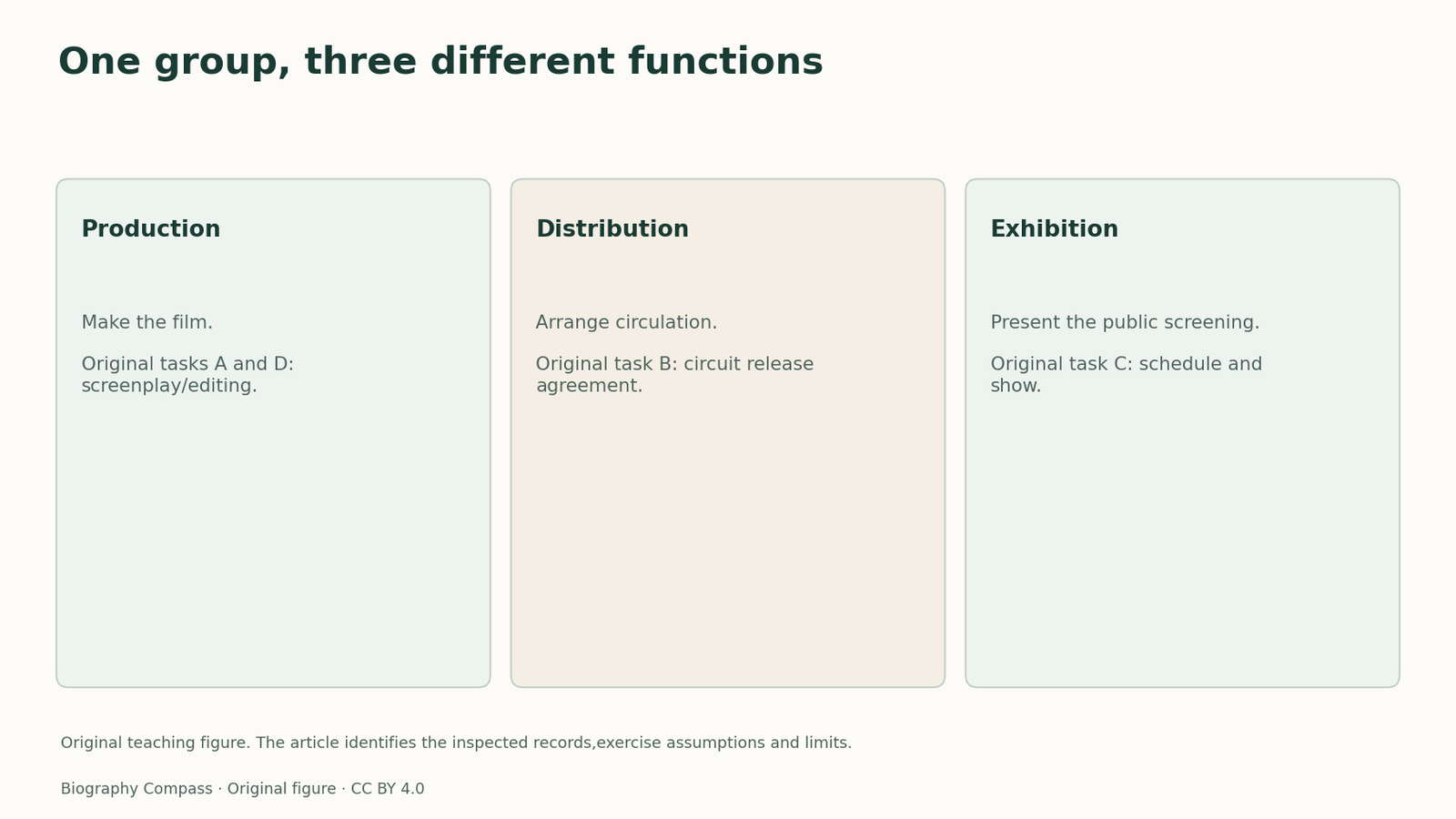
Production makes a film; distribution arranges its circulation; exhibition presents it to an audience.
A single corporate group may coordinate these functions without making them identical. The distinction gives a concrete meaning to vertical integration rather than treating it as a synonym for a large business.
Sources for this section: [1]
Partners and entities remain visible
Cathay-Keris was formed with Ho Ah Loke in 1953.
The filmmaker biography places the Yung Hwa takeover in 1955.
The retrospective programme instead describes an official acquisition and MP & GI establishment in 1956.
The selected wording is insufficient to prove that these dates describe precisely the same legal step. Keep the discrepancy explicit rather than inventing a convenient agreement. It does not erase the documented distinction between a studio, distributing organisation and cinema circuit.
Original workflow classification
A teaching dossier contains four invented work orders: A, commission and edit a screenplay; B, negotiate a release’s circulation through a cinema circuit; C, schedule and present a public screening; D, edit the footage and assemble the finished film. Place them under production, distribution or exhibition. Assume these are the stated functions, not a complete legal description of their contracts.
Reference answer: A and D are production tasks, B concerns distribution and C exhibition. Corporate ownership of all three functions would not identify who wrote A or edited D. To supply those creative credits, consult the particular film’s credited personnel. This model classifies supplied activities; it does not claim to reconstruct every historical contract.
Sources for this section: [1]
Use the staff evidence rather than a sole-creator story
The programme names screenwriters, directors and performers, including Eileen Chang and Grace Chang, and describes specialised work in publicity, distribution and production.
An adequate business history can therefore explain coordination while preserving individual work. An adequate film note can identify a studio without calling its chairman the screenwriter. Those are complementary descriptions of the same enterprise. Only the selected institutional records were read; no complete film, screenplay or studio archive was viewed.
Sources for this section: [1]
Continue the chronology
Related history guides
Biography context
Explore Singapore and Hong Kong through connected lives
Connected biographies
The connected careers
1915–1964
Loke Wan Tho
Cinema entrepreneurA regional enterprise connected venues, circulation and creative work.Read biographyQuick answers
Common questions
- Does controlling a studio identify its screenwriter?
- No. Ownership and a particular creative credit are different claims.
Primary and institutional sources
How this history was checked
Read these dated records together; the original task states its own assumptions and separates them from reported facts. This article was reviewed on 31 October 2026.