
The short answer
Which transactions fall within the selected approval clause, and why is an emergency qualification different from a blanket absence of regulation?
The records answer different questions
Trigger, qualification and historical scope
Compare the particular functions and conditions identified in this study.
| Record or measure | What it establishes | What it does not establish |
|---|---|---|
| Named agreement | The historical institutional relationship | Later ownership automatically projected backwards |
| Selected clause | A defined transaction and qualification | Every possible aviation requirement |
| Original cases | Conditional classification from supplied facts | A current legal opinion |
Chronology
A timeline of the turning points
Instrument
Named parties and commencement are specified.
Later acquisition
Ownership changes after the original agreement.
Start with the instrument’s parties and date
The Act commenced on assent, 18 November 1952, and approved an agreement between the Commonwealth and Australian National Airways. The Commission was the public airline body.
Ansett’s purchase of ANA came in 1957.
The sequence matters: a later corporate acquisition cannot make the earlier text an agreement originally signed by the later owner. This study reads the as-made historical instrument, not current aviation law.
The selected trigger was narrower than every aircraft sale
Schedule clause 8 required approval for purchases or hires from the Commonwealth, a Commonwealth authority or a corporation in which it had an interest. Temporary hiring for emergency requirements was excepted.
The seller’s institutional relationship and the nature of the hire are therefore material facts.
Clause 9 dealt with certificates and the division of available aircraft.
Neither a broad slogan about two airlines nor a later company history can substitute for these particular words.
Sources for this section: [1]
Original case file
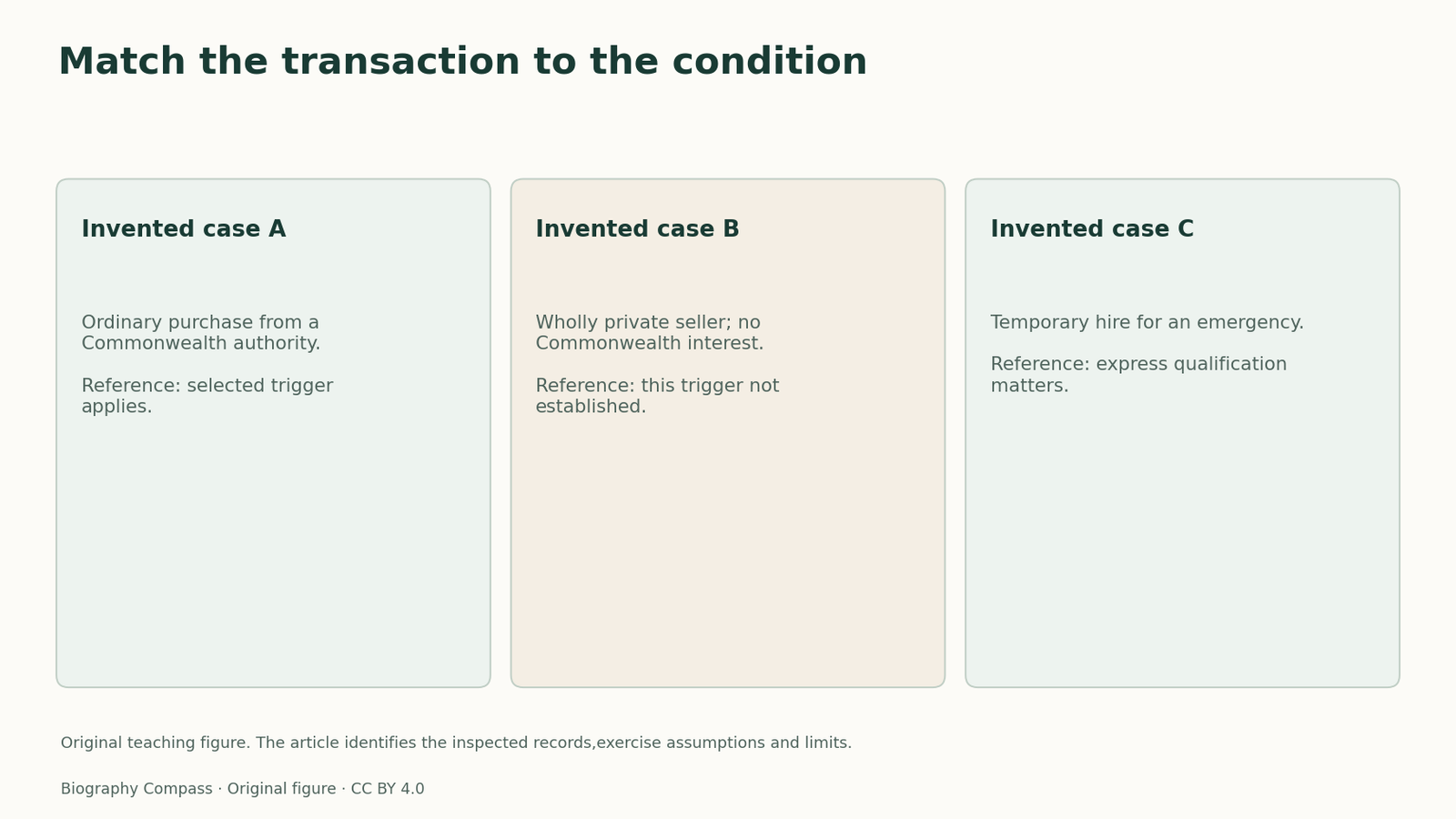
Stipulate that all cases concern one of the two entities covered by the agreement. A proposes an ordinary purchase from a Commonwealth authority, without a certificate. B proposes a purchase from a wholly private seller with no Commonwealth interest. C proposes a temporary hire to meet an emergency. Which selected clause 8 condition or qualification is relevant to each? Do not infer the result under other legislation.
Reference answer: A falls within the stated source-of-aircraft trigger and requires prior approval. For B, the selected clause does not establish that trigger; this is not proof that no other rule applies. C matches the express emergency-hiring qualification. The answer depends on the supplied facts. If ownership, temporariness or the emergency is uncertain, the classification cannot be completed simply by reading the airline’s name.
Sources for this section: [1]
What the certificate rule does not prove
Clause 9 assigned an odd available aircraft through the Chairman’s decision with regard to comparative strength; it did not name a permanent preferred recipient.
That is why this exercise avoids inventing a universal odd-aircraft formula or using present company labels. An institutional process can specify relevant considerations without yielding every outcome from one arithmetic rule. The useful historical skill is to match the actor, transaction and qualification to the actual provision, before asking what additional evidence would resolve a particular dispute.
Sources for this section: [1]
Continue the chronology
Related history guides
Biography context
Explore Australia through connected lives
Connected biographies
The connected careers
1909–1981
Reg Ansett
Transport entrepreneurExpansion combined operating skill, public protection and contested control.Read biographyQuick answers
Common questions
- Does a private seller prove that no aviation rule applies?
- No. It only fails to establish this selected trigger; other rules require their own examination.
Primary and institutional sources
How this history was checked
Read these dated records together; the original task states its own assumptions and separates them from reported facts. This article was reviewed on 31 October 2026.