
The short answer
How does a precise reading change when the small print specifies different courses, two-way means and a result awaiting confirmation?
Evidence and interpretation
Keep the claim attached to the record
Each row answers a different part of the question.
| Record | Supported reading | Limit |
|---|---|---|
| Headline | A promotional superlative. | Not the complete measurement statement. |
| Small print | Two course means; provisional. | Not two individual run values. |
| Archive commentary | A contextual year. | Not a year printed in every proof. |
Chronology
A timeline of the turning points
Event date on proof
No printed year inferred from this field alone.
Archive attribution
A separately supplied contextual year.
Read below the headline
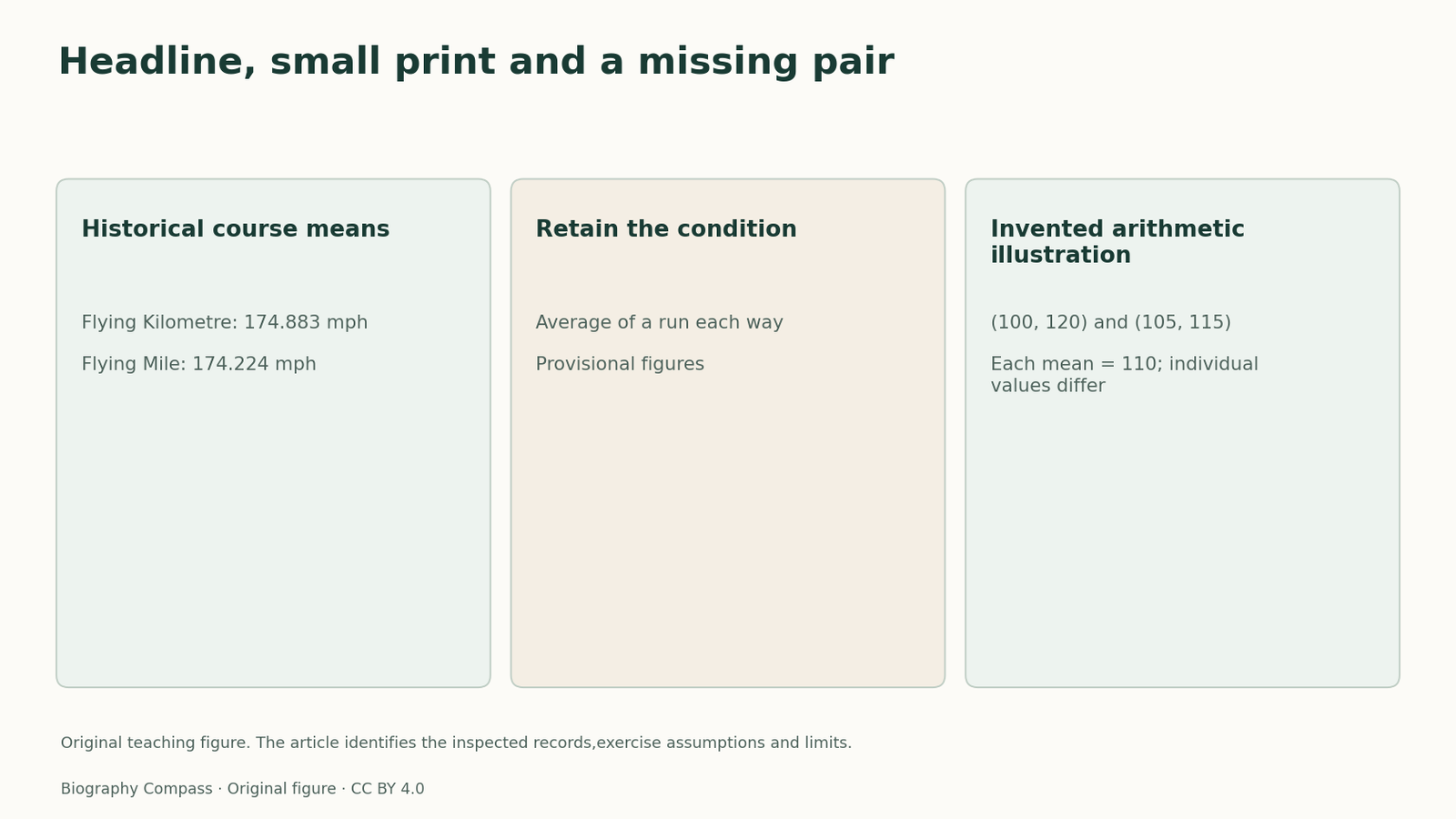
The proof reports 174.883 mph for the Flying Kilometre and 174.224 mph for the Flying Mile. It describes the average of a run each way and makes the figures subject to confirmation.
The distance named in each course is not the speed unit. Both figures use the same unit, so the difference is not a conversion from kilometres per hour to miles per hour. Nor does a two-run mean tell us either individual run’s speed.
Sources for this section: [1]
Keep the archive’s dating work visible
The archive assigns the example to 1927 and explains that the guard books often supply publication and day but omit the year.
That is useful contextual work, not a year visibly supplied by every proof. The advertisement’s provisional condition also belongs in a careful historical caption; a later account of a record does not justify silently deleting the original qualification.
Sources for this section: [2]
Original task: rewrite and test the inference
Write an original caption that preserves course, speed unit, averaging and provisional status. Avoid repeating the headline as if it were the complete measurement statement. Then test the claim that each individual run necessarily equalled the reported mean.
For a separate invented illustration, stipulate an arithmetic mean of 110 units for two readings. Give two different positive pairs that meet it. This is an inverse-problem demonstration only: it does not supply actual historical runs or assume the rules of a contemporary speed-record body.
Sources for this section: [1]
Reference answer: qualification and non-uniqueness
A defensible caption keeps the two labelled course values separate and identifies the figures as provisional means. It does not claim confirmed ratification, individual run values, or a controlled demonstration that the advertised lubricant caused the result.
For the invented arithmetic model, both (100, 120) and (105, 115) have mean 110. They are different pairs with the same mean. The missing individual readings cannot be recovered uniquely from that mean alone. This calculation explains the inference limit; it is not a reconstruction of the historical measurement procedure.
Sources for this section: [1]
Continue the chronology
Related history guides
Biography context
Explore United Kingdom through connected lives
Connected biographies
The working life
Quick answers
Common questions
- Are course distance and speed unit interchangeable?
- No. A course can be named by one distance unit while a speed uses another.
Primary and institutional sources
How this history was checked
Compare the selected accounts and objects below; each has a stated date and scope, and the learning task supplies its own instructions. This article was reviewed on 31 October 2026.