
The short answer
The same word, expiry, can describe different events. The selected company records distinguish a support deadline from the right to keep using an existing version and from the capabilities of a term-licensed product.
The records answer different questions
Keep the measures separate
The question changes when the object, unit or reporting period changes.
| Record or measure | What it establishes | What it does not establish |
|---|---|---|
| Support deadline | A dated end to specified services. | An automatic universal shutdown rule. |
| Perpetual use | An existing version can remain usable. | Unlimited future upgrades or patches. |
| Term-product expiry | A separate product-specific rule. | A transferable rule for all licences. |
Chronology
A timeline of the turning points
Notice
The supplier describes a forthcoming service boundary.
Support deadline
The listed products reach the announced boundary.
What the historical notice ended
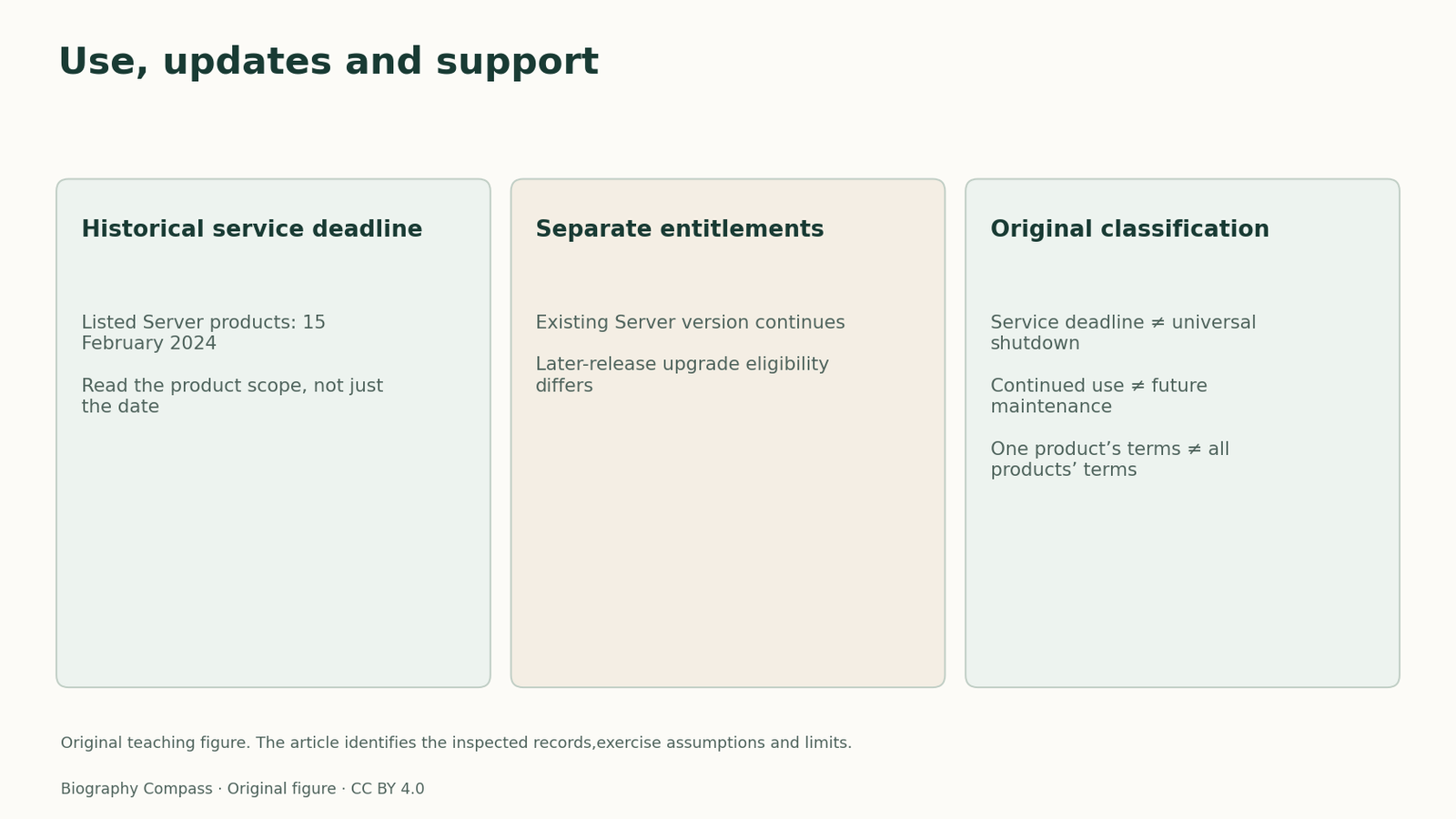
Atlassian’s 22 January 2024 notice set 15 February 2024 at 12 am PT as the end of support for the listed Server products. Technical support, security updates and bug fixes would stop.
A notice about those services does not by itself say that every installed copy immediately stops executing. It also names a product scope: substituting an unlimited claim about every company product would remove an important qualification. The historical commercial decision must be described at the level the notice actually covers.
Sources for this section: [1]
An existing version and a later release are different
The Server subsection of Atlassian’s licence article says perpetual Server software continues in its current state after maintenance expires, including after end of support. A version released after the maintenance expiry is not an eligible upgrade.
The right to run an existing version and the entitlement to obtain a newer one are different. Continued execution also does not prove that compatibility or security problems will be repaired. The support notice and licence explanation answer related questions without contradicting one another.
Sources for this section: [2]
A product-family boundary changes the answer
The same article gives a different Data Center expiry example: users can work on existing issues, but cannot create new issues.
The 2024 annual-report excerpt distinguishes historical perpetual licences from term-based Data Center licensing and describes risks in the cloud transition.
A similar product name is not enough to transfer an entitlement from one licensing model to another. The business context explains why customers encountered the distinction, while the product-specific record supplies the particular functionality. This is a historical reading exercise, not a recommendation to operate unsupported software.
Original classification task
Consider three invented statements: A, “The support deadline proves every installation stopped running.” B, “A perpetual licence guarantees future patches.” C, “The expiry example for a term product is automatically the rule for the perpetual product.” Identify the extra inference in each statement. Then write a two-column note separating use of an existing version from an entitlement to future work by the supplier.
Reference answer: A turns a service deadline into a shutdown rule; B turns continued use into an ongoing service obligation; C transfers terms across product families. The use column concerns an existing licensed version. The supplier-work column concerns support and eligible updates under the relevant dated terms. Neither column should be completed from a product name alone.
Continue the chronology
Related history guides
Biography context
Explore Worldwide through connected lives
Connected biographies
The connected careers
born 1979
Mike Cannon-Brookes
Atlassian co-founder and CEOCannon-Brookes leads Atlassian.Read biographyQuick answers
Common questions
- Does continued operation mean continued maintenance?
- No. An existing-version entitlement and a supplier’s future maintenance obligation must be read separately.
Primary and institutional sources
How this history was checked
Compare the dated company records with the independent or regulatory context. Original task inputs are labelled separately from reported historical measures. This article was reviewed on 31 October 2026.