
The short answer
Why did Brown defend different principles for the two chambers?
Evidence comparison
Read the records together
The records were created for different purposes and support different kinds of claims.
| Record | What it establishes | Question to keep open |
|---|---|---|
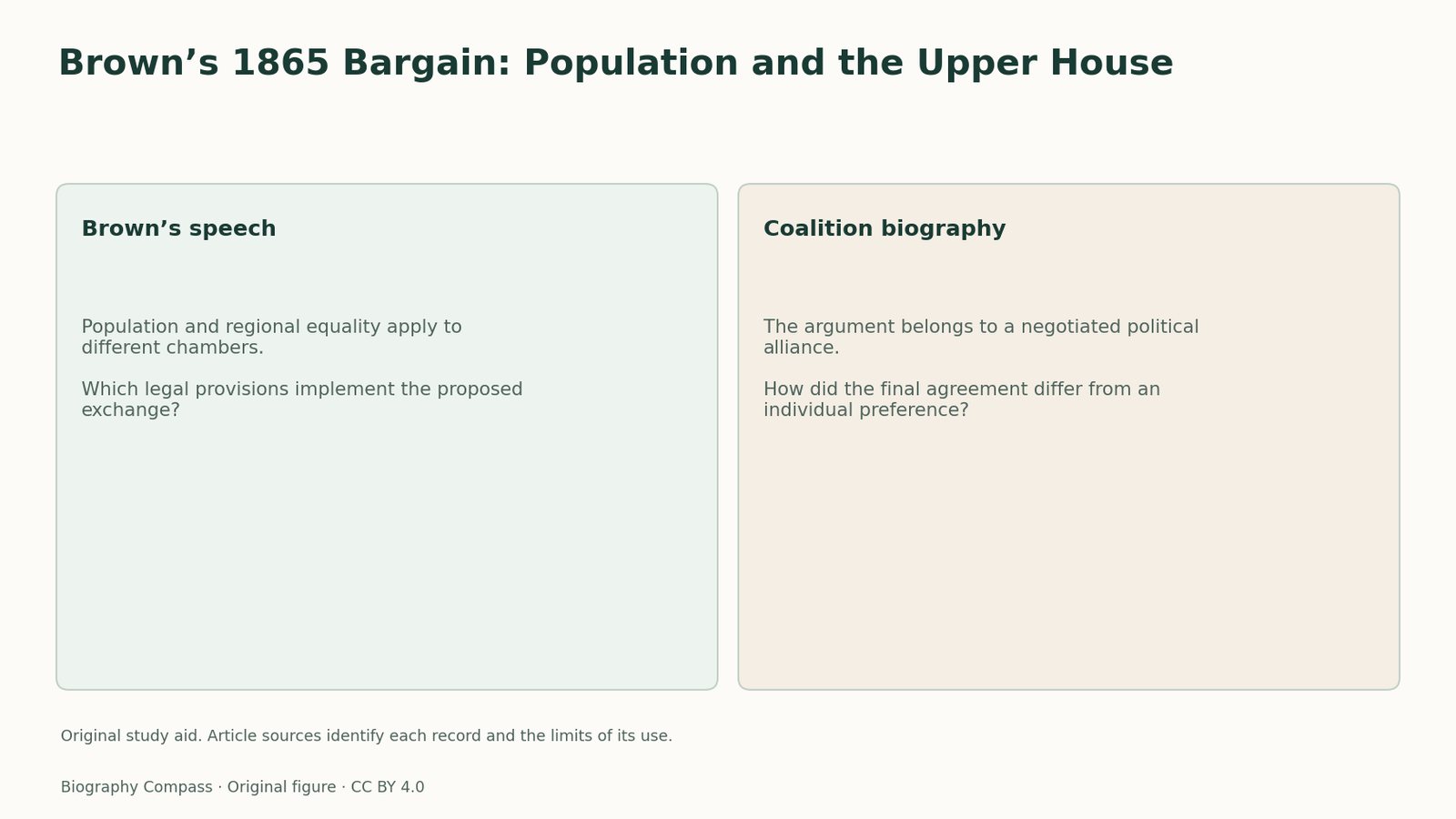
| Brown’s speech | Population and regional equality apply to different chambers. | Which legal provisions implement the proposed exchange? |
| Coalition biography | The argument belongs to a negotiated political alliance. | How did the final agreement differ from an individual preference? |
Chronology
A timeline of the turning points
Great Coalition
Brown joins the alliance advancing union.
Bargain defended
He explains different principles for the two chambers.
Identify the two allocation principles
Brown stated that Lower Canadian delegates had accepted representation by population in the lower chamber on condition that they secured equality in the upper house. The sentence identifies an exchange. To understand it, create separate spaces for the two institutions. Applying population alone to the entire legislature would remove the second part of the bargain and make Brown’s explanation of how agreement was reached unintelligible.
Sources for this section: [2]
Keep selection apart from allocation
He also opposed an elected upper house and defended appointment through the government. The question of how many seats a region received is different from how the people occupying those seats were chosen. A chamber could be regionally balanced and elected, or balanced and appointed. Brown discussed both features because he wanted a particular institutional relationship, including a lower chamber with the central role in money bills and confidence.
Sources for this section: [2]
Read a negotiated scheme as a proposal
The Great Coalition explains why Brown was speaking for a negotiated settlement rather than presenting an isolated private plan. His speech is nevertheless evidence of advocacy during the debate. It should not substitute for the final constitutional text when the question concerns enacted seat numbers, appointment qualifications or later changes. The biography explains the coalition’s significance; the speech explains the compromise he defended at that particular stage.
Model a population change
Imagine two regions with unequal populations. Sketch a population-based lower chamber beside an upper chamber in which the regions receive equal shares. Increase one region’s population and note which principle implies change. The useful result is a distinction between competing forms of representation, not a verdict that one chamber duplicates the other. Mark the drawing as a hypothetical model so its invented numbers are not confused with the historical seat allocations.
Continue the chronology
Related history guides
Biography context
Explore Canada through connected lives
Connected biographies
People behind the records
1818–1880
George Brown
Journalist and reform politicianBrown used the Globe and parliamentary alliances to advance reform, then defended a federal compromise balancing population and regional representation.Read biographyQuick answers
Common questions
- Did Brown propose population-based seats in both chambers?
- His argument accepted regional equality in the upper house as part of the bargain for population-based representation below.
Primary and institutional sources
How this history was checked
Sources support the chronology and the record comparison. The reading exercise is original. This article was reviewed on 7 November 2026.