
The short answer
The 1984 Act belongs within a longer history of hospital and medical insurance. Its funding conditions and their enforcement are a more precise subject than a claim that a single statute made every health service free.
Different records, different questions
A funding rule is not the whole health system
Compare the object of each record before drawing a conclusion.
| Source | What it establishes | What remains open |
|---|---|---|
| Official biography | Bégin’s role in introducing legislation. | Sole authorship of medicare. |
| Historical compliance report | Transfer deductions and their institutional object. | A named patient’s repayment. |
| 1996 scholarship | An argument about enforcement possibilities. | A current legal result or coverage decision. |
Chronology
A timeline of the turning points
Earlier arrangements
Hospital and medical insurance already existed.
Funding conditions
A further stage in the framework.
Reporting period
Do not confuse the report’s setting with the Act’s origin.
A reform of an existing system
Bégin’s official biography credits her introduction of the Act. Health Canada’s 2003–2004 report describes the earlier hospital and medical insurance legislation, then identifies the 1984 change: specific deductions for extra-billing and user charges alongside discretionary provisions for other failures. Read in that sequence, the Act strengthened a federal funding framework. It did not mark the beginning of all provincial health insurance. The earlier Saskatchewan study provides a separate account of one important preceding stage.
The reporting mechanism had a defined object
The report distinguishes mandatory dollar-for-dollar transfer deductions from discretionary penalties and describes consultation before the latter. A deduction from a federal transfer is a fiscal action between governments. It is not, by itself, evidence that a particular patient received a refund or obtained access to every desired service. The report’s transfer terminology belongs to its 2003–2004 setting; later funding names are not projected backwards into 1984. The inspected passages provide a historical explanation, not present eligibility or billing advice.
Sources for this section: [2]
A scholarly argument asked a different question
In his 1996 article, Sujit Choudhry considered whether the statutory framework could support legal enforcement and discussed obstacles to individual claims. The inspected English abstract presents both legal and political dimensions of litigation. That is an attributed argument, not proof that a particular claimant won, or that the article describes the law today. The comparison is useful precisely because official compliance reporting and a scholar’s proposed legal strategy answer different questions.
Sources for this section: [3]
Original exercise: follow the money and the claim
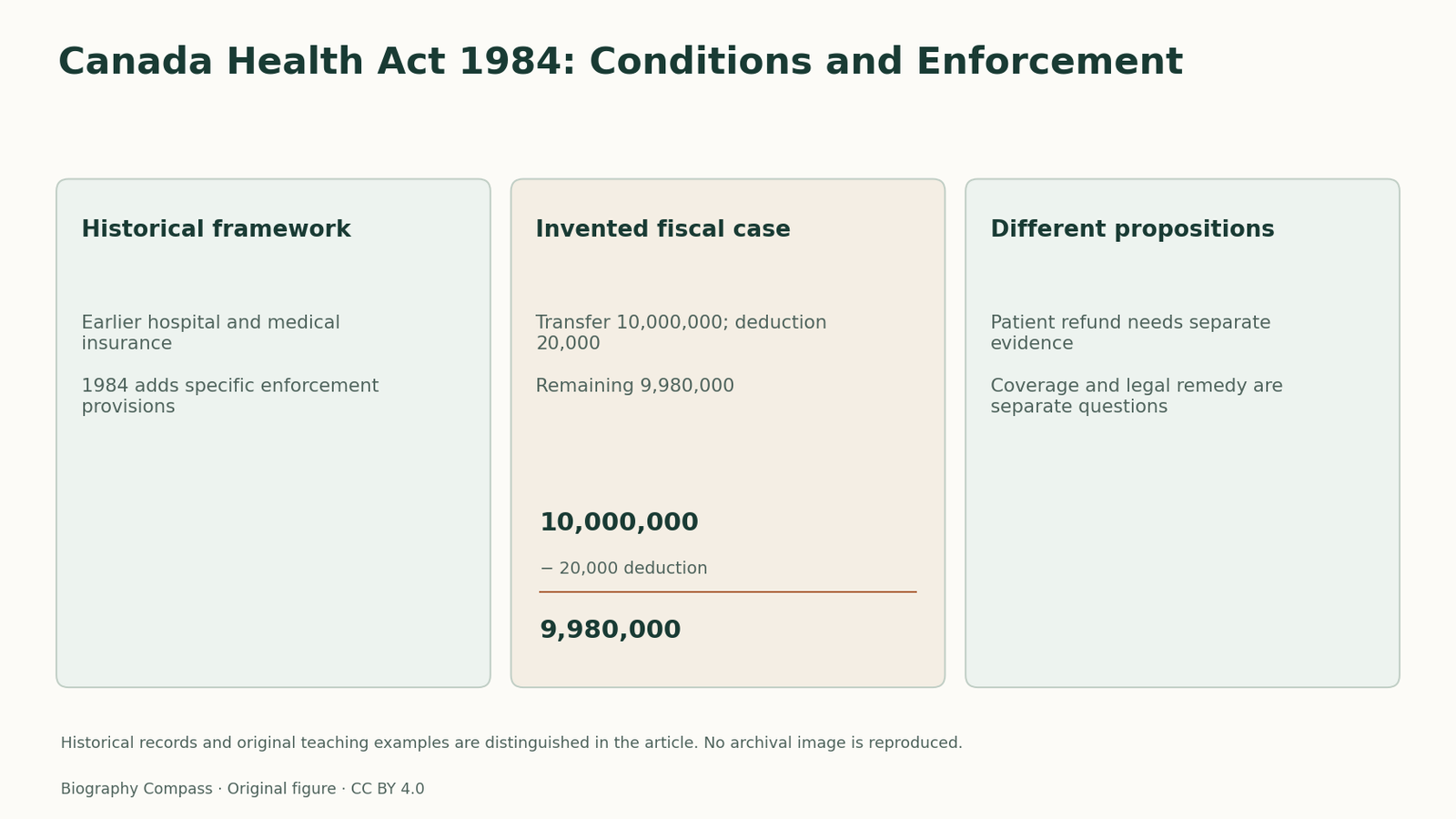
In a deliberately simplified invented example, a jurisdiction has 10 million units of otherwise payable transfer and a verified 20,000 units triggering a stipulated equal deduction. Calculate the remaining transfer. A caption also says that the 20,000 has automatically been paid to a named patient and that every uncovered service must now be insured. Which statements follow from the inputs?
Reference answer: 10,000,000−20,000=9,980,000 units remain under the exercise’s rule. Nothing supplied identifies a patient repayment or determines the coverage of an additional service. Those assertions require separate facts and legal records. The amounts and simplified rule are invented; the example is an exercise in identifying the object of a fiscal action, not a recreation of a province’s accounts or guidance on an individual health claim.
Continue the chronology
Related history guides
Biography context
Explore Canada through connected lives
Connected biographies
The connected career
1936–2023
Monique Bégin
Sociologist and former ministerBégin connected research with public policy.Read biographyQuick answers
Common questions
- Does a transfer deduction itself establish a patient’s entitlement or refund?
- No. A fiscal action between governments and an individual claim are different propositions needing different evidence.
Primary and institutional sources
How this history was checked
The source descriptions below identify the inspected records and their dates. This article was reviewed on 31 October 2026.