
The short answer
An NMR experiment can reveal structure without producing an ordinary photograph. Callaghan and colleagues’ 1991 abstract describes a particular route to that inference; a separate numerical exercise shows why different averages can carry different information.
Original source comparison
Do not replace an experiment with an illustrative statistic
Keep the measured object and the inference attached to the record that supports them.
| Record or claim | What the evidence supports | What it does not establish |
|---|---|---|
| Original 1991 abstract | A specified NMR experiment and indirect averaged structural information. | An ordinary photograph or unique image of every pore. |
| Fictional signed means | Cancellation in two declared five-observation samples. | That every molecule was stationary. |
| Fictional squared means | A difference between the two supplied samples. | A calibrated NMR echo, diffusion coefficient or unique geometry. |
Chronology
A timeline of the turning points
Massey research setting
Callaghan returned to New Zealand for a lectureship.
Nature report
The five-author paper reported diffraction-like effects in a porous-material experiment.
Wellington move
Callaghan took the Alan MacDiarmid Chair.
Colleague account
Hendy and McGrath published their obituary and account of the programme.
Begin with the actual experiment’s material
Callaghan, Coy, MacGowan, Packer and Zelaya’s 1991 Nature report describes proton NMR of water in a loosely packed, orientationally disordered arrangement of equal-sized polystyrene spheres. That is a specific experimental system, not a generic claim that every material can be photographed at arbitrary resolution. Its abstract connects the experiment with the wider problem of fluid transport in porous structures. The present guide has read that original abstract through a university research repository, together with a colleague account of Callaghan’s programme. The complete publisher paper and raw echo data were not accessible.
A field gradient supplies a different kind of spatial encoding
The abstract explains an analogy between a gradient-pulse quantity, represented by q, and a wavevector in diffraction. The observed effects can supply indirect, averaged information about the structure through which fluid diffuses. Callaghan’s colleagues also describe using magnetic-field gradients to encode spatial information and investigate molecular motion. This is a measurement-and-inference process. It should not be described as a tiny camera recording a unique snapshot of every pore. Equally, indirect does not mean imaginary: an experiment can provide reproducible structural evidence through a well-specified relationship between a signal and a model.
An average is defined by what it retains
Averaging can preserve one property while losing another. To isolate that idea, the exercise below uses ordinary signed displacements and their squared values. It does not simulate an NMR pulse sequence or claim that either average alone equals the 1991 echo signal. That boundary matters: a simple teaching statistic can illuminate a general information problem without pretending to reconstruct a specialist apparatus. Ask what quantity was computed, which differences survive the calculation and which possible structures could still share the same result.
Sources for this section: [1]
Original exercise: compare two fictional displacement samples
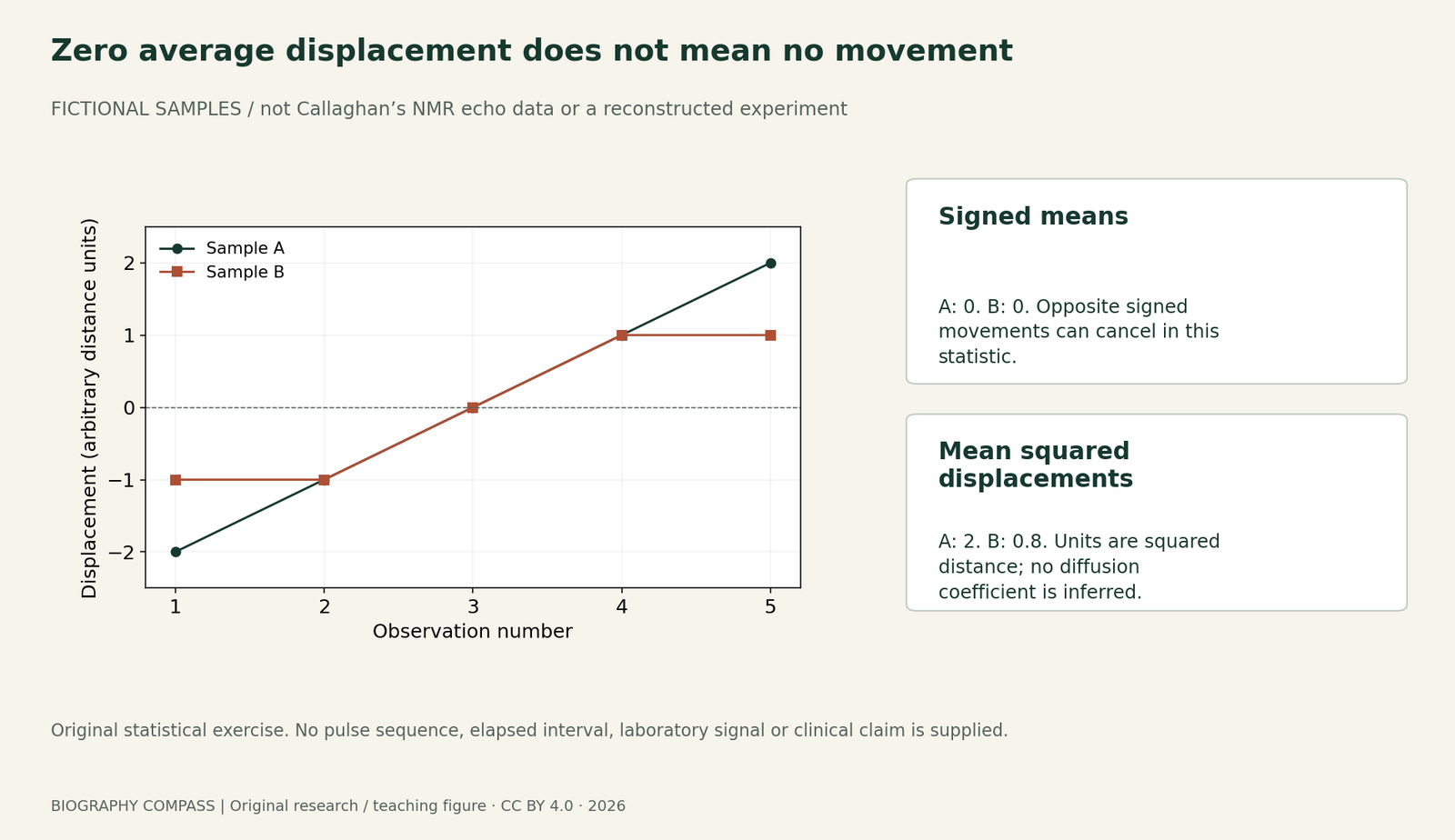
Sample A contains −2,−1,0,1,2 arbitrary distance units. Sample B contains −1,−1,0,1,1 in the same units. Both are invented, with five observations each. Calculate their mean signed displacement and mean squared displacement. Would the signed mean distinguish the samples? Would the squared mean do so? Then assess the proposed caption: “A zero mean proves that no molecule moved and uniquely identifies the pore geometry.” Identify each separate unsupported inference. Do not turn the squared-displacement result into a diffusion coefficient: no observation interval or suitable diffusion model has been supplied.
Sources for this section: [1]
Reference answer: zero displacement average is compatible with motion
Both signed sums are 0, so both signed means are 0. For A, the squared values sum to 10 and their mean is 2 square distance units. For B, the squared sum is 4 and the mean is 0.8 square distance units. The signed average hides equal movements in opposite directions; it does not prove that every observation was stationary. The squared mean distinguishes these two declared samples, but it does not uniquely identify every possible distribution or pore structure. An actual NMR inference needs the experiment’s signal relationship and assumptions, rather than simply relabelling these fictional statistics as a measured echo.
Sources for this section: [1]
The historical result concerns a defined form of structural information
The 1991 abstract reports experimental confirmation of predicted diffraction-like effects and describes a resolution advantage over conventional NMR imaging under the conditions discussed. This guide does not invent a numerical resolution, a medical scanning protocol or a universal superiority claim. Its lesson is narrower and more useful: an indirect experiment can reveal aspects of internal structure, while the information recovered depends on the measurement and interpretation. The teaching figure plots only the two invented samples and their explicitly calculated statistics. It reproduces no historical chart or newly measured molecular trajectory.
Sources for this section: [1]
Connect the method with the career that sustained it
Callaghan’s programme involved instrument construction, collaboration and teaching as well as theory. His later work at Wellington and the MacDiarmid Institute, and the development of Magritek with colleagues, connected research capabilities with other laboratories and uses. Those stages are described in his biography. The related Wilson guide offers another example of molecular evidence supporting a historical inference, but its genetic relationships are not an NMR measurement. Reading across the two makes the shared question clearer: what can a defined observation support, and which additional information would a stronger conclusion require?
Continue the chronology
Related history guides
Biography context
Explore New Zealand through connected lives
Connected biographies
People behind the work

1947–2012
Paul Callaghan
Experimental physicist and science communicatorPaul Callaghan developed nuclear magnetic resonance methods for studying fluids and complex materials, helped build a national materials-science collaboration and brought scientific questions to a wide public audience. His research also contributed to the instrument company Magritek.Read biographyQuick answers
Common questions
- Are the displacement values from Callaghan’s experiment?
- No. They are invented teaching inputs and do not simulate the pulse sequence.
- Does an indirect measurement have no evidential value?
- No. Its value depends on the defined relationship between the measurement and the inferred property.
Primary and institutional sources
How this history was checked
Compare the identified original texts, participant accounts and institutional records; the teaching examples are separately labelled. This article was reviewed on 27 October 2026.
- P.T.Callaghan, A.Coy, D.MacGowan, K.J.Packer and F.O.Zelaya; King’s research repositoryDiffraction-like effects in NMR diffusion studies of fluids in porous solids, Nature351,467–469(1991): original abstract
- Shaun Hendy and Kathryn McGrath; New Zealand Association of ScientistsSir Paul Callaghan(1947–2012), NZ Science Review69(1),26–28