
The short answer
A bone can support evidence of terrestrial life while its narrower identification remains unresolved. The records associated with New Zealand’s Cretaceous discoveries show why finding, naming, dating and reconstructing an animal are different questions.
Original source comparison
Which question does the record answer?
Keep the measured object and the inference attached to the record that supports them.
| Record or claim | What the evidence supports | What it does not establish |
|---|---|---|
| 1984 phalanx abstract | A probable anatomical assignment and terrestrial-fauna inference. | Complete species, appearance or swimming behaviour. |
| 1975/1980 biographical sequence | Finding and later recognition of a different vertebra. | That every later paper describes the same object. |
| 2010 dinocyst abstract | Age constraints on identified geological samples. | A new anatomical diagnosis or documented match to every earlier bone. |
Chronology
A timeline of the turning points
Different discovery
The institutional biographies place the unusual dinosaur vertebra find around this time.
Conference report
Molnar announced the identified vertebra at a Wellington conference.
Phalanx paper
Scarlett and Molnar published the probable bird-or-dinosaur assignment.
Dating study
Young and Hannah reported dinocyst constraints on specified fossil-bearing material.
Start with the actual title and authors
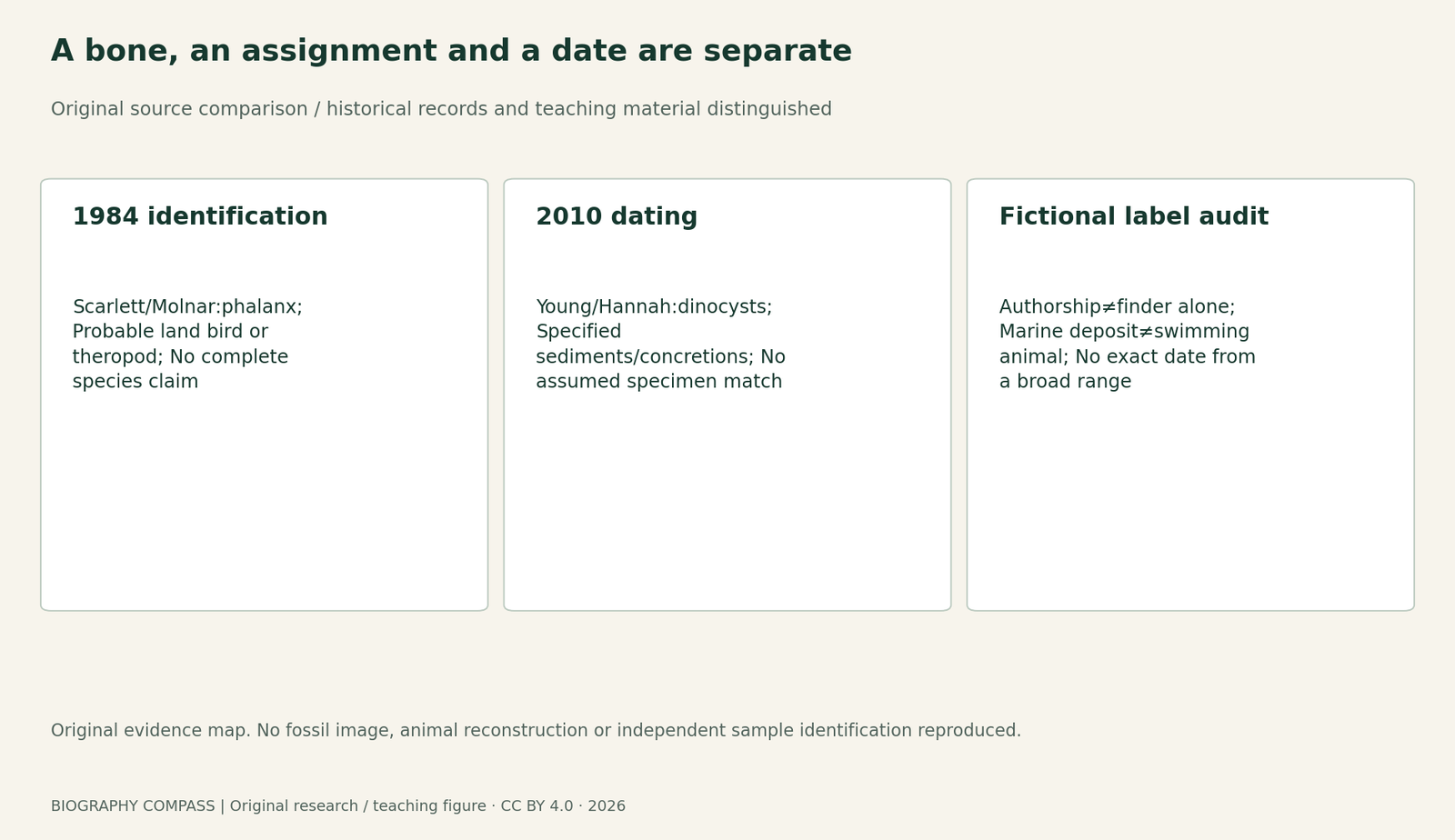
The 1984 paper Terrestrial bird or dinosaur phalanx from the New Zealand Cretaceous was authored by R.J.Scarlett and R.E.Molnar. The publisher-deposited abstract describes a phalanx found near Mangahouanga Stream and leaves a probable alternative between a land bird and a theropod dinosaur. It also argues for terrestrial vertebrate fauna on the isolated landmass. Wiffen’s discoveries form the wider fieldwork context, but she is not listed as an author of this paper. That distinction prevents the history of finding material from absorbing every later identification and publication into one person’s bibliography.
Read the historical categories with care
The words “bird or dinosaur” in a 1984 title record the alternatives as that paper framed them. Modern museum explanations place birds within the dinosaur family and distinguish avian from non-avian dinosaurs. The point here is the unresolved narrower assignment, not a claim that modern taxonomy puts birds outside all dinosaurs. A probable identification of one bone also leaves many other properties unknown. It does not by itself provide a full species diagnosis, body outline, colour, behaviour or count of all animals living at the locality.
A discovery sequence is not a geological age
Wiffen’s institutional biographies distinguish finding an unusual vertebra around 1975 from Molnar’s later identification and a 1980 conference announcement. Those are events in the history of research. A Cretaceous age concerns when the organism and sediment belonged in geological time. The 1984 abstract uses a historical Haumurian range of 65–80million years before present. That range should remain identified as the paper’s wording, rather than being silently converted into an exact current age. The vertebra and the 1984 phalanx also must not be assumed to be the same object merely because both belong to the region’s fossil discoveries.
Later dating evidence has its own samples and limits
Young and Hannah’s 2010 abstract uses dinoflagellate cysts to constrain ages of the Maungataniwha Sandstone and fossil-bearing concretions. It distinguishes in-situ concretions from loose material and reports different age ranges for specified samples. Its dinosaur-bearing concretions could only be dated no younger than the stated early-Maastrichtian interval. This is a later geological inference, not a new anatomical identification of every bone in earlier papers. The present guide has read the complete publisher-deposited abstract, not the full methods or sample tables, and does not match an older specimen to a later sample without a documented identifier.
Sources for this section: [2]
Original exercise: repair an overconfident museum label
The following label is invented: “Joan Wiffen’s 1984 paper identifies the complete species of a swimming dinosaur, proves its exact age and shows that the bone found in 1975 is the same sample dated in 2010.” Identify four separate claims requiring correction or more evidence. Then draft a replacement label of two or three sentences using only the records read here. Keep the anatomical alternative, publication authorship and limits of sample matching visible. Do not infer an animal’s usual habitat solely from the fact that its remains occur within a marine sedimentary setting.
Reference answer: separate the object and the inference
Scarlett and Molnar authored the 1984 paper; its abstract leaves a probable land-bird or theropod alternative rather than naming a complete species. Neither that assignment nor the wider presence of marine sediment proves the proposed swimming behaviour. The abstract’s historical age range and the 2010 sample constraints do not give one universally exact bone date. Finally, the records inspected do not establish that the 1975 vertebra,1984 phalanx and 2010 dated material are the same specimen. A replacement can describe a Cretaceous phalanx, its unresolved assignment and its contribution to evidence for terrestrial fauna, while leaving those further claims open.
Uncertainty can coexist with a significant result
Wiffen’s work helped establish a much richer history of New Zealand’s reptiles through specimens, preparation and collaboration. The 1984 abstract illustrates a scientific result whose wider significance does not depend on a complete species identification. Later specialists can revisit the material and its geological context because collections and records preserve it. The original teaching figure maps these distinct questions without inventing a drawing of the animal. Primary publisher metadata and abstracts, museum explanation and the named biographical records supply the guide’s scope; no original-paper figures, fossil images or full anatomical reanalysis are claimed.
Continue the chronology
Related history guides
Biography context
Explore New Zealand through connected lives
Connected biographies
People behind the work
1922–2009
Joan Wiffen
Self-taught palaeontologistJoan Wiffen taught herself fossil preparation and palaeontology while working with her family, friends and professional collaborators in Hawke’s Bay. Their discoveries transformed knowledge of Cretaceous reptiles on the New Zealand landmass.Read biographyQuick answers
Common questions
- Was Wiffen an author of the 1984 phalanx paper?
- The publisher metadata lists R.J.Scarlett and R.E.Molnar.
- Can an unresolved identification still matter?
- Yes. The paper argues for terrestrial vertebrate fauna while retaining uncertainty about the narrower assignment.
Primary and institutional sources
How this history was checked
Compare the identified original texts, participant accounts and institutional records; the teaching examples are separately labelled. This article was reviewed on 27 October 2026.
- R.J.Scarlett and R.E.Molnar; publisher metadata through CrossrefTerrestrial bird or dinosaur phalanx from the New Zealand Cretaceous, NZ J Zool11,271–275(1984): publisher-deposited abstract
- Martin D.Young and Michael J.Hannah; publisher metadata through CrossrefDinoflagellate biostratigraphy of the vertebrate fossil-bearing Maungataniwha Sandstone, NZ J Geol Geophys53,81–87(2010): original abstract
- Australian MuseumThe living dinosaurs: bird or dinosaur?
- Simon Nathan; Manatū Taonga Ministry for Culture and HeritageJoan Wiffen: Dictionary of New Zealand Biography,2018
- Museum of New Zealand Te Papa TongarewaJoan Wiffen, a fossil expert