
The short answer
Two models can agree on the observation used to introduce them and still disagree elsewhere. To compare them, keep track of what each model removes and what it leaves capable of responding.
Selected evidence and original reasoning
Same self-silence, different remaining capacities
Four unit-weight clones and both response rules are invented.
| Rule | S responses | X/Y responses |
|---|---|---|
| Delete S-reactive clones | 0 | 1/1 |
| Block S-reactivity only | 0 | 2/2 |
| Observe S silence alone | Both fit | Does not distinguish rules |
Chronology
A timeline of the turning points
Theoretical alternatives
Clone deletion compared with inhibition.
Response-set fixture
Find a second comparison that distinguishes two rules.
The alternatives in the selected lecture
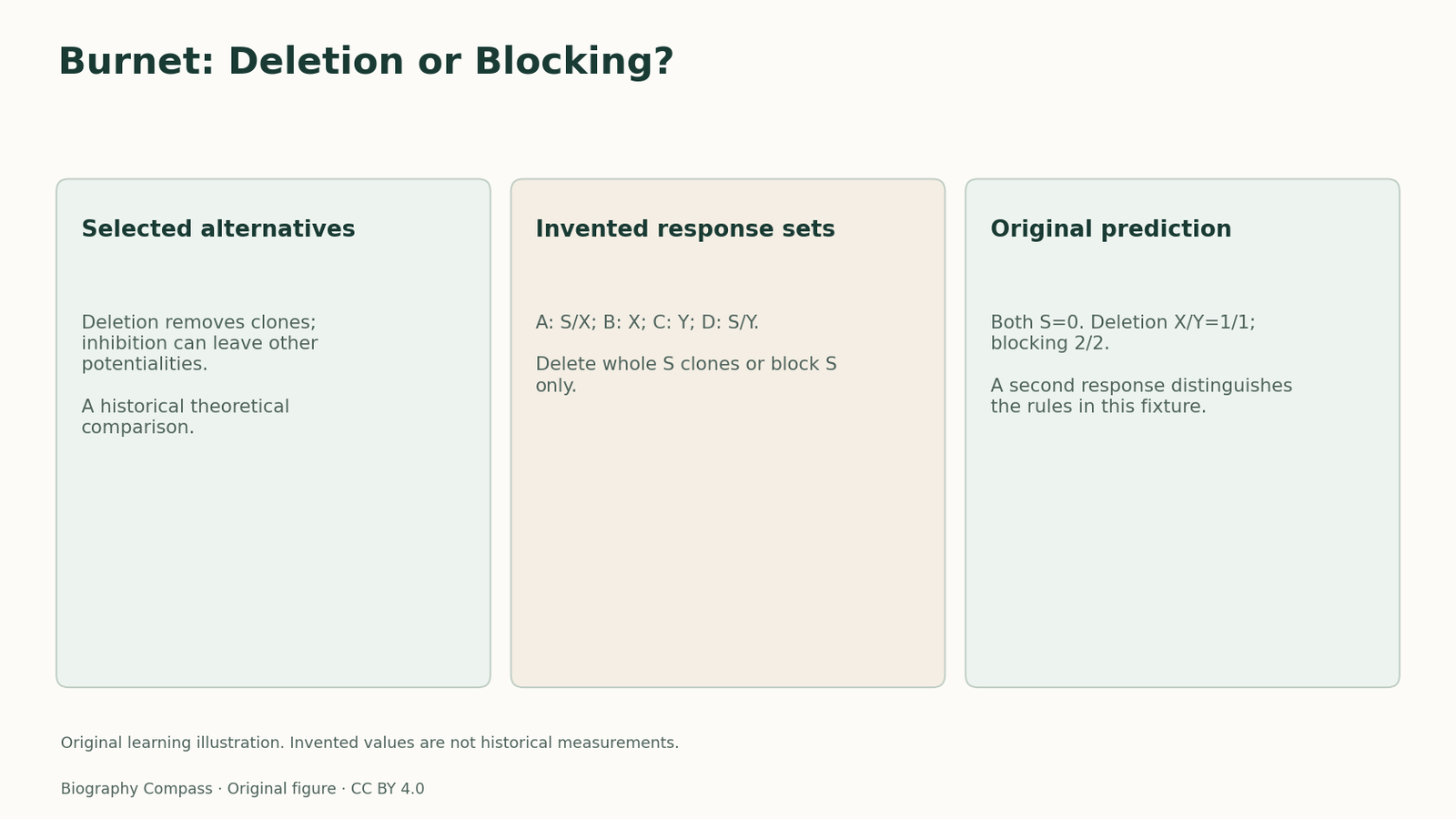
Burnet considers eliminating a clone carrying a self-reactive pattern. He also discusses blocking a particular reactivity while leaving other potential reactions available, especially when a cell could carry several patterns.
These are historical theoretical alternatives in selected pages, not a complete current description of immune tolerance. The original symbolic example below isolates their different consequences.
Sources for this section: [1]
Invent four symbolic clones
Give each invented clone a set of potential responses: A={S, X}, B={X}, C={Y}, D={S, Y}. S stands for a self signal and X/Y for two other signals. All clones have unit weight. Under deletion, remove every clone containing S. Under selective blocking, keep every clone but erase only S from its response set.
Count potential unit responses to S, X and Y under both rules. Then ask whether observing no response to S distinguishes them. These are defined logical rules, not experimental organisms or a treatment proposal.
Sources for this section: [1]
Reference answer
Deletion removes A and D, leaving B and C. Response counts are S=0, X=1, Y=1. Selective blocking retains A={X}, B={X}, C={Y}, D={Y}, so the counts are S=0, X=2, Y=2. Both produce silence for S; only the second preserves the additional X and Y potentialities.
In this fixture, a test involving X or Y would separate the rules, whereas S silence alone would not. Counts are potential unit contributions, not antibody concentrations, cell proliferation rates or probabilities of a patient outcome.
Sources for this section: [1]
The discriminating test follows the difference
The example does not prove that either rule describes a particular biological system. It shows why the information a hypothesis discards matters. Any real comparison would need an appropriate measurement and controls, not just the labels in this table. The lecture’s theoretical scope and Medawar’s experimental role remain separate.
Sources for this section: [1]
Continue the chronology
Related history guides
Biography context
Explore Australia through connected lives
Connected biographies
Researcher and context
Quick answers
Common questions
- Does the table describe present treatment?
- No. It is a symbolic historical-theory exercise, not clinical advice.
- Does self-silence alone identify the rule?
- No. Both original rules yield zero S response.
Primary and institutional sources
How this history was checked
Selected records ground the historical explanation. Original models have their own stated assumptions. This article was reviewed on 31 October 2026.