
The short answer
Two changes can each look beneficial when tested alone. Their combination is another measurement, not an answer already contained in the two single-change results.
Selected evidence and original reasoning
Do not hide the benchmark
All scores and benchmark definitions are original.
| Comparison | Expected AB | Observed minus expected |
|---|---|---|
| Additive increments | 17 | −5 |
| Multiplicative ratios | 18.2 | −6.2 |
| Measured selection | A=14 is highest | AB=12 does not win |
Chronology
A timeline of the turning points
Lecture account
Repeated mutation and screening explained.
Combined-score fixture
Compare parent, singles and combination.
What the actual account combines
Arnold describes repeated mutation and reproducible screening, including Chen’s work adapting subtilisin to new conditions. She also explains that useful mutations could have effects her group could not predict from structure.
That research account supports testing combinations. It does not license an assumption that every pair of beneficial mutations must improve the enzyme together. The following benchmarks are our definitions, not a numerical reconstruction of the historical experiment.
Sources for this section: [1]
Define two original benchmarks
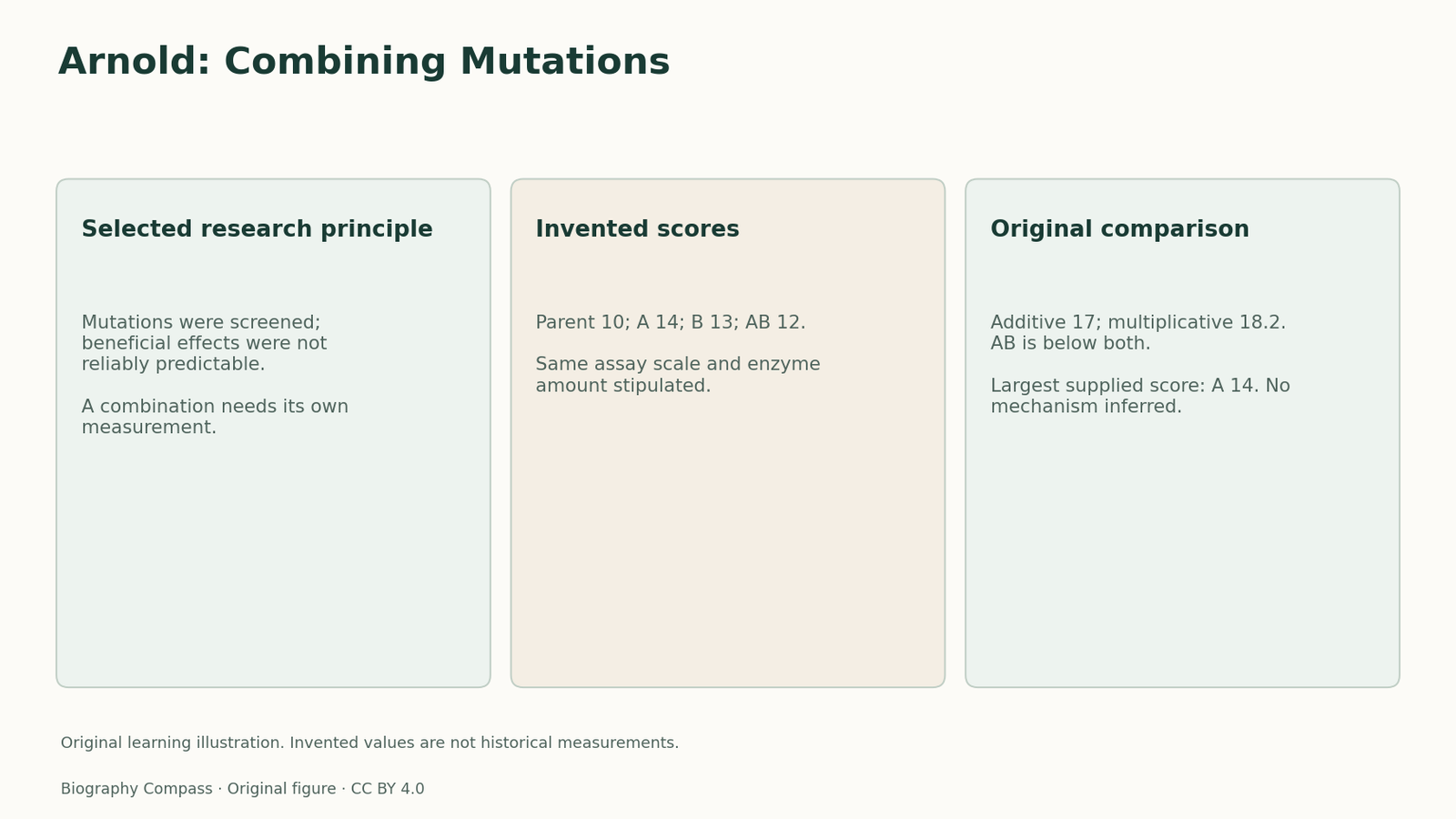
Invent scores measured on one comparable activity scale, with equal enzyme amounts and identical assay conditions: parent 10, variant A 14, variant B 13, and combined AB 12. Treat these four values as exact for this model. An additive benchmark preserves the two single-change increments; a multiplicative benchmark preserves their ratios to the parent.
Calculate both expected combination scores and the difference between observed AB and each benchmark. Which variant would you select if this score were the only objective?
Sources for this section: [1]
Reference answer
The single-change increments are 4 and 3. The additive prediction is 10+4+3=17; the observed 12 is 5 units below it. Equivalently, the additive interaction is 12−14−13+10=−5.
The single-change ratios are 1.4 and 1.3. The multiplicative prediction is 10×1.4×1.3=18.2; observed AB is 6.2 units below it. A has the largest supplied score, 14. Combining the individually beneficial changes did not beat either single variant here.
Sources for this section: [1]
An interaction depends on the stated comparison
The two numerical departures differ because the benchmarks use different scales. Neither residual identifies the atomic cause, establishes statistical significance or predicts performance under another assay. Replication and uncertainty were not supplied. The useful decision is to preserve the measured parent, singles and combination rather than infer the last from the first three.
Sources for this section: [1]
Continue the chronology
Related history guides
Biography context
Explore United States through connected lives
Connected biographies
Researcher and context
Quick answers
Common questions
- Does this establish the historical experiment’s interaction?
- No. These scores are invented; the selected lecture explains the research approach.
- Are additivity and multiplication the same null model?
- No. One combines increments, the other relative ratios.
Primary and institutional sources
How this history was checked
Selected records ground the historical explanation. Original models have their own stated assumptions. This article was reviewed on 31 October 2026.