
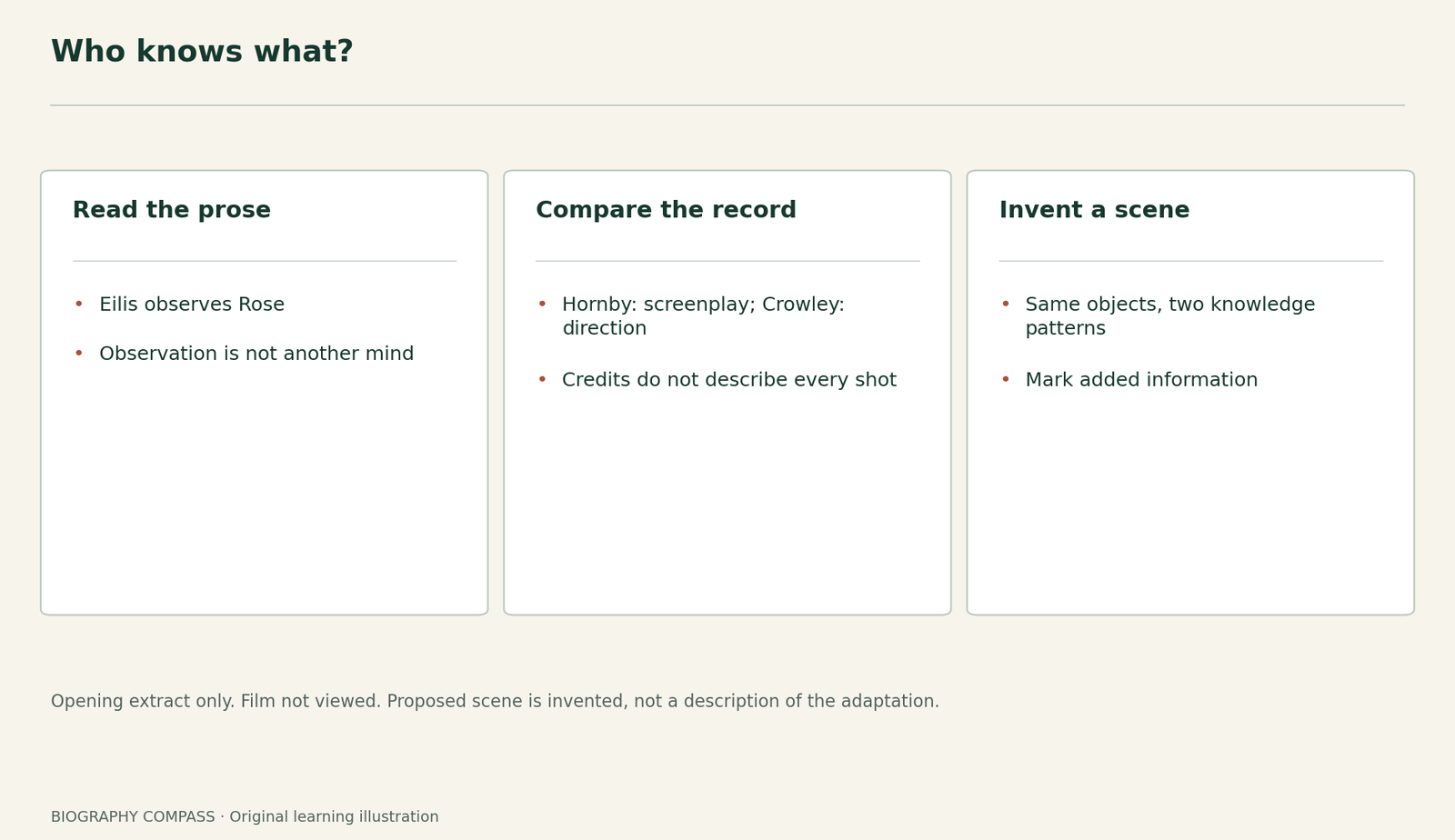
The short answer
Adapting fiction requires choices about how information reaches an audience. First identify what prose actually supplies, then distinguish the decisions a new scene would require from decisions documented about an existing film.
Record comparison
Compare the evidence
Keep the record, its authority and the claim being tested together.
| Record | What it establishes | What remains separate |
|---|---|---|
| Prose opening | Knowledge stays close to Eilis | Other minds remain inferential |
| Producer interview | Explains adaptation choices and collaborators | Not direct viewing evidence |
| Original scene plan | Supplies a new distribution of knowledge | Not a claim about the released film |
Chronology
A timeline of the turning points
Novel
Brooklyn is published.
Adaptation
Separate direction and screenplay credits.
Observation is not access to every mind
The opening follows Eilis watching Rose return home. Clothes, a handbag and golf clubs locate Rose within an active social world; Eilis is working on bookkeeping. The narrator can report Eilis’s expectations without announcing Rose’s private thoughts.
Objects therefore do more than decorate a room. Their selection builds an uneven distribution of activity, money and knowledge. A reader can infer a relationship, but an inference is not equivalent to a sentence establishing another character’s intention.
Sources for this section: [1]
Uncertainty has a grammatical location
The shopkeeper’s summons gives Eilis incomplete information. At the shop, she tries to interpret Miss Kelly’s manner and possible offence. Her uncertainty remains visible rather than being replaced by a confident explanation from outside her experience.
When annotating a passage, use three columns: directly observed, remembered or expected, and inferred. The categories can overlap, but recording the overlap is more useful than calling everything description.
Sources for this section: [1]
A production account poses a different problem
Producers Dwyer and Posey describe selecting Hornby for the adaptation and the challenge of translating understated prose to cinema.
BFI credits Crowley as director and Hornby as screenwriter.
That evidence identifies responsibilities and an adaptation problem. It does not establish what a particular shot, edit or performance does. The following task proposes a possible solution; it is not a reconstruction of the released film.
Exercise: externalize one private inference
Invented situation: a trainee arrives at a workshop after receiving an unexplained invitation. She sees a second chair, a sealed envelope and a clock five minutes fast. Write two three-beat scene plans: one keeps her inference uncertain; the other gives the audience information she lacks. Use no voice-over and add no dialogue from the novel.
Reference answer: uncertain version—she checks the chair; notices the envelope; waits without opening it. Audience-ahead version—before she enters, another worker labels the envelope “job offer”; she then checks the empty chair; she waits, unaware of what viewers know.
The second plan changes the distribution of knowledge, not simply the camera position. Neither plan proves what the absent inviter thinks. A sound alternative must state what new information it supplies and who can perceive it.
Continue the chronology
Related history guides
Biography context
Explore Ireland and the United States through connected lives
Connected biographies
People connected with these records
born 1955
Colm Tóibín
Novelist and essayistTóibín writes fiction and non-fiction across Irish and international settings.Read biographyQuick answers
Common questions
- Is this a review of the film?
- No. It combines a read prose extract with production accounts and credits, then proposes an original scene-planning task.
Primary and institutional sources
How this history was checked
Compare each record’s date, author and stated purpose. The supplied tasks and reference answers are original learning material. This article was reviewed on 30 October 2026.
- Colm TóibínBrooklyn: author-hosted extract
- Joseph Walsh / BFIGirls on film: Brooklyn interview with the producers
- BFIBrooklyn (2015): credits
- Columbia UniversityColm Tóibín: faculty biography
- Anne Enright / Grove AtlanticThe Gathering: opening extract
- The Booker Prize FoundationAnne Enright
- Windham-Campbell Prizes / YaleAnne Enright: 2025 recipient