
The short answer
How did the Broken Hill syndicate’s interests become shares in the 1885 company?
Compare the documents
Authority, evidence and limits
These records describe different responsibilities; one should not silently substitute for another.
| Record | What it establishes | What it does not establish |
|---|---|---|
| NSW mining history | Describes 16,000 £20 shares and the 14,000/2000 division. | Nominal capital is not verified cash received. |
| Company 1935 jubilee account | Describes the £9 offer and £19 creditedpaid-up position. | A later narrative is not the original subscription ledger. |
| Our arithmetic | Separates £320,000 nominal, £18,000 conditional cash and £38,000 credit. | A calculation cannot prove all subscribers paid every instalment. |
Begin with the kind of figure being described
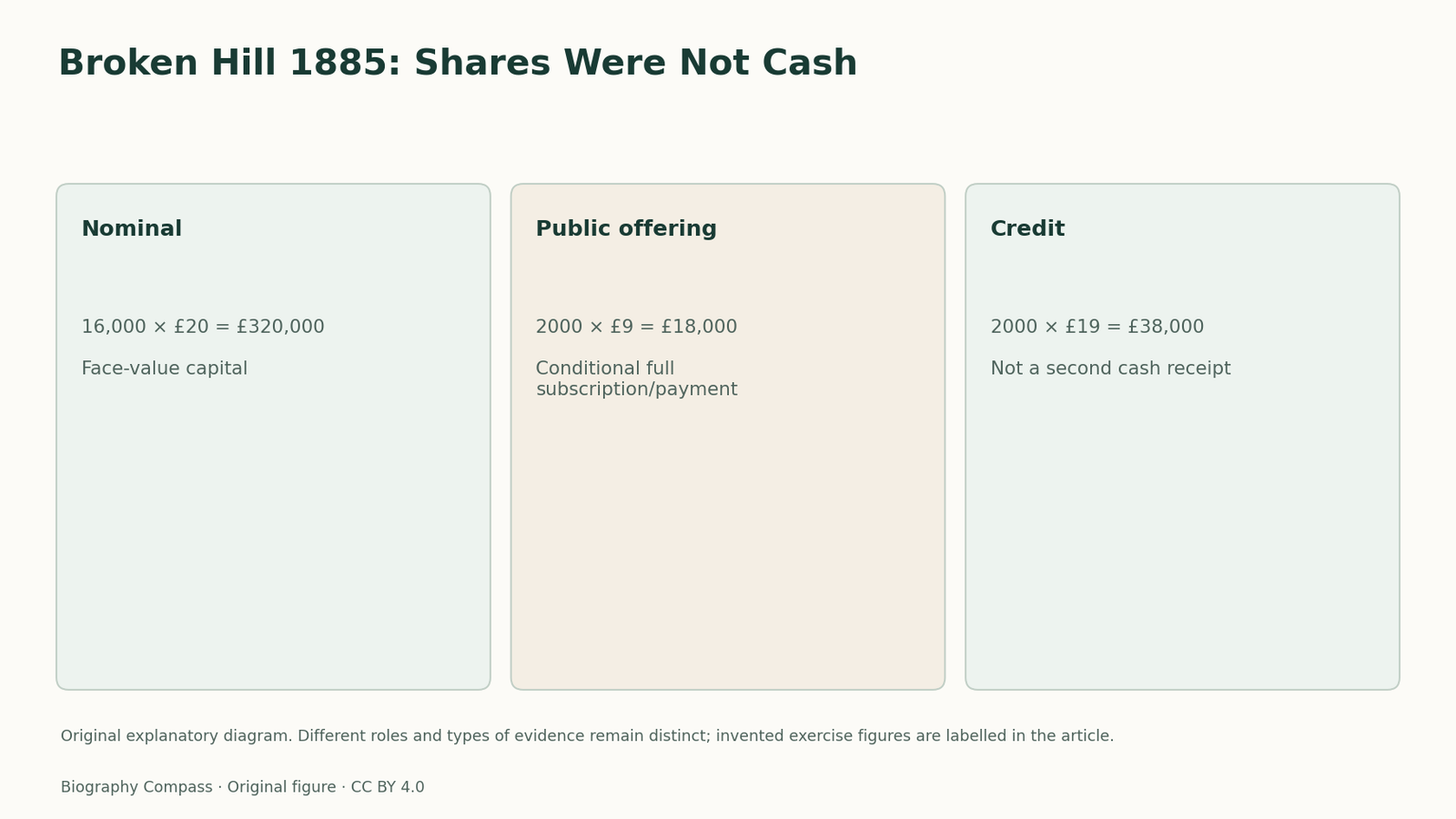
The New South Wales mining history describes an 1885 structure of 16,000 shares with a nominal value of £20 each, including 14,000 associated with the syndicate and 2,000 offered publicly. Multiplying the total by the face value gives £320,000 of nominal capital. That calculation does not establish £320,000 arriving in a bank account. A company can recognise non-cash interests and use shares to organise ownership; a nominal amount answers a different question from money subscribed or received. The original subscription register was not inspected. This guide therefore works with the announced structure described in the records rather than asserting a verified cash ledger.
Sources for this section: [4]
An issue price and credited amount can differ
The company’s 1935 jubilee account describes the 2,000 public shares as offered for £9 each and credited as £19 paid up, with the cash amount payable in instalments. These are not three interchangeable prices. Face value describes the share’s nominal denomination; an issue price describes the terms offered to a buyer; a credited paid-up amount describes its stated capital position. This explanation is an original reading of the figures, not advice on modern share accounting. The retrospective source is also interested company history written fifty years later, so it should not be presented as a newly inspected original 1885 prospectus or as independent proof that every scheduled payment was actually received.
Sources for this section: [3]
Later narratives must be compared carefully
The government mining history and the company’s jubilee narrative both help explain the transition from syndicate to company, but their descriptions give different exact dates around preparation and issue. We retain the supported year and do not manufacture a single precise offering date by choosing whichever account appears more convenient. That limit does not prevent comparison of the clearly identified capital concepts. The distinction also keeps this guide separate from the story of Rasp’s claim and changing assay results. Evidence for mineral content and evidence for the terms of a financial offering describe related events, but neither document can replace the other.
Calculation exercise and checked answer
Using the described offering as a calculation model, multiply 2,000 public shares by £9. The result is £18,000 if every offered share was subscribed and the full stated amount paid. Now multiply the same shares by £19: £38,000 is the credited paid-up figure on that description, not additional cash generated by the subtraction. Finally compare both with £320,000 nominal capital across all 16,000 shares. The reference answer names each total and its assumptions instead of adding them into a fictitious cash receipt. No inference of completed collection follows from the arithmetic alone. This is an original exercise based on the published terms, and checking actual receipts would require subscription and payment records beyond the passages inspected here.
Continue the chronology
Related history guides
Biography context
Explore Australia through connected lives
Connected biographies
People behind the collaboration
1848–1907
George McCulloch
Pastoral manager and mining syndicate organiserGeorge McCulloch helped organise and finance the Broken Hill syndicate, linking Charles Rasp’s claim with the management and capital needed to develop a mining company.Read biography1846–1907
Charles Rasp
Prospector and Broken Hill syndicate memberCharles Rasp recognised a promising outcrop at Broken Hill and joined the syndicate whose further prospecting and finance helped turn the claim into a major mining enterprise.Read biographyQuick answers
Common questions
- Did £320,000 nominal capital mean that much cash was raised from the public?
- No. The records distinguish the whole nominal share structure from the 2,000 public shares and their stated £9 issue price. Actual receipts require payment records.
Primary and institutional sources
How this history was checked
The bibliography distinguishes contemporary records, retrospective participant accounts and later institutional research. Access limits and uncertain attributions are identified in the article; the exercise is an original teaching example. This article was reviewed on 7 November 2026.