
The short answer
What did the Broken Hill discovery claim establish before the mine became a company?
Compare the documents
Authority, evidence and limits
These records describe different responsibilities; one should not silently substitute for another.
| Record | What it establishes | What it does not establish |
|---|---|---|
| National Museum account | Separates the initial suspicion, syndicate and later silver discovery. | A later successful mine does not prove the first mineral interpretation correct. |
| NSW mining history, selected p. 5 | Records successive assays and development milestones. | A sample result is not a whole-deposit average or reserve statement. |
| ADB biography | Places the claim within Rasp’s changing career. | Biography does not replace the original claim register. |
A claim identified an interest in a particular place
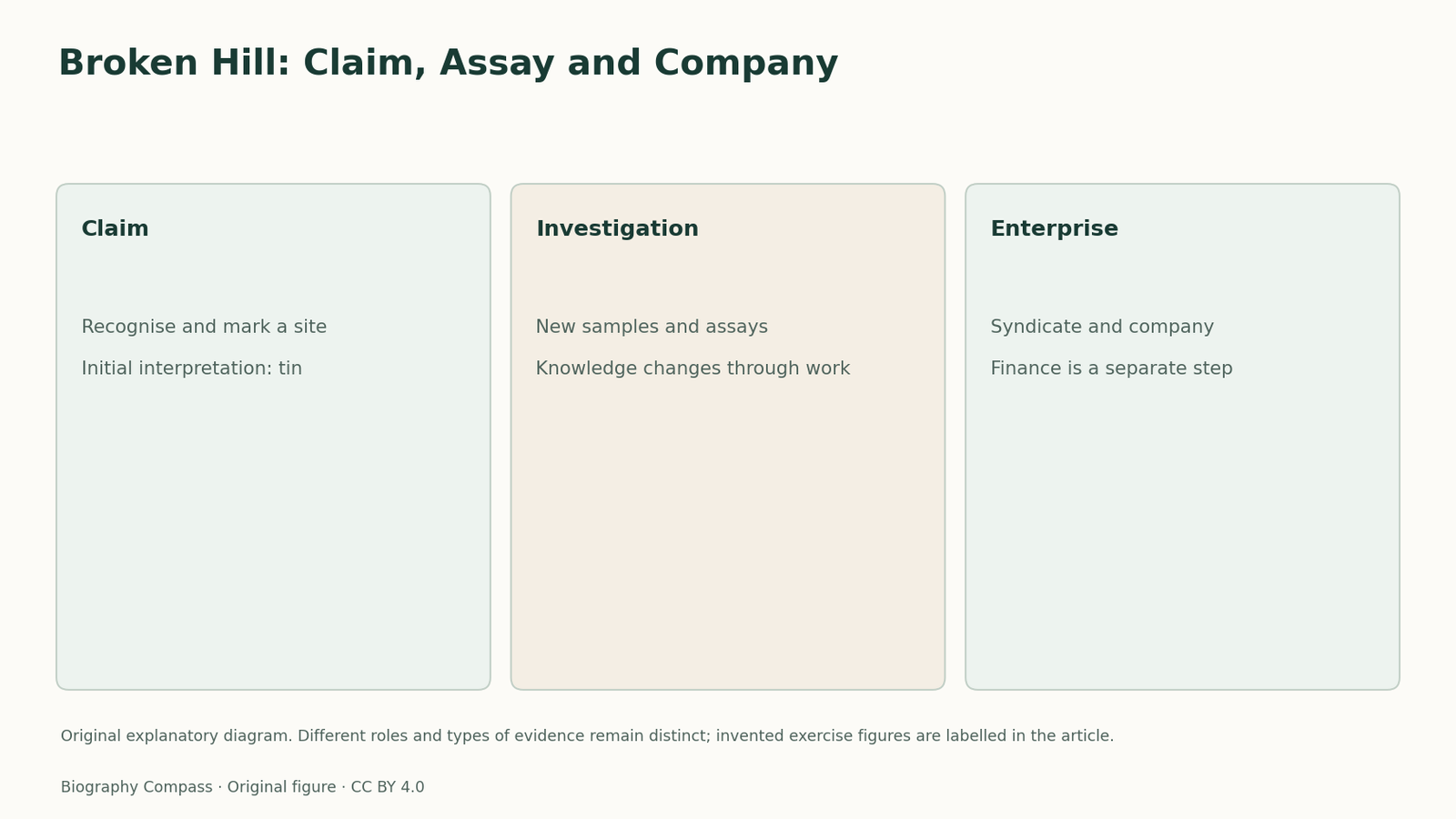
Rasp’s September 1883 claim began with an interpretation of an exposed outcrop. He suspected tin; later work established a different mineral story. A claim is therefore evidence of an attempt to secure and investigate a site, not proof that the claimant correctly identified everything beneath it. The National Museum’s account places James Poole and the seven-person syndicate within that process. That prevents discovery from becoming a single instant in which one observer supposedly knew the entire future mine. The original 1883 register was not inspected for this guide, so its precise wording and legal boundaries are not reconstructed from later descriptions.
An assay is a result for material that was tested
The New South Wales mining history records successive 1885 tests associated with Philip Charley, James Nutt and further workings. Their results helped transform expectations after discouraging early samples. This is evidence of investigation over time, with different people producing information that mattered to the enterprise. As an analytical distinction, a rich result for one submitted sample is not the same as the average grade of an entire deposit, and a promising deposit is not automatically cheap to mine. The inspected historical passage does not supply a modern reserve estimate or a full sampling plan. Its importance is the sequence through which new material changed the syndicate’s understanding.
Sources for this section: [3]
Company formation answered a financial question
The 1885 corporate structure created a way to hold interests and raise further money; it did not retrospectively make Rasp’s initial mineral identification correct. The mining history describes a nominal share structure, while the museum explains that some original participants sold before the major expansion. Discovery, testing and capital organisation consequently belong on connected but separate lines. This is why the companion article on shares asks a different question from this guide. Here the concern is what each stage can establish about the evidence for a mine, rather than how the later company’s announced capital should be calculated or divided among investors.
Evidence-sequence exercise and reference answer
Imagine three invented documents: a notice marking a claim, a laboratory result for one bag of mineral material and a prospectus offering shares. Put them in the order needed to answer three questions: who sought an interest in the ground, what a tested sample contained, and how a business proposed to finance development. Now ask which document proves the average yield of the whole mine. The reference answer is none by itself. The assay is relevant to the particular sample; the notice concerns the claim; the prospectus concerns an offering and its representations. The example is not a transcription of the Broken Hill originals. It explains why the documented change from Rasp’s tin suspicion to silver investigation is a history of accumulating evidence and organised work, rather than a reason to dismiss his observation or exaggerate what he initially knew.
Continue the chronology
Related history guides
Biography context
Explore Australia through connected lives
Connected biographies
People behind the collaboration
1846–1907
Charles Rasp
Prospector and Broken Hill syndicate memberCharles Rasp recognised a promising outcrop at Broken Hill and joined the syndicate whose further prospecting and finance helped turn the claim into a major mining enterprise.Read biography1848–1907
George McCulloch
Pastoral manager and mining syndicate organiserGeorge McCulloch helped organise and finance the Broken Hill syndicate, linking Charles Rasp’s claim with the management and capital needed to develop a mining company.Read biographyQuick answers
Common questions
- Did Rasp initially identify the outcrop as a silver deposit?
- The inspected accounts say he suspected tin. Subsequent prospecting and assays helped establish the silver-bearing potential.
Primary and institutional sources
How this history was checked
The bibliography distinguishes contemporary records, retrospective participant accounts and later institutional research. Access limits and uncertain attributions are identified in the article; the exercise is an original teaching example. This article was reviewed on 7 November 2026.