
The short answer
A measured radio position narrows the search for an optical counterpart. The strength of a match depends on the precision of the measurement and on what else is in the field.
Reading the evidence
Measurement and identification are separate steps
A candidate can fit the position without explaining the emission.
| Stage | Evidence | What to check |
|---|---|---|
| Radio position | A reduced coordinate and uncertainty. | How the observation and refraction correction were made. |
| Optical candidate | An object in the same region. | How many objects fit the uncertainty. |
| Physical match | Evidence connects the signals. | Whether position and other observations agree. |
Follow the measurements to coordinates
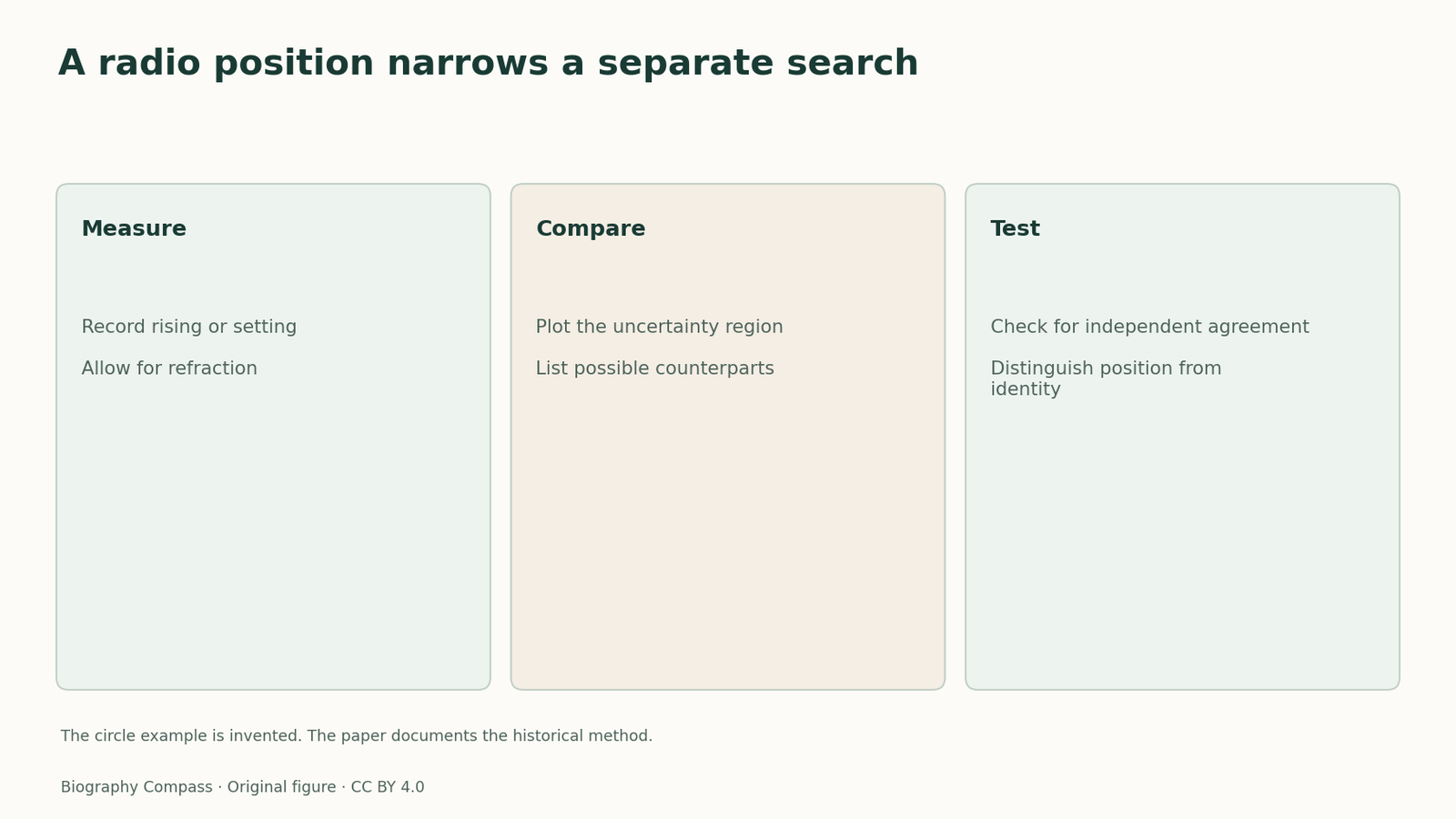
The paper by Bolton, Stanley and Slee says that observations from different coastal sites were used to improve positions of three sources. It describes correcting for atmospheric refraction before determining positions from rising and setting observations. A coordinate is the result of reducing those observations. It is not a direct view of the source through an optical telescope.
This matters when reading a result in a table. The observing time, the assumed path and the correction affect the final place. The radio coordinate can then be compared with objects measured in a separate way.
Decide what a positional match can support
A well-determined position allows a comparison that a broad direction alone cannot. If several optical objects lie within the uncertainty region, the position does not select one unambiguously. A candidate can still be worth investigating. Better measurements or observations at other wavelengths can test whether the two detections belong to the same source.
The authors worked with data available at the time. Their paper is valuable as a record of how measured positions made the question testable. Later physical classifications should be dated separately.
Sources for this section: [2]
Try two invented uncertainty regions
Draw two optical marks 4 and 9 units from a measured radio centre. A circle of radius 10 leaves both as possible positional matches. A circle of radius 5 leaves only the nearer one within the boundary. That stronger association is still a positional result. A study of the emission would add a different kind of evidence.
Continue the chronology
Related history guides
Biography context
Explore Australia through connected lives
Connected biographies
People in the records
1922–1993
John Gatenby Bolton
Radio astronomer and first director of the Parkes telescopeBolton used coastal observations to improve positions of radio sources and later led the Parkes telescope.Read biographyQuick answers
Common questions
- Is the nearest optical object automatically the radio source?
- No. Position helps identify candidates. Uncertainty and the presence of other objects determine how strong the positional evidence is.
Primary and institutional sources
How this history was checked
Dates, legal milestones and historical claims are checked against the official and institutional records below. This article was reviewed on 5 November 2026.