In this biography
Quick facts
- Born
- 1922
- Died
- 1993
- Birthplace
- Sheffield, England
- Country
- Australia
- Nationality
- Not independently established
- Known for
- Positions and possible identifications of discrete radio sources
Why this life matters
His work moved radio observations toward an astronomy in which a measured source could be compared with objects at other wavelengths.
Timeline
Key moments
Radiophysics in Australia
Joins the postwar programme studying celestial radio signals.
Three source positions
Publishes a paper with Gordon Stanley and Bruce Slee.
Parkes
Becomes the telescope’s first director.
Learning to work with radio instruments
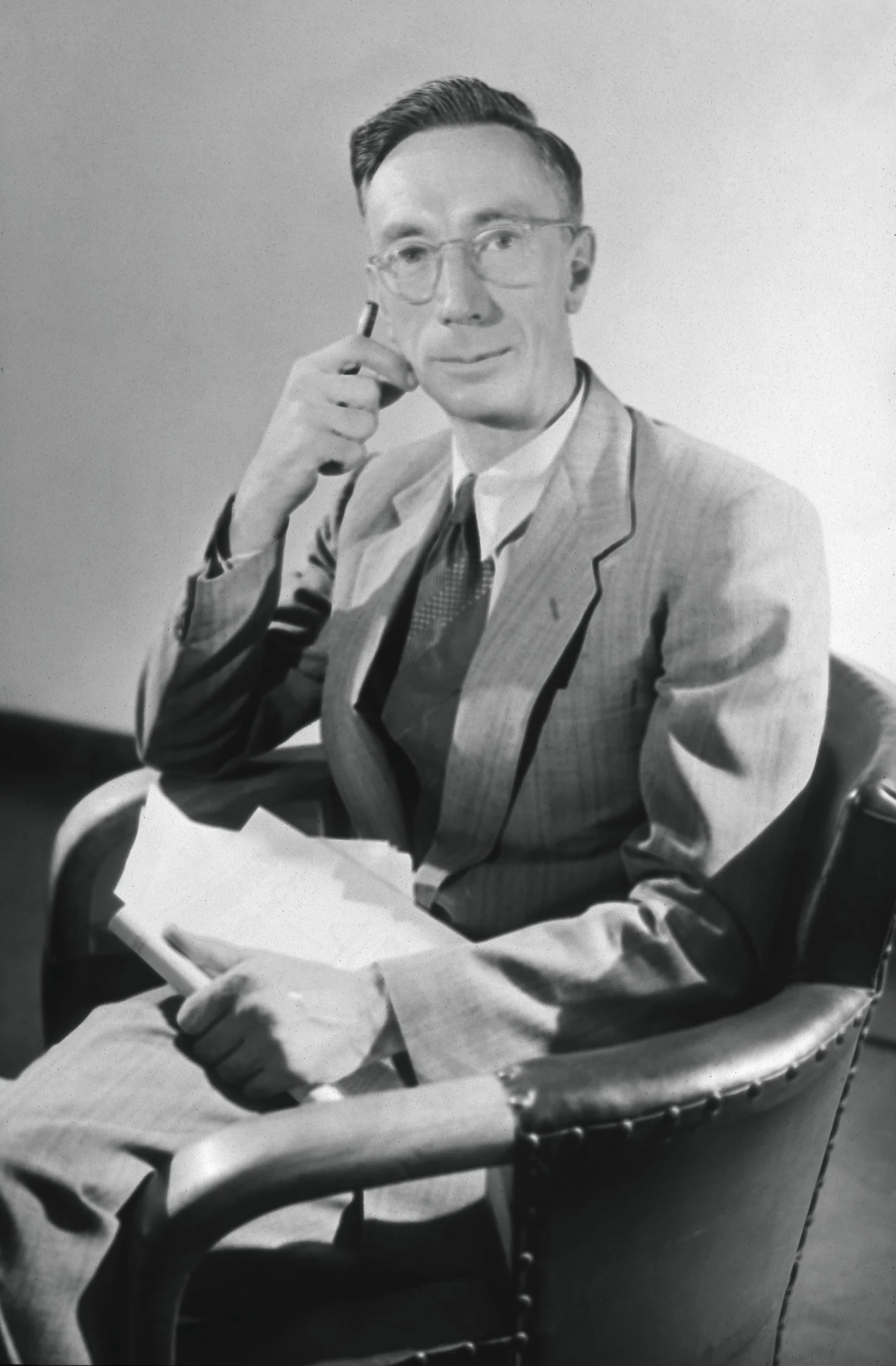
Bolton was born in Sheffield and trained in physics. Wartime radar work gave him experience with receiving signals, identifying interference and using instruments outside a laboratory. He went to Australia and joined the radiophysics programme in which scientists were beginning to use wartime equipment to study celestial sources. One challenge was to tell a source with a definite direction from changes in the equipment or its surroundings.
A radio signal did not arrive with the name of a visible object attached. To make a connection with optical observations, the radio measurement needed a position precise enough to test proposed matches.
Positions measured from the coast
Bolton worked with Gordon Stanley and Bruce Slee on discrete radio sources. Their 1949 paper reports improved positions derived from observations on the coasts of Australia and New Zealand. At suitable sites, patterns observed as a source rose or set helped the team estimate its position. They accounted for atmospheric refraction before inferring celestial coordinates.
The results let astronomers consider optical objects in the same regions. A position match was important evidence, while identifying the physical source required further work. The paper’s title uses the language of its own period. It should not be taken as a modern classification of all the sources it discussed.
From individual observations to a facility
Bolton continued his career in Australia and the United States. He became the first director of the Parkes telescope and helped establish how researchers would use a large, dedicated radio observatory. His work spans two stages of the field. Coastal sites made early positional measurements possible. A permanent facility supported a wider range of observations that others could repeat and extend.
Quick answers
Frequently asked questions about John Gatenby Bolton
- Who co-authored Bolton’s 1949 radio-source paper?
- Gordon J. Stanley and O. B. Slee shared authorship of the paper on three source positions.
Keep exploring
Lives connected to this story
- Joseph Pawsey
Read about the group’s earlier use of coastal geometry to study solar signals.
- Ronald Bracewell
Compare a different problem in interpreting observations made with radio antennas.
Sources and further reading
Explore the evidence
These references support the biography and offer further reading. Official records, first-person accounts and independent reporting provide different perspectives; image records document attribution and licensing.
- 1. Australian Dictionary of Biography, Australian National UniversityJohn Gatenby Bolton
- 2. Bolton, Stanley and Slee, Nature 1949Positions of Three Discrete Sources of Galactic Radio-Frequency Radiation
Read the opening on coastline measurements, atmospheric refraction and positional inference. Keep the title’s historical terminology distinct from modern source classification.
- 3. Encyclopedia of Australian Science and InnovationJohn Gatenby Bolton