
The short answer
How were Hall rifle parts made and tested for interchangeability?
Evidence comparison
Read the records together
The records were created for different purposes and support different kinds of claims.
| Record | What it establishes | Question to keep open |
|---|---|---|
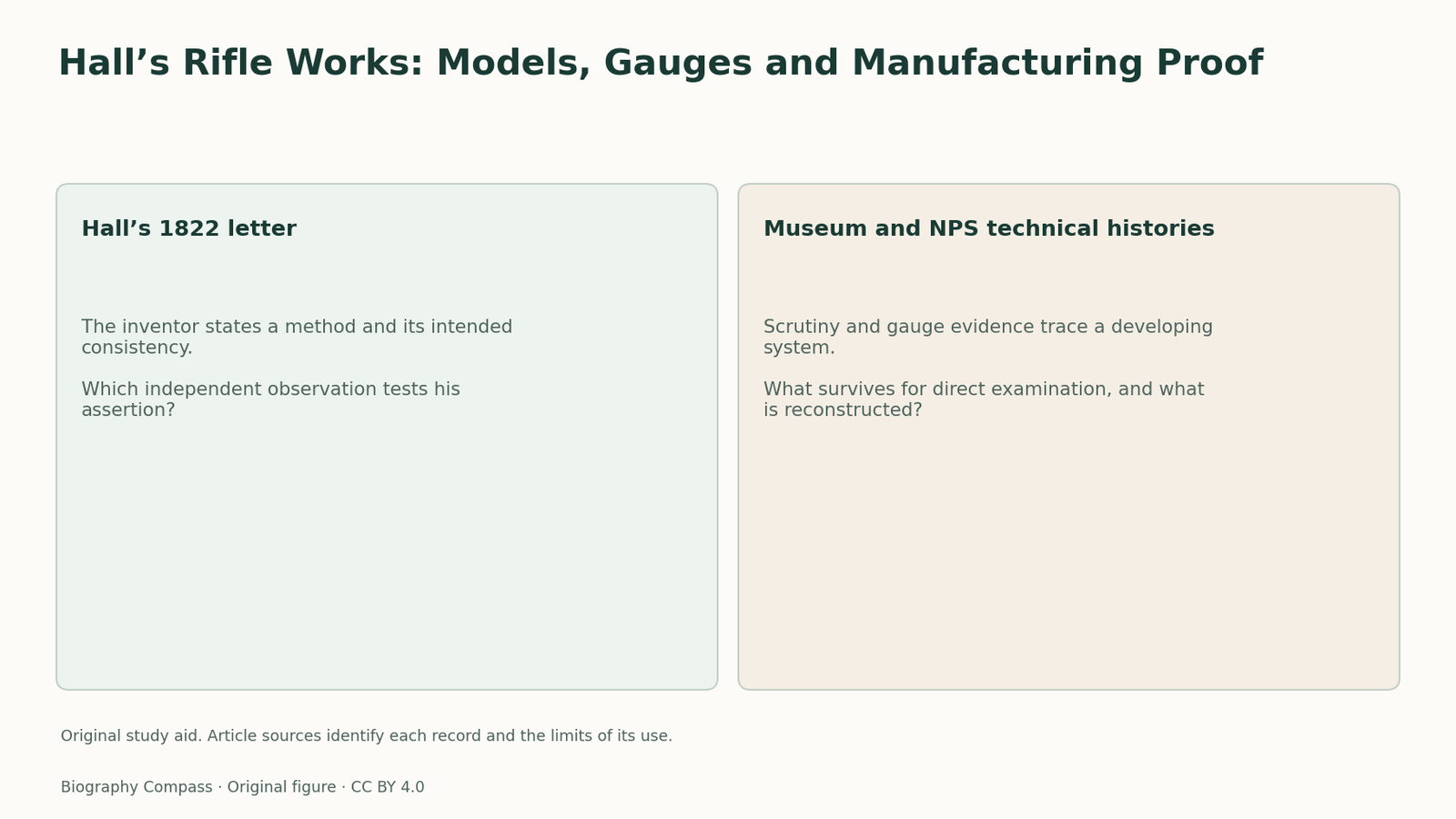
| Hall’s 1822 letter | The inventor states a method and its intended consistency. | Which independent observation tests his assertion? |
| Museum and NPS technical histories | Scrutiny and gauge evidence trace a developing system. | What survives for direct examination, and what is reconstructed? |
Chronology
A timeline of the turning points
Rifle Works
Hall begins the federal production undertaking.
Claim of success
His letter describes methods for uniform arms.
Scrutiny
An inquiry examines the machinery and production.
Identify the workshop’s target
Hall sought to make parts conform to an established model rather than fit each piece individually to one particular rifle. His 1822 letter describes methods intended to produce arms alike through repeatable operations. This is a useful statement of purpose, but it remains a claim made by the developer to his government patron. A study of achievement needs records beyond an inventor’s confidence in his own system.
Sources for this section: [1]
Connect cutting with measurement
Guides and stops constrain a cutting operation; gauges address whether the resulting part conforms to the intended dimensions. Those tasks support each other without becoming identical. The technical history discusses documentary evidence for sixty-three Hall gauges by 1827. It also acknowledges that the gauges have not survived for direct evaluation. The count therefore belongs to a historical reconstruction, not to a modern physical inventory that readers can inspect object by object.
Compare internal consistency with exchange across sites
The museum describes investigation of the machinery after the 1826 dispute, while the NPS report identifies later evidence of compatibility with North’s rifle production. Making parts consistent inside one workshop and exchanging them with parts from another site are related achievements of different scope. Shared reference standards become especially important when work crosses institutional boundaries. A successful claim about one should not automatically be substituted for proof of the other.
Specify what a stronger test would record
Design a hypothetical inspection sheet with columns for manufacturing site, part type, gauge result and assembly result. Label it as a proposed study tool, not an original Hall document. Ask readers which fields the cited sources can actually fill. A sound answer distinguishes an inventor’s statement, official observation and reconstructed production evidence. It also explains why the absence of surviving gauges limits technical detail without erasing the documented importance of the manufacturing programme.
Continue the chronology
Related history guides
Biography context
Explore United States through connected lives
Connected biographies
People behind the records
1781–1841
John H. Hall
Gunmaker and precision-manufacturing innovatorJohn Hall moved from Maine craft work to Harpers Ferry, developing rifles, specialised machinery and gauges intended to produce genuinely interchangeable parts.Read biographyQuick answers
Common questions
- Is making a part accurately the same as proving interchangeability?
- No. Accuracy concerns conformity to requirements; exchange and assembly evidence address whether parts actually function in the intended combinations.
Primary and institutional sources
How this history was checked
Sources support the chronology and the record comparison. The reading exercise is original. This article was reviewed on 7 November 2026.