
The short answer
A location may be remembered for an agreement or a headquarters, while a person linked to it is remembered for keeping people alive. These records illuminate different parts of the same conflict.
Evidence and interpretation
What each record can establish
Read each record in the context in which it was produced.
| Record | Evidence it supplies | Limit of inference |
|---|---|---|
| Tecson’s marker | A commemorated life and title | A complete account of care facilities |
| Bulacan biography | A claim about organising care | A dated patient list |
| NHCP site entry | A place, marker and commemorative scope | Every contribution connected to the place |
Chronology
A timeline of the turning points
Revolutionary work
Official accounts place Tecson in the fighting and the care of wounded men.
Site marker
The NHCP registry dates a Biak-na-Bato site marker to this year.
Compare the subject of each marker
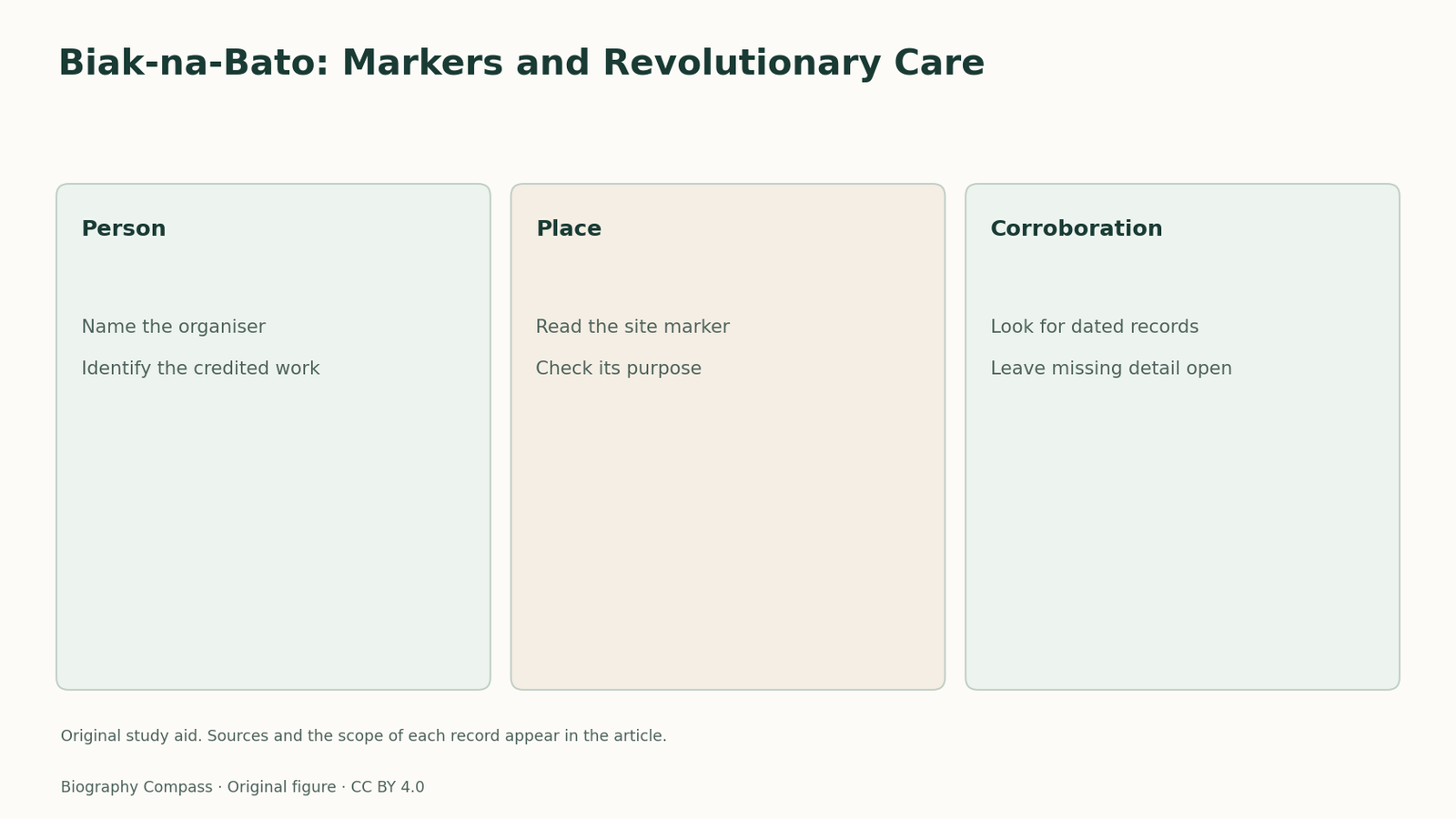
The Tecson marker names a person and connects her to revolutionary action. The Biak-na-Bato registry entry names a place and preserves the wording and date of a site marker. Different subjects invite different details. An omission in a site record about an individual’s daily labour is not evidence that the labour did not occur. The comparison begins by identifying what each record was made to commemorate.
Separate a title from an appointment
The accounts associate Tecson with the title Mother of Biak-na-Bato. Bulacan also states that she organised women to nurse injured soldiers. One statement is a commemorative title and the other describes an activity. Neither establishes a formal hospital appointment, an exact number of patients, or a modern nursing qualification. Those would need independent records of personnel, facilities or training.
Use multiple forms of evidence for care
A concise public account can credit an organiser without identifying everyone who did the work. To investigate how care operated, look for dates, locations, named participants and supplies in reports closer to the conflict. Compare them to the marker’s selection. A mismatch may reflect what the genre records rather than a contradiction about whether assistance was given.
Make a claim ledger
Write three statements on separate cards: the place was commemorated, an organiser supported care for the wounded, and a particular building treated a specified number of people. Assign the site registry to the first and the person accounts to the second. Leave the third open unless there is a dated facility or patient record. The exercise helps a reader retain the evidence for care without adding unsupported detail.
Continue the chronology
Related history guides
Biography context
Explore Philippines through connected lives
Connected biographies
People behind the records
1848–1928
Trinidad Tecson
Revolutionary and organiser of care for the woundedTecson took part in revolutionary operations and organised women to care for wounded fighters.Read biographyQuick answers
Common questions
- Does the honorific identify a formal nursing rank?
- It is a commemorative title. A formal rank would require a separate record.
Primary and institutional sources
How this history was checked
The records below support the chronology and the evidence comparison. The reading exercise is original. This article was reviewed on 5 November 2026.