
The short answer
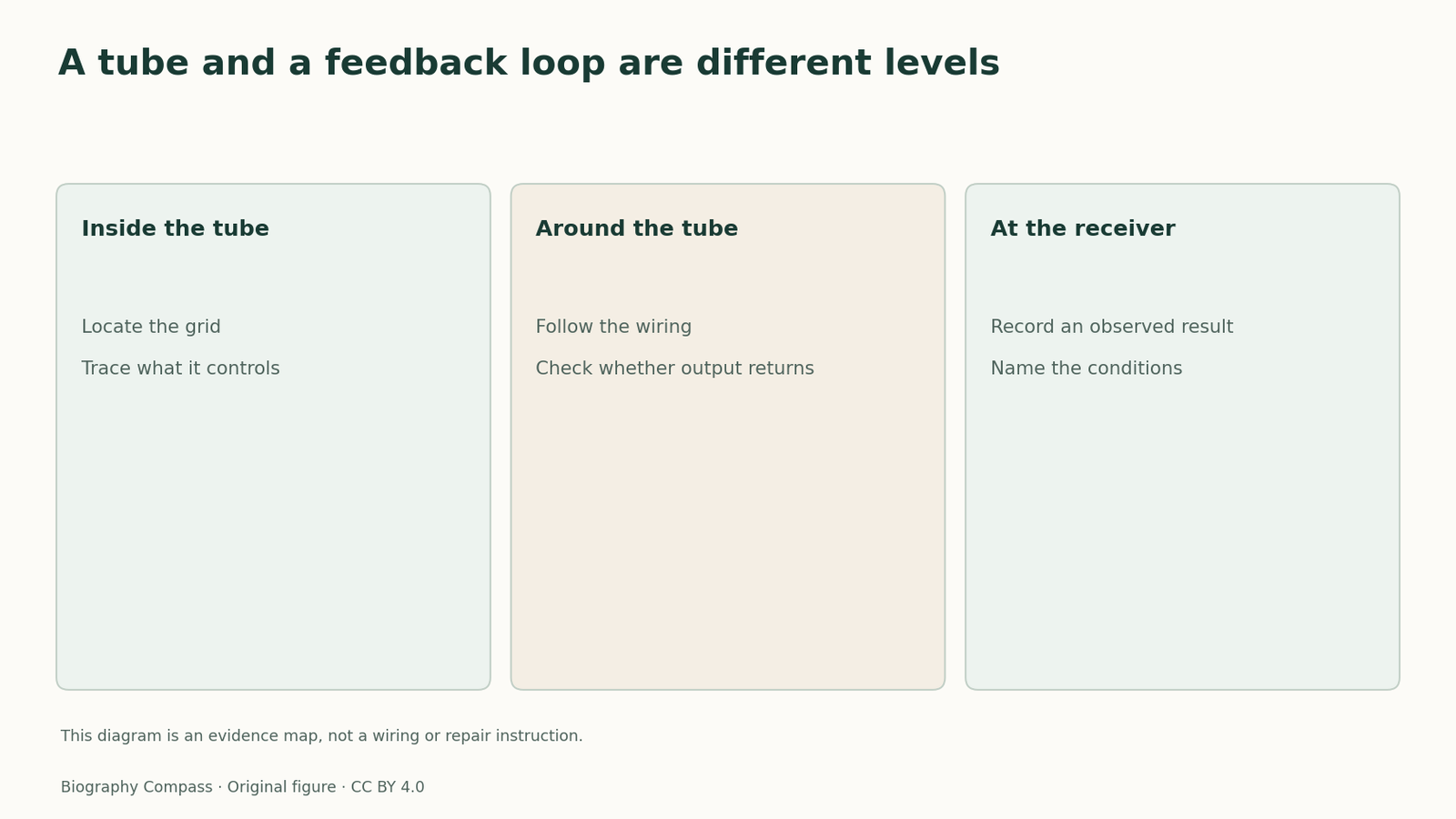
The grid is a part inside a tube. A feedback loop is a connection through a circuit. Keeping those two levels distinct clarifies both the engineering and the historical credit.
Reading the evidence
Part, assembly and measured result
Each level requires its own record.
| Stage | Evidence to inspect | What to keep distinct |
|---|---|---|
| Part | Patent and physical tube. | Control electrode versus output. |
| Assembly | Wiring and connections. | Tube design versus external loop. |
| Result | Test description and conditions. | Observed reception versus proposed operation. |
Start with the device drawing
In De Forest’s patent, look for the heated element, the electrode that collects current and the additional electrode between them. The third electrode can affect the current without itself being the output. An original tube record gives a second way to identify the device, though a museum object does not report its behaviour at every operating point.
The distinction between control and output is a useful first step. Label a small input that changes a condition in the tube. Then label the current whose change might be used elsewhere in a circuit. The explanation becomes more precise when it specifies which quantity the engineer is observing.
Put the wiring on a different page
Armstrong’s experimental detector places an Audion in a circuit with a route back toward the input. That arrangement can reinforce a received signal. The tube contributes a controllable electrical response; the wiring establishes the route through which part of the response returns. Changing the external wiring can change what the system does while leaving the internal tube intact.
Read the patent for the device and the other object record for the assembly. A description of the assembly cannot be derived from a photograph of an unconnected tube.
Practice assigning a claim
Imagine that a collection contains a loose tube, a wiring diagram and a dated observation of a station received more clearly. Assign each record a job. The tube can help identify components. The diagram can show the intended circuit relation. The dated observation can support the result, provided it identifies the setup that was tested. This exercise prevents the effect of the system from being credited automatically to a single component.
Continue the chronology
Related history guides
Biography context
Explore United States through connected lives
Connected biographies
People in the records
1873–1961
Lee de Forest
Inventor of the Audion and sound-film researcherDe Forest added a control electrode to a vacuum-tube design and pursued radio and sound film.Read biographyQuick answers
Common questions
- Does the grid itself make a feedback loop?
- No. The grid can control current, while feedback depends on connections in the surrounding circuit.
Primary and institutional sources
How this history was checked
Dates, legal milestones and historical claims are checked against the official and institutional records below. This article was reviewed on 5 November 2026.