
The short answer
An auction interface can show one amount while holding another as a bidder’s limit. A second condition can also prevent the leading bidder from buying. The two official help records explain these separate mechanisms.
The records answer different questions
Keep the measures separate
The question changes when the object, unit or reporting period changes.
| Record or measure | What it establishes | What it does not establish |
|---|---|---|
| Maximum | A bidder’s supplied limit. | An amount necessarily paid. |
| Displayed bid | The current result under the competition rules. | Every bidder’s private limit. |
| Reserve condition | A seller’s minimum-sale requirement. | Proof of delivery or product quality. |
Chronology
A timeline of the turning points
First instruction
A supplies a maximum.
Competing instruction
B supplies a lower maximum; the trace is resolved.
A maximum is an instruction
eBay’s automatic-bidding explanation says the bidder enters a maximum, and the system raises bids incrementally without exceeding that limit. Immediate outbidding can occur because another participant already entered a higher maximum.
A private limit therefore need not equal the displayed price. The interface represents the competition under a rule, rather than revealing every participant’s willingness to pay at once. Reading the maximum as an amount that must always be paid would misunderstand the instruction.
Sources for this section: [1]
The increment table is conditional
The help table assigns a $1 increment to the $25–99.99 current-price range. It also warns that an actual increment can be smaller when competing limits are close.
A trace should specify its range and limits before using a simple addition. It should not imply that one increment applies at every price. A worked example is useful precisely because its assumptions can be inspected, while a real auction may introduce conditions the example deliberately leaves out.
Sources for this section: [1]
Leading is not always a completed sale
The separate reserve-price record says an item is not sold when the reserve is unmet, even if someone is the highest bidder at the end. The reserve may be undisclosed until a bid meets or exceeds it.
The first record describes competition among bids; the second introduces a seller’s minimum-sale condition. Combining them prevents a displayed leading position from being treated as unconditional proof of a purchase. Neither record by itself establishes delivery, authenticity or a transaction’s eventual performance.
Sources for this section: [2]
Original trace with explicit exclusions
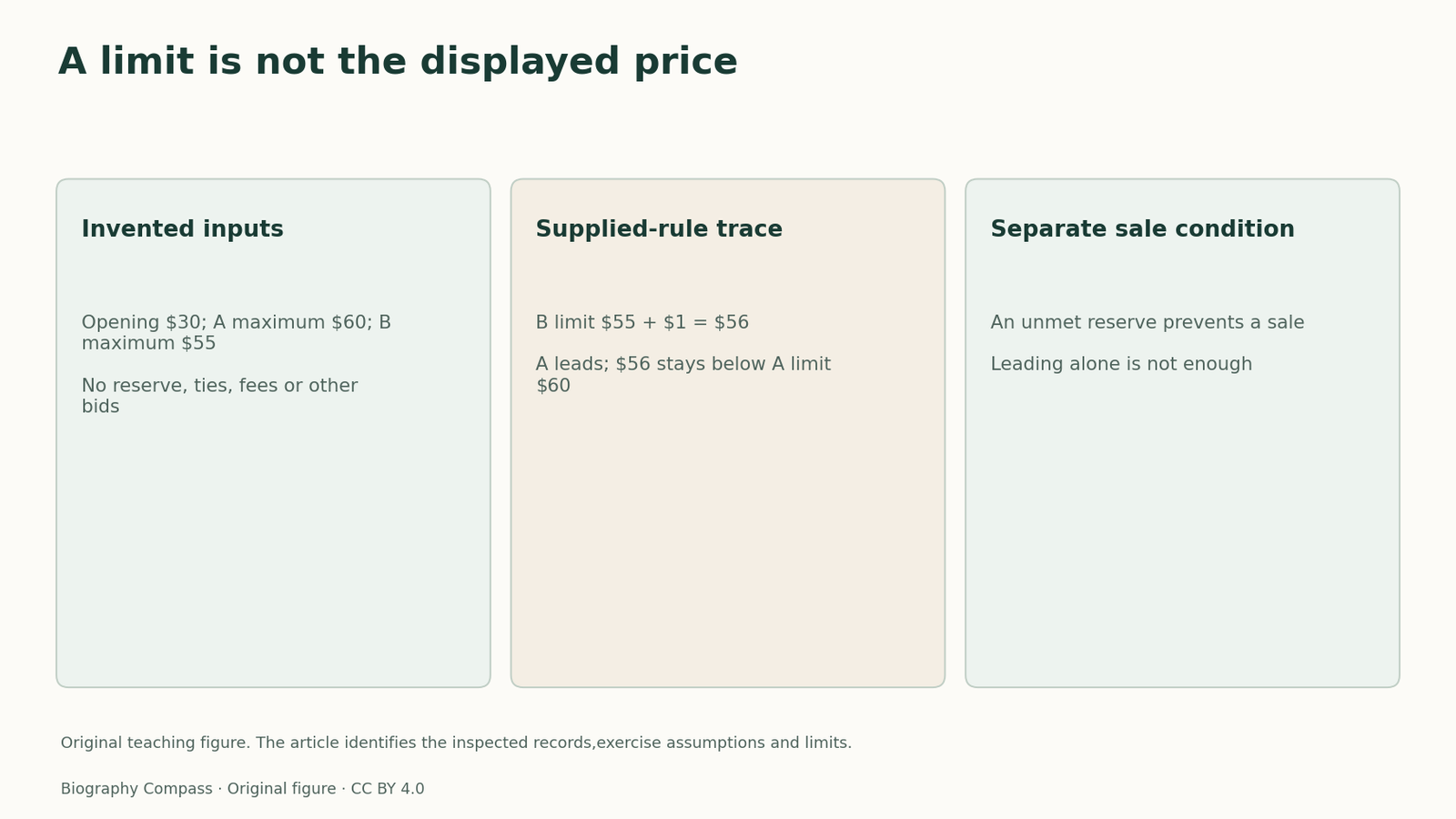
Invented auction: opening price $30, no reserve, no ties, no additional bidders, and no shipping, taxes or fees. A enters a maximum of $60 first; B later enters $55. Use the supplied increment rule for this range. Identify the leader and displayed amount. Then consider a separate auction with an unmet reserve: can leading alone establish a sale?
Reference answer: A remains ahead at $56, one increment above B’s limit and below A’s own maximum. The instruction $60 is not automatically the amount displayed. In the separate unmet-reserve case, a leading bid alone cannot establish a sale. The exercise is an original simplified trace, not a live auction, bid recommendation or guarantee about every listing.
Continue the chronology
Related history guides
SAS: Duplicate Keys and Whole Rows
Compare another concrete business record and a different interpretive problem.
Read the timeline1998eBay's 1998 IPO and Marketplace Expansion
Compare the existing financing and executive-history question with the separate auction mechanism here.
Read the timelineBiography context
Explore Worldwide through connected lives
Connected biographies
The connected careers

born 21 June 1967
Pierre Omidyar
eBay founder and philanthropistOmidyar founded eBay and supports philanthropy.Read biographyQuick answers
Common questions
- Why is the answer not the higher maximum?
- The supplied trace needs only the increment above the competing limit, while respecting the higher limit.
Primary and institutional sources
How this history was checked
Compare the dated company records with the independent or regulatory context. Original task inputs are labelled separately from reported historical measures. This article was reviewed on 31 October 2026.