
The short answer
A campaign can reach an important milestone before the resulting instrument takes effect. A useful chronology identifies the legal action attached to each date instead of choosing one year to stand for the whole process.
Compare the records
Match the action to its evidence
A chronology becomes clearer when every date has an attached verb.
| Evidence | What to identify | What remains to establish |
|---|---|---|
| Adoption | Approval of the negotiated text. | Completion of later participation steps. |
| Signature | A specified formal action. | A substituted deposit of ratification. |
| Entry rule | The qualifying deposit and interval. | A single universal date for later participants. |
Chronology
A timeline of the turning points
Adoption
Date recorded by the UN and Secretariat.
Signature opens
A separate procedural milestone.
Entry into force
The initial effective date.
Start with the records, not a compressed anniversary
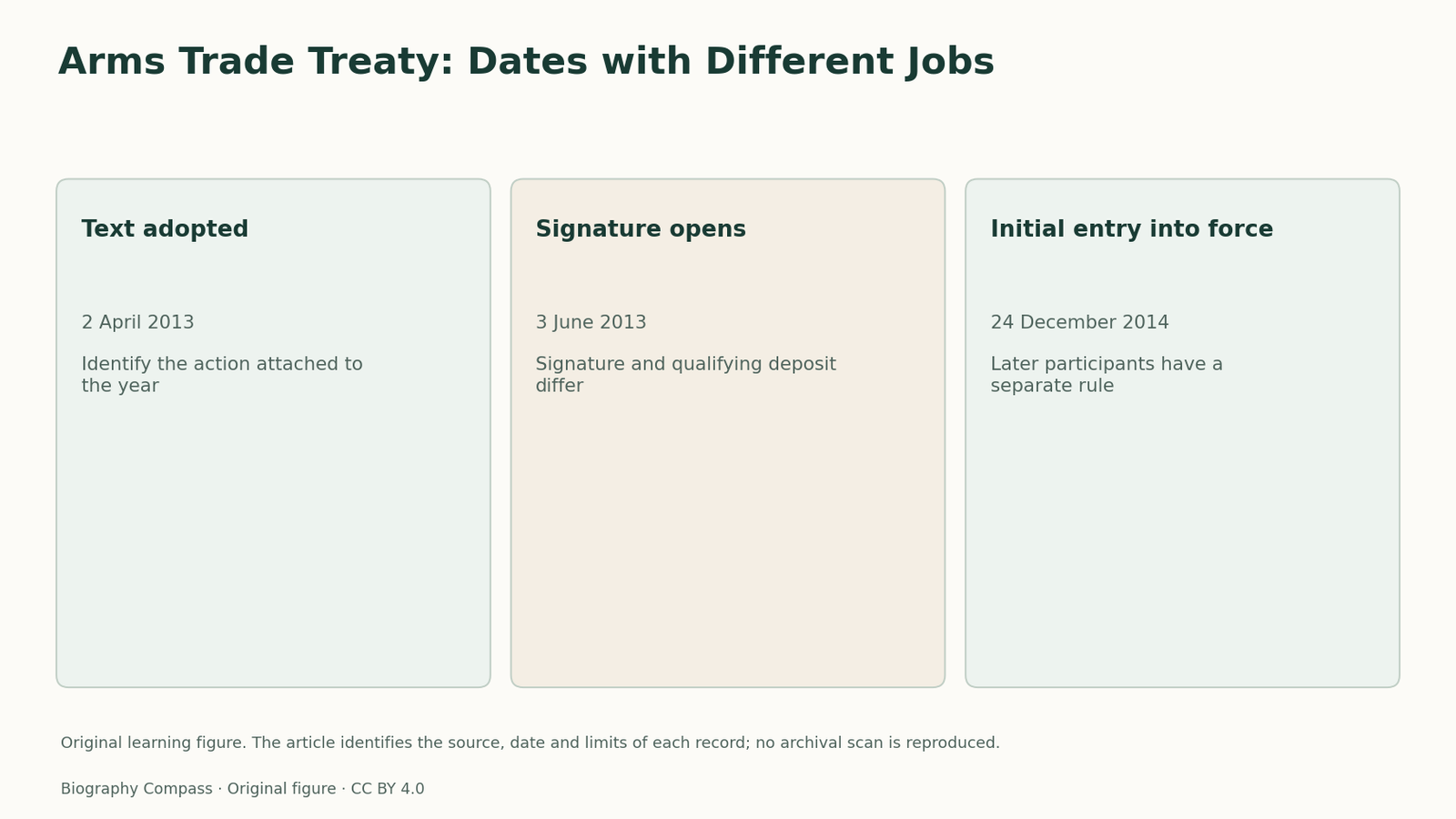
The UN record dates conclusion of the Arms Trade Treaty to 2 April 2013 and entry into force to 24 December 2014. The Secretariat’s chronology separately records opening for signature on 3 June 2013.
These are three actions, not rival estimates of one event. A biographical sentence that describes 2014 as the adoption year compresses two stages. The Jo Cox Foundation’s account of campaigning is useful testimony about advocacy, but its date wording should be checked against the treaty’s own records.
Why a signature is not the whole mechanism
Article 21 makes the treaty subject to ratification, acceptance or approval by signatories and provides for depositing those instruments. Article 22(1) sets initial entry into force ninety days after deposit of the fiftieth qualifying instrument.
The selected clause thus connects an institutional action with a waiting period. Counting supportive speeches, signatures or days since adoption cannot replace the specific input it names. A campaign’s political success and completion of this formal sequence need separate evidence.
Sources for this section: [3]
Initial operation and a later participant
Article 22(2) separately addresses a state depositing its instrument after the treaty has entered into force: the treaty takes effect for that state ninety days after its deposit. The initial global milestone is therefore not every later participant’s individual effective date.
That distinction is enough for this historical reading exercise. A particular state’s position would require its own deposit record and any relevant declarations; no current participant list or complete assessment of treaty obligations is supplied here.
Sources for this section: [3]
Original classification task and answer
Invent three notes: A says a text has been adopted; B records a signature; C records deposit of a qualifying instrument. Which note supplies the event named in the selected entry rule? What else would you need before calculating an effective date?
Reference answer: C identifies the relevant kind of event, but a date alone is insufficient. Establish whether the question concerns the initial threshold or a later participant, and whether the required threshold has been met. A and B document other stages. This is a reading task with supplied notes, not a claim that any invented state has joined the treaty.
Sources for this section: [3]
Continue the chronology
Related history guides
Biography context
Explore Worldwide through connected lives
Connected biographies
A connected working life
1974–2016
Jo Cox
Humanitarian campaigner and Member of ParliamentCox moved from policy and advocacy work into constituency representation and Parliament.Read biographyQuick answers
Common questions
- Does the initial effective date answer every later state’s timing?
- No. The selected second paragraph specifies a separate rule for a later qualifying deposit.
Primary and institutional sources
How this history was checked
Selected records, their dates and access limits are distinguished below; invented cases are explicitly labelled. This article was reviewed on 31 October 2026.