
The short answer
A drawing that clarifies a fossil can also include choices about how to restore missing or obscured parts. The two purposes can be separated.
Evidence at a glance
What can a connected fossil skeleton establish?
Match each piece of evidence to a specific inference.
| Evidence | What it supplies | How to read it |
|---|---|---|
| Slab | Bones lie in an observable arrangement. | Evidence of association. |
| Reconstruction | The paper shows a proposed complete form. | An interpretation to compare. |
| Blank | A model leaves concealed parts unmarked. | Absence of usable evidence. |
Chronology
A timeline of the turning points
Recovery
Anning finds the plesiosaur.
Published account
Conybeare illustrates and describes the fossil.
Start with the surviving specimen
The Natural History Museum catalogues the plesiosaur as PV OR 22656. The museum calls the skeleton articulated because many bones remain in their anatomical relationships. That matters to a reader testing whether the long neck belongs with the rest of the fossil. Connected bones provide positional evidence that a bag of isolated bones could not supply. Articulation is evidence about arrangement and association, even where an individual surface is damaged or hard to see.
Compare the two views in 1824
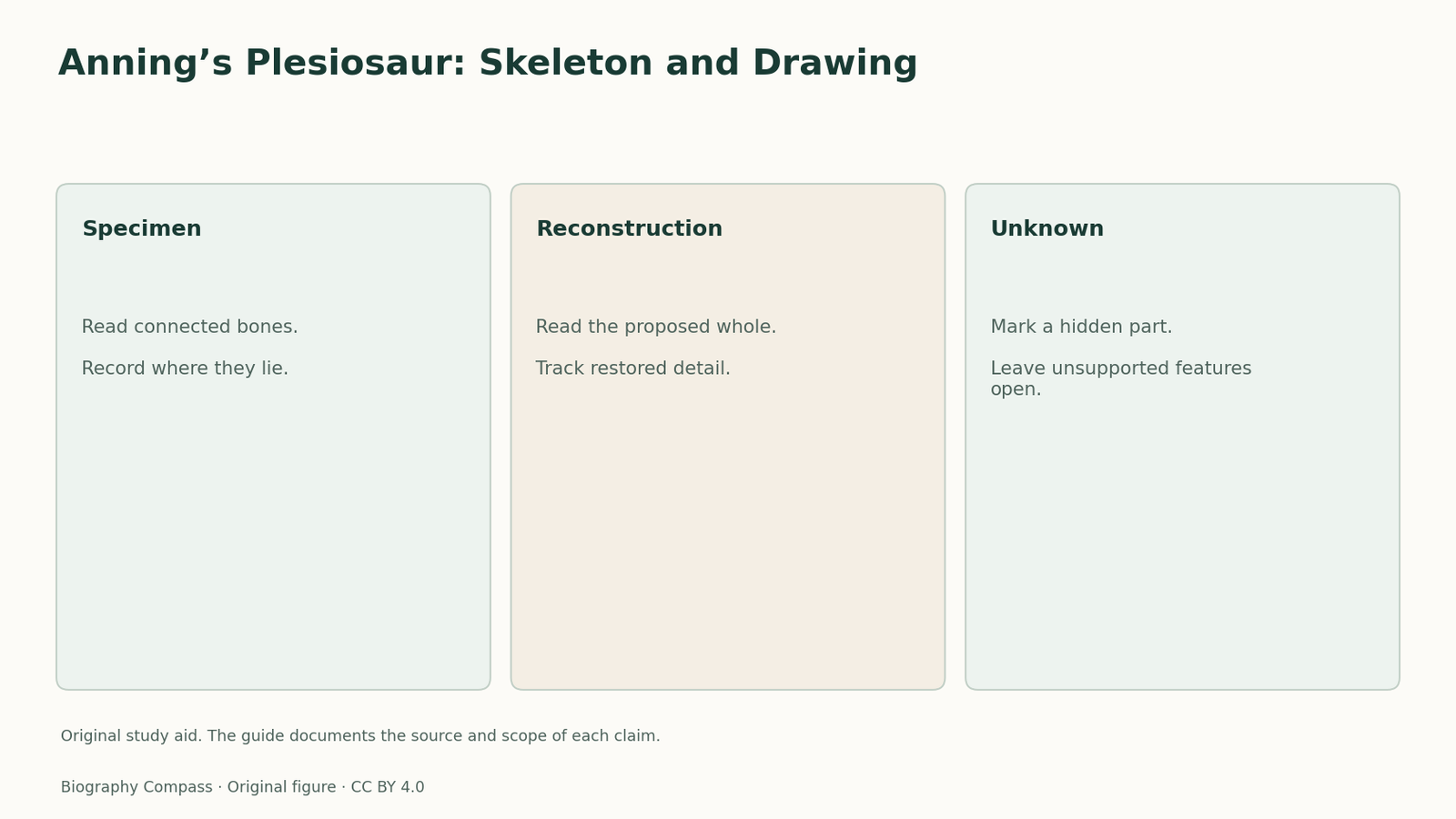
The Geological Society displays Conybeare’s published specimen view and his separate skeletal reconstruction. Use the first view to ask where the recovered parts actually lie. Use the reconstruction to ask what the author proposed the entire animal looked like. Details can be legible in the reconstruction even when their position is unclear on the slab. That added clarity comes from an interpretation that a reader can examine against the fossil.
Sources for this section: [3]
Mark three classes of observation
Make a classroom tracing with three symbols. Draw a solid line for a visible edge, a dotted line for a continuation you infer, and a blank for a region with no usable evidence. Imagine two neck bones joined cleanly and the next position hidden under rock. Mark the join as visible and the concealed position as unknown. The exercise deliberately avoids giving Anning’s specimen invented measurements or claiming how many vertebrae it contains.
Keep field credit separate from image credit
A museum label identifies the object and its collecting history. A journal plate has a publication history of its own. The 1823 recovery date and the 1824 account answer different questions. Record both dates and label the role of each person when making a timeline. The exercise makes visible the work of recovering a fossil, explaining its anatomy and preserving the specimen for later readers.
Continue the chronology
Related history guides
Iguanodon’s Teeth and the Evidence for a Name
Compare what isolated teeth can show with the evidence in an articulated skeleton.
Read the timeline1970s–1990sBird or Dinosaur? What a Fossil Bone Can Establish
Compare a separate study in which a fragment supplied less anatomical context.
Read the timelineBiography context
Explore United Kingdom through connected lives
Connected biographies
The researcher behind the records
1799–1847
Mary Anning
Fossil collector and preparatorAnning recovered, prepared and sold fossils that transformed knowledge of Jurassic marine reptiles.Read biographyQuick answers
Common questions
- Why compare a specimen drawing with a reconstruction?
- A specimen drawing documents the recovered arrangement. A reconstruction organizes that evidence into a proposed complete form.
Primary and institutional sources
How this history was checked
Publication dates and specimen records describe different events. Invented exercises are labelled. This article was reviewed on 5 November 2026.