
The short answer
The Smithsonian holds a cotton shirting sample associated with A. Allidina Visram of Mombasa and a 1917 consular trade enquiry. This small object offers a concrete way to study an extensive trading network. Rather than beginning with an impressive but hard-to-verify count of branches, ask what can be established from its material, label and collection context. The record identifies white cotton shirting, a commercial name and a dated enquiry. Each supplies a different piece of evidence about how goods and information moved through East African trade.
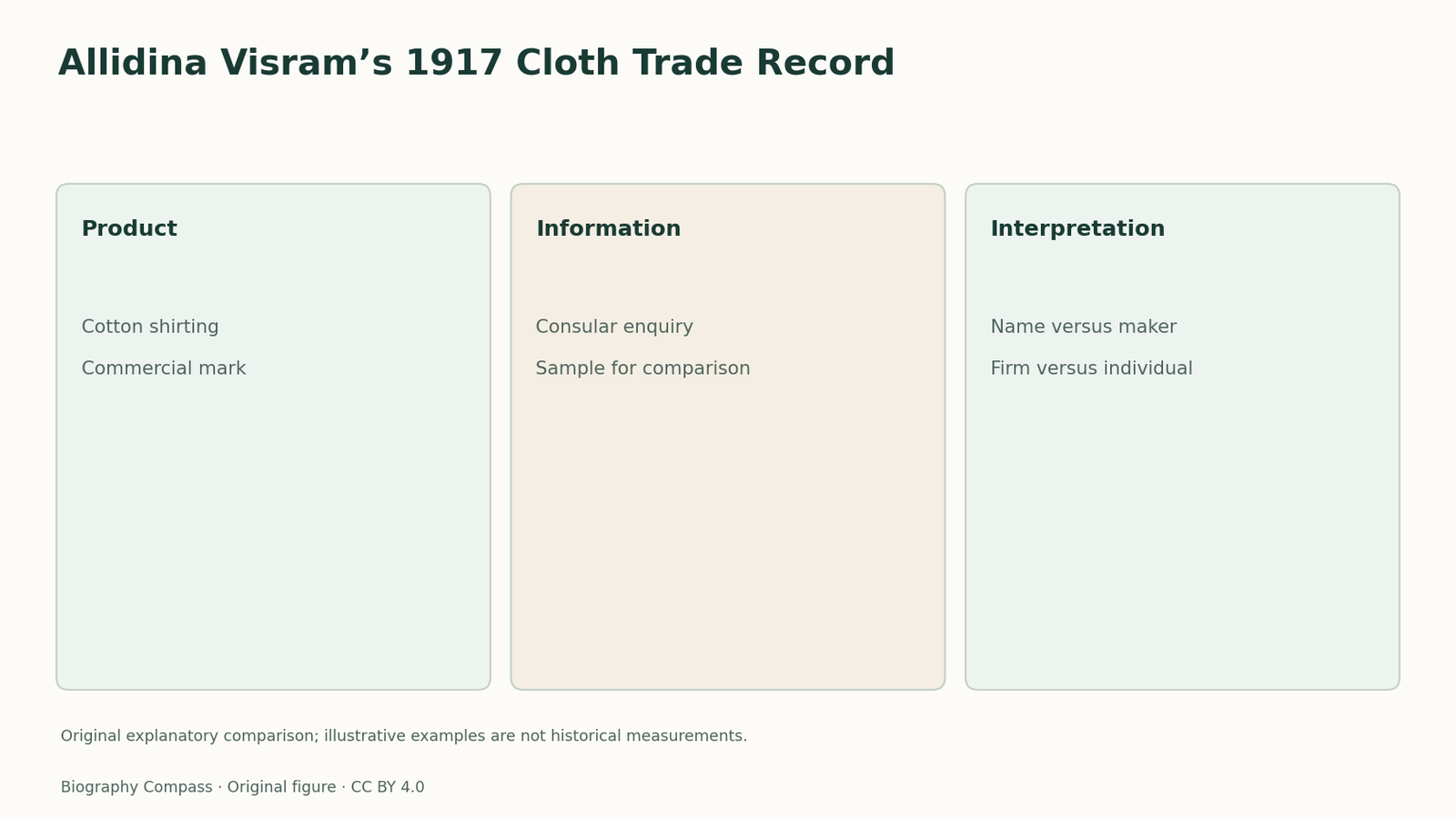
A worked comparison
What each part contributes
Use the specific distinctions developed in the study.
| Part or record | What it establishes | Why the distinction matters |
|---|---|---|
| Commercial mark | A.Allidina Visram, Mombasa | Trader’s name, not necessarily maker |
| Consular tag | 28 July 1917 trade enquiry | Specific dated context |
| Biography | Death in 1916 | Firm’s later name is not personal activity |
A cloth sample is a commercial document
The Smithsonian holds a cotton shirting sample associated with A. Allidina Visram of Mombasa and a 1917 consular trade enquiry. This small object offers a concrete way to study an extensive trading network. Rather than beginning with an impressive but hard-to-verify count of branches, ask what can be established from its material, label and collection context. The record identifies white cotton shirting, a commercial name and a dated enquiry. Each supplies a different piece of evidence about how goods and information moved through East African trade.
Sources for this section: [4]
What the attached label establishes
The transcribed label names the American Consulate at Mombasa, a trade-opportunity number and 28 July 1917. The fabric carries the business name in gold. Those details connect the item with a commercial enquiry and a particular named outlet. They do not identify the person who wove the cloth or prove that Visram manufactured it. A trader’s mark and a manufacturer’s identity need not be the same. This is an important distinction in a network where imported goods could pass through agents, wholesalers and retail stores.
A sample moved information as well as fabric
The museum explains that consuls collected such samples to promote trade and business opportunities. The sample therefore had a second function beyond eventual clothing use: it allowed someone elsewhere to inspect a product’s material qualities. This information role links a local market with distant commercial decision-makers. The inspected record does not establish an actual subsequent order or sale arising from the enquiry. It does demonstrate an institutional channel through which a product could be described, labelled and compared beyond the original trading location.
Sources for this section: [4]
Place the object beside the network
Scholarship describes Visram’s shops, assistants and transport relationships across East Africa. A sample from Mombasa fits that trading setting, but one coastal object cannot by itself map all the inland branches. Conversely, a large network narrative cannot explain away the sample’s specific 1917 date. Visram had died the previous year, so the object belongs to the continuing commercial name rather than a newly documented personal action. The distinction improves a biography by preserving a material connection without extending a person’s life to match every later occurrence of his name.
A provenance exercise
Sort four claims into “shown,” “plausible question” and “not established.” The label’s 1917 date and Mombasa business name are shown by the transcribed object record. Whether the sample helped a foreign supplier secure an order is a plausible research question. That Visram personally manufactured it or handled it in 1917 is not established; the latter also conflicts with his 1916 death. This original exercise shows how a small artifact can produce a strong historical lesson precisely because its evidential limits are specific. Good provenance records distinguish marks, makers, owners, dates and later collecting institutions.
Continue the chronology
Related history guides
Bombay Hospital 1845: Reading Occupancy
Use Peet’s 1849 hospital report to distinguish patient transfer, average occupancy and admissions after Bombay’s 1845 hospital opening, with a worked calculation.
Read the timeline1876Mitsui 1876: Trade, Management and Credit
Read the 1876 Mitsui founding sequence through agreements, management and bank finance, separating the trading company from the similarly dated bank.
Read the timelineBiography context
Explore Kenya through connected lives
Connected biographies
People and wider context
1851?–1916
Allidina Visram
merchant and trading-network organiserAllidina Visram was a merchant and trading-network organiser, known for East African retail, transport and commercial networks.Read biographyQuick answers
Common questions
- Does the 1917 cloth sample show that Allidina Visram was alive and handling it then?
- No. He died in 1916. The label establishes a commercial name and enquiry context, not his personal participation in 1917.
Primary and institutional sources
How this history was checked
Read the cited original records, institutional accounts and later interpretations. The comparison and exercise explain the specific evidence used in this study. This article was reviewed on 8 November 2026.
- Saada Wahab, Göttingen University Press,2022The History of Indians in Zanzibar from the 1870s to 1963
- Journal of Eastern African Studies scholarly articleMerchant-kings and Everymen
- Les Cahiers d’Afrique de l’EstKisumu commercial development study
- National Museum of American HistoryBolt end of cotton cloth for the African market,1917
- Original 1917 artifact transcribed by SmithsonianConsular tag and commercial fabric mark,28 July 1917